U.S. declares blockade ‘fully implemented,’ cutting off Iran’s seaborne trade ‘completely’
Anadolu | Anadolu | Getty Images

The announcement comes at a time when the White House has been signaling a diplomatic solution to the conflict in the Middle East, as discussions around continuing negotiations with Tehran are underway.
“A blockade of Iranian ports has been fully implemented as U.S. forces maintain maritime superiority in the Middle East,” said Brad Cooper, Centcom commander, highlighting that it was achieved under 36 hours of President Donald Trump’s order.
“U.S. forces have completely halted economic trade going in and out of Iran by sea.”
More than 90% of Iran’s $109.7 billion in annual seaborne trade transits through the Strait of Hormuz, and Iran lacks any significant alternative trade routes, according to Miad Maleki, a senior fellow at the Foundation for Defense of Democracies, a non-partisan think tank in Washington.
The blockade is estimated to cost Iran approximately $435 million a day in combined economic damage, Maleki estimates.
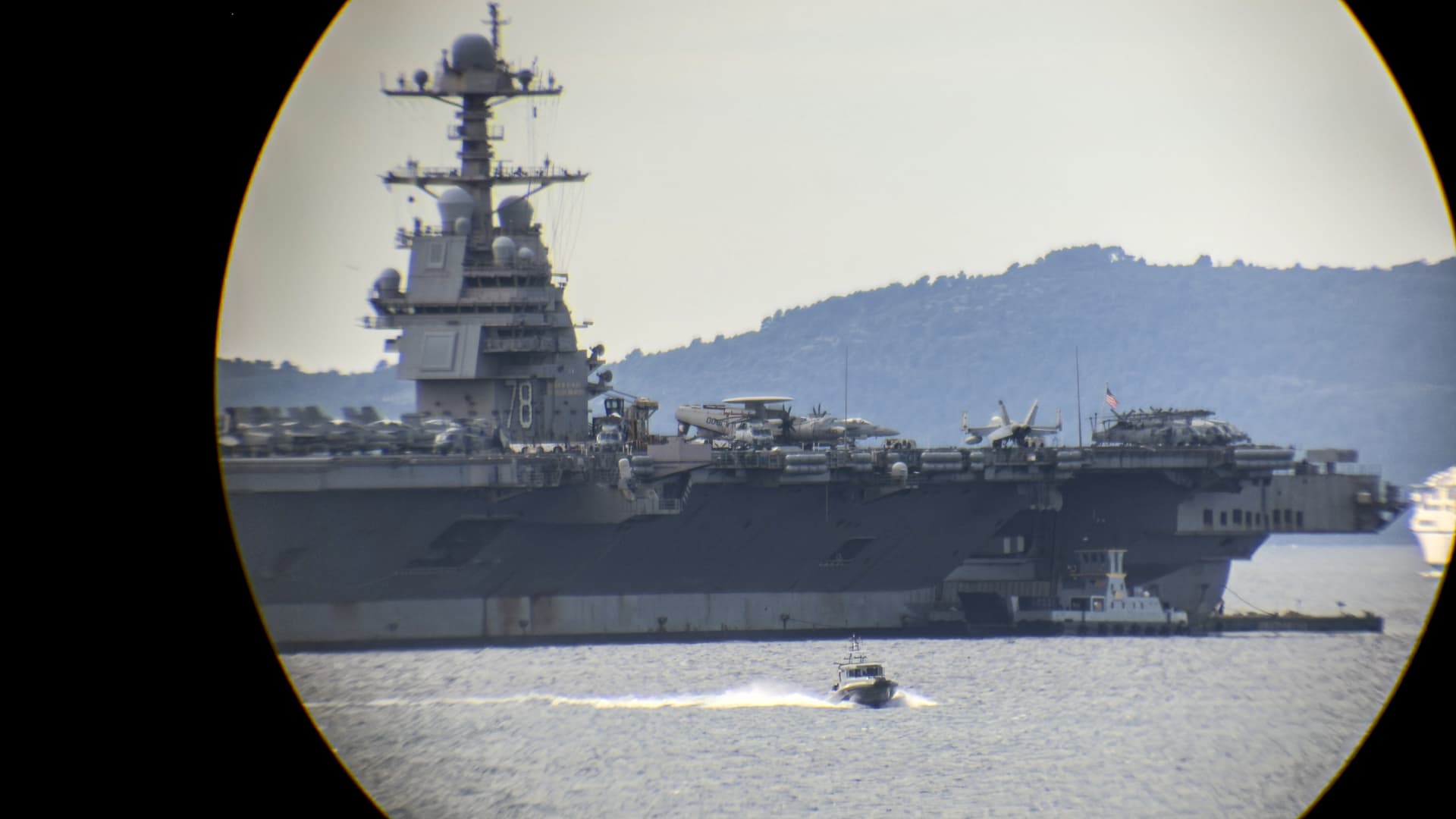
The U.S. blockade, which took effect Monday amid a shaky two-week ceasefire, involves more than 10,000 U.S. troops, over a dozen Navy ships and fighter jets in the Gulf of Oman and the Arabian Sea, the U.S. military said.
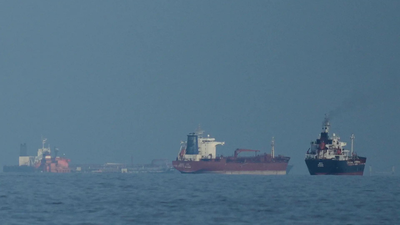
During the first 24 hours, no ships made it past the U.S. blockade, with 6 merchant vessels ordered to turn back to re-enter an Iranian port on the Gulf of Oman, the U.S. forces said.
Maritime intelligence firm Windward identified at least two vessels that made their journey through the Strait of Hormuz in the first full day under active U.S. enforcement, including a U.S.-sanctioned Chinese-owned tanker, Rich Starry, that exited the Gulf on Tuesday.
“Transit through the Strait remains limited and concentrated among sanctioned, falsely flagged, and high-risk vessels, with early enforcement signals now shaping vessel behavior,” Windward analysts said in the latest report.
Iran has choked the Strait of Hormuz, that carried about a fifth of the world’s oil supplies before the war, in retaliation for the joint U.S.-Israeli strikes on Iranian territory that began Feb. 28.
The U.S. naval blockade could further upend energy flows through the vital waterway and risks straining Washington’s ties with countries such as China and India, which have been among the key buyers of Iranian oil.
China on Tuesday called the U.S. blockade of Iranian ports in the Strait of Hormuz a “dangerous and irresponsible act” that will only further enflame tensions in the region.
The International Monetary Fund on Tuesday cut its global growth forecast to 3.1% for 2026, down from 3.3% in its January forecast, while warning that the world was drifting toward an “adverse scenario,” where oil prices could stay around $100 per barrel.
Signals of a diplomatic resolution to the Middle East conflict have released some pressure in oil markets, with U.S. crude oil futures for May delivery dropping 0.88% to $90.4 per barrel as of 8:35 p.m. ET. Futures for the international benchmark Brent for June delivery lost 0.31% $94.47 per barrel.
Discover more from stock updates now
Subscribe to get the latest posts sent to your email.