SpaceX Could Soon Run Into a $2.7 Trillion Roadblock Named Amazon
Key Points
- Amazon Leo will compete directly against SpaceX’s Starlink satellite internet service.
- Amazon is set to be a formidable rival to Space X with its massive cash position.
-
SpaceX needs a stellar IPO to raise the cash needed to compete against Amazon Leo.
- These 10 stocks could mint the next wave of millionaires ›
What’s the most exciting investing story of 2026? While there are several contenders, I’d say the impending initial public offering of SpaceX ranks near the top of the list. The space technology company founded by Elon Musk is preparing for a valuation in the ballpark of $2 trillion, which would make it by far the highest-valued IPO stock ever.
The biggest reason for SpaceX’s expected astronomical market cap is its Starlink satellite internet service. Starlink generated revenue of $15 billion to $16 billion with profits of around $8 billion last year, according to Reuters.
Will AI create the world’s first trillionaire? Our team just released a report on the one little-known company, called an “Indispensable Monopoly” providing the critical technology Nvidia and Intel both need. Continue »
But the seemingly easy money for Starlink may be only temporary. SpaceX could soon run into a $2.7 trillion roadblock named Amazon (NASDAQ: AMZN).
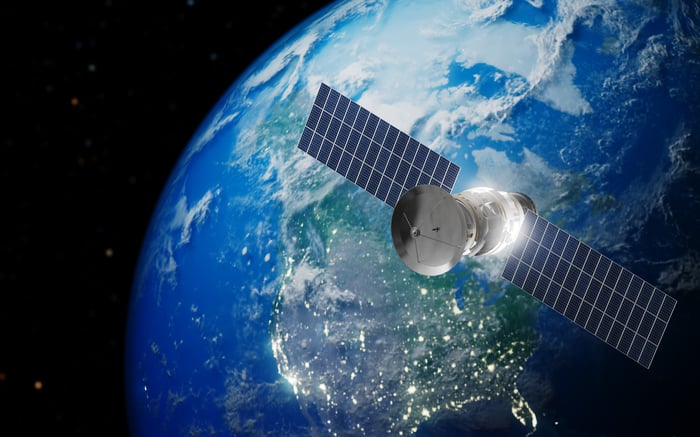
Image source: Getty Images.

Amazon enters the space race
Amazon announced in 2019 plans to deploy a large constellation of satellites to offer broadband internet service worldwide. The company launched its first satellites last year and now has 180 satellites in orbit. Its initial design calls for more than 3,000 satellites.
This satellite internet service business was originally named Project Kuiper (after the region of icy objects in the outer solar system called the Kuiper belt. However, Amazon rebranded the unit as Amazon Leo (a nod to the acronym for low earth orbit) in November 2025.
Although Amazon Leo won’t begin providing widely available service until later this year, it has already lined up dozens of commercial customers. Amazon CEO Andy Jassy said in his company’s fourth-quarterearnings callthat AT&T (NYSE: T), DirecTV Latin America, JetBlue (NASDAQ: JBLU), and Australia’s national broadband network are among the early customers. He added that Leo has “many more on the way.”
Last week, Amazon announced plans to acquire Globalstar (NASDAQ: GSAT) for around $11.6 billion. The deal will enable Amazon Leo to offer direct-to-device services (satellite connectivity for mobile phones and other cellular devices). Amazon simultaneously announced an agreement with Apple (NASDAQ: AAPL) to provide satellite services for iPhone and Apple Watch devices.
Advantage SpaceX — for now
SpaceX’s Starlink has a significant head start in the satellite internet services market. It already has more than 7,800 satellites in low Earth orbit. Musk’s company has ironed out some of the early stage wrinkles that Amazon Leo will likely face over the next couple of years. Starlink has also already built a substantial customer base.
However, make no mistake: Amazon Leo will be a formidable rival to SpaceX. The Globalstar acquisition and Apple agreement were clearly shots across Starlink’s bow.
The space race between these two companies could turn into a capital race. If so, Amazon could chip away at SpaceX’s lead. While SpaceX hopes to raise a boatload of cash with its IPO, Amazon already has $123 billion in cash and can easily add to that.
SpaceX also won’t be able to match Amazon’s ability to offer bundling deals to attract customers. Amazon Leo already offers businesses the option to connect to the AWS cloud. Amazon could choose to subsidize hardware costs by bundling Leo with AWS for corporate customers. What about retail customers? It’s not hard to envision Amazon bundling Leo with Prime.
The coming collision
SpaceX could still emerge as the winner of the coming collision with Amazon. A record IPO for the space stock this summer should help improve its chances of success.
However, Amazon’s entry into the satellite internet market will tighten this part of the space race significantly. Investors considering buying shares of SpaceX at or immediately after its IPO should keep the intensifying competitive landscape in mind.
Maybe Amazon won’t be a full-blown roadblock for SpaceX. But it will almost certainly be a big speed bump.
Don’t miss this second chance at a potentially lucrative opportunity
Ever feel like you missed the boat in buying the most successful stocks? Then you’ll want to hear this.
On rare occasions, our expert team of analysts issues a “Double Down” stock recommendation for companies that they think are about to pop. If you’re worried you’ve already missed your chance to invest, now is the best time to buy before it’s too late. And the numbers speak for themselves:
- Nvidia: if you invested $1,000 when we doubled down in 2009, you’d have $523,131!*
- Apple: if you invested $1,000 when we doubled down in 2008, you’d have $51,457!*
- Netflix: if you invested $1,000 when we doubled down in 2004, you’d have $524,786!*
Right now, we’re issuing “Double Down” alerts for three incredible companies, available when you join Stock Advisor, and there may not be another chance like this anytime soon.
*Stock Advisor returns as of April 20, 2026.
Keith Speights has positions in Amazon and Apple. The Motley Fool has positions in and recommends Amazon and Apple and is short shares of Apple. The Motley Fool has a disclosure policy.
The views and opinions expressed herein are the views and opinions of the author and do not necessarily reflect those of Nasdaq, Inc.
Discover more from stock updates now
Subscribe to get the latest posts sent to your email.