


Nvidia Rival Cerebras Files for an IPO: What Investors Should Know
Key Points
- The IPO date and price range for the proposed offering have not yet been set.
- Cerebras intends its stock to be listed in the United States on the Nasdaq stock exchange under the ticker “CBRS.”
-
Cerebras could prove a formidable competitor to AI chip leader Nvidia, in my opinion.
- 10 stocks we like better than Nvidia ›
Investors seem poised to soon have another investment choice in the hot artificial intelligence (AI) chip space: Cerebras Systems. The venture capital-backed, Silicon Valley-based company announced on Friday, April 17, that it filed a registration statement with the Securities and Exchange Commission (SEC) indicating its intent to hold an initial public offering (IPO) of its common stock.
Given publicly available data, Cerebras could prove a formidable competitor to Nvidia (NASDAQ: NVDA), which currently dominates the AI chip market. That said, the AI chip market is growing at such a blistering pace that there is room for several companies in this business to perform very well over the long run.
Will AI create the world’s first trillionaire? Our team just released a report on the one little-known company, called an “Indispensable Monopoly” providing the critical technology Nvidia and Intel both need. Continue »
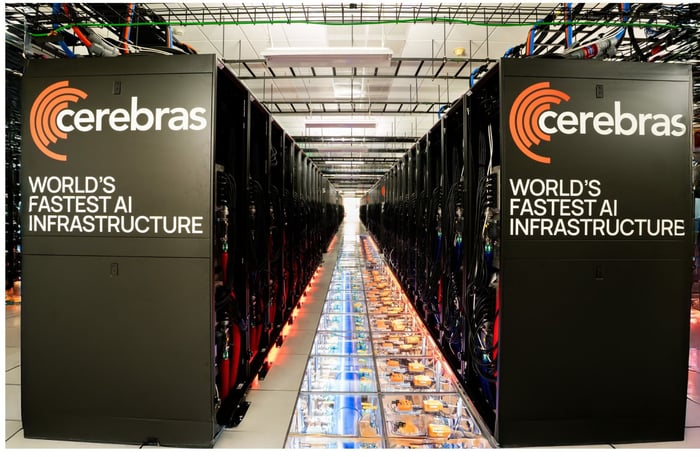
Image source: Cerebras Systems.
Cerebras Systems’ plans to go public
Cerebras did not indicate when it plans to hold its IPO, other than to say the timing will depend on market conditions. It said the number of shares of stock to be offered and the price range for the proposed offering have not yet been determined.
Cerebras expects its stock to be listed in the United States on the Nasdaq stock exchange under the ticker “CBRS.”

Cerebras Systems’ business
Cerebras was founded in 2015 to bring wafer-scale AI computing to market. Wafer-scale refers to using a full silicon wafer to create one massive chip, rather than cutting it into smaller dies.
Several of its co-founders held technology leadership roles – such as Chief Technology Officer (CTO) — at chipmaker Advanced Micro Devices (AMD) before starting the company. AMD is Nvidia’s main competitor in the graphics processing unit (GPU) market. Currently, GPUs are the gold standard for AI training and inference (deployment) — a fact that Cerebras aims to change.
On its website, Cerebras touts that it “stands alone as the world’s fastest AI inference and training platform.” It adds that “Organizations across [diverse fields] use our CS-2 and CS-3 systems to build on-premise supercomputers, while developers and enterprises everywhere can access the power of Cerebras through our pay-as-you-go cloud offerings.”
CS-2 and CS-3 stand for Cerebras System 2 and 3, respectively, the company’s second- and third-generation wafer-scale AI supercomputers. These systems are powered by the company’s AI processors, the current of which is the WSE-3 (Wafer-Scale Engine 3). Cerebras touts that this giant chip is the “world’s largest and fastest AI processor.”
Cerebras’ customers
Recently, Cerebras gained some big-name customers, including ChatGPT maker OpenAI, Amazon (NASDAQ: AMZN), and Facebook parent Meta Platforms. Customers also include pharmaceutical giant GSK (formerly GlaxoSmithKline), Mayo Clinic, the U.S. Department of Energy, and the U.S. Department of Defense.
In January 2026, Cerebras and OpenAI signed a major multiyear partnership agreement in which OpenAI will deploy 750 megawatts of Cerebras wafer-scale systems to serve its customers. The “deployment will roll out in multiple stages beginning in 2026, making it the largest high-speed AI inference deployment in the world,” according to the press release.
Last week, it was reported that OpenAI would invest $20 billion in Cerebras chips and tech over three years.
In March 2026, Cerebras signed a deal with Amazon AWS, under which AWS will become the first hyperscaler (operator of massive-scale data centers) to deploy Cerebras chips in its own data centers.
Cerebras’ investors
Significant new investors in Cerebras’ Series G round in September included Tiger Global Management, founded and run by billionaire Chase Coleman, and 1789 Capital, of which Donald Trump Jr. is a partner. Some existing investors also participated in the round.
Other notable investors include Sam Altman, co-founder and CEO of OpenAI.
Group 42 Holding, based in the United Arab Emirates (UAE), was an early and major investor. It — along with affiliated companies — has also been Cerebras’ largest customer, by far, through 2025. In 2026, this heavy customer revenue concentration should begin to significantly lessen due to the recent big deals Cerebras has inked.
Cerebras’ financials
In 2025, Cerebras’ revenue surged 76% year over year to $510 million, according to its SEC filing. This growth was driven by 69% in hardware and 99% in cloud and other services.
The company’s financials are solid for a start-up. While it reported a loss from operations of $145.9 million in 2025, this was due to significant research and development spending. Its 2025 R&D expenditure was 48% of its annual sales. 2025 net income was positive, but only because of a significant positive “net, other income” stemming primarily from “a change in fair value and extinguishment of forward contract liability.”
Operating cash flow was negative $10.1 million, so Cerebras was not far from break-even on a cash from operations basis.
A stock worth considering investing in — or at least watching
In short, all signs point to Cerebras Systems stock as worth considering for investment — at the very least, worth watching.
Should you buy stock in Nvidia right now?
Before you buy stock in Nvidia, consider this:
The Motley Fool Stock Advisor analyst team just identified what they believe are the 10 best stocks for investors to buy now… and Nvidia wasn’t one of them. The 10 stocks that made the cut could produce monster returns in the coming years.
Consider when Netflix made this list on December 17, 2004… if you invested $1,000 at the time of our recommendation, you’d have $524,786!* Or when Nvidia made this list on April 15, 2005… if you invested $1,000 at the time of our recommendation, you’d have $1,236,406!*
Now, it’s worth noting Stock Advisor’s total average return is 994% — a market-crushing outperformance compared to 199% for the S&P 500. Don’t miss the latest top 10 list, available with Stock Advisor, and join an investing community built by individual investors for individual investors.
*Stock Advisor returns as of April 20, 2026.
Beth McKenna has positions in Nvidia. The Motley Fool has positions in and recommends Advanced Micro Devices, Amazon, Meta Platforms, and Nvidia. The Motley Fool recommends GSK. The Motley Fool has a disclosure policy.
The views and opinions expressed herein are the views and opinions of the author and do not necessarily reflect those of Nasdaq, Inc.
Discover more from stock updates now
Subscribe to get the latest posts sent to your email.