


India, South Korea aim to deepen ties amid geopolitical uncertainty. Here is what’s holding them back.
Pacific Press | Lightrocket | Getty Images
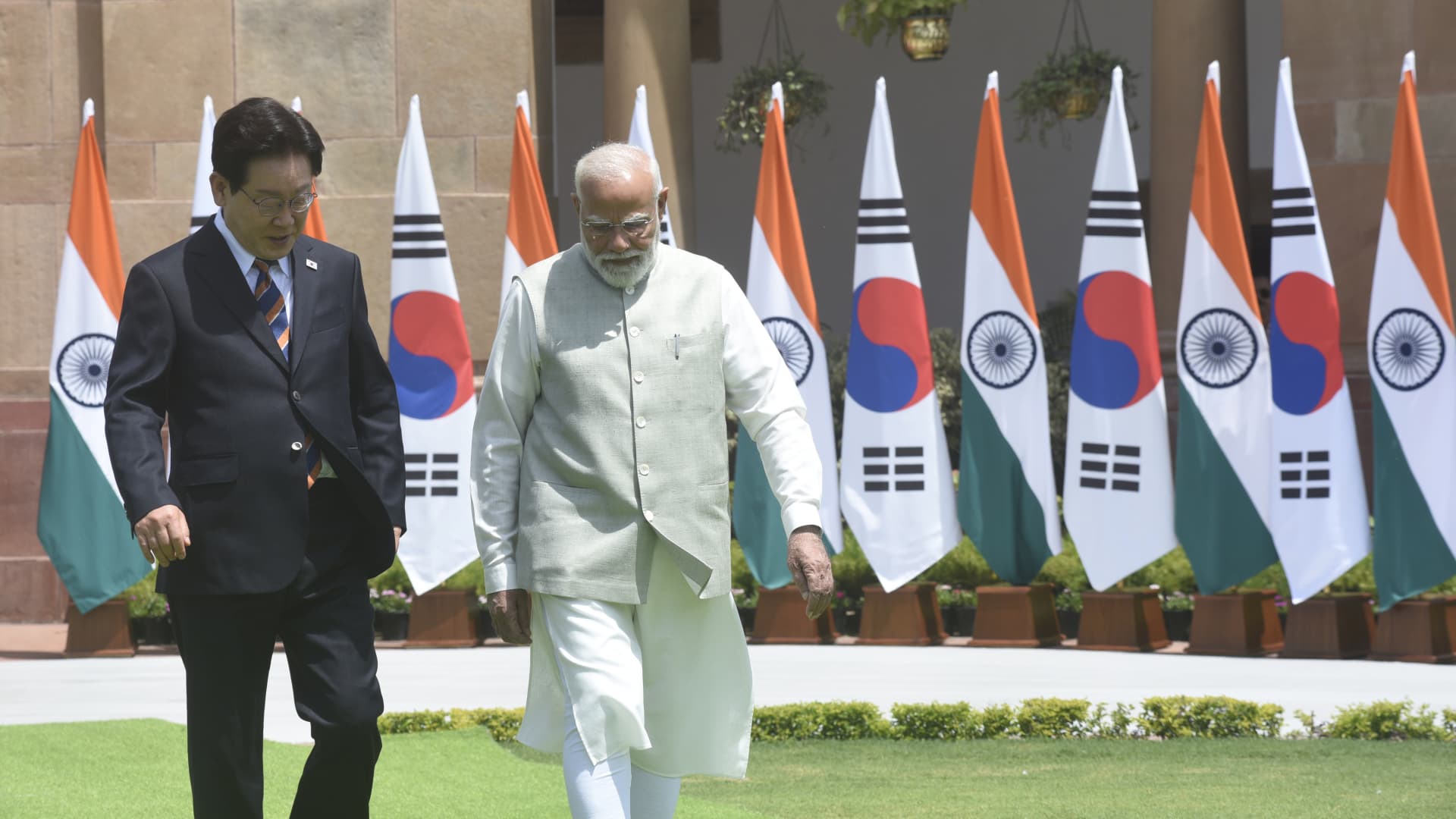
On Monday, the Indian Prime Minister Narendra Modi and South Korean President Lee Jae Myung reaffirmed plans to increase bilateral trade to $50 billion by 2030, a goal that was first announced in 2018.

Modi, in a joint press statement, said that the two countries were moving from a “trusted partnership” to a “futuristic” one where areas of collaboration spanned “chips to ships, talent to technology, and environment to energy.”
Jae Myung, the first South Korean president to visit India in eight years, added that in “an era of hyper uncertainty,” the two countries can be “the most ideal partners for comprehensive cooperation to promote mutual growth and Innovation.”
But despite the big targets and talk, trade between the two countries grew at a compounded annual rate of just 3% from 2018 to 2025. In the financial year ending March 2025, total trade between India and Korea was $26.89 billion — a little over half the goal set for 2030, as per Indian commerce ministry data.
“I would just say unrealized potential is tremendous,” Ashok Malik, partner at public policy think tank The Asia Group, told CNBC, adding that both countries are looking to diversify from the U.S. market and explore sourcing options other than China.
Korea is a great fit for India as it offers advanced technology in EVs, electronics, semiconductors, and AI. India wants to diversify its sourcing away from China in these sectors, Malik said, adding that shipbuilding and automotive steel are further areas of interest to India.
But experts, including Malik, said that regulatory delays are a key deterrent for South Korean companies looking to invest in India.
Practical challenges
The biggest concern is policy unpredictability, said Reema Bhattacharya, head of Asia research at Verisk Maplecroft, adding that land acquisition, infrastructure delays, and regulatory complexity “remain practical operational challenges” for Korean companies investing in India.
Take the case of Korean steel giant POSCO, which announced a $12 billion investment in India almost two decades ago. This project encountered several delays, and POSCO dropped it a few years ago due to difficulties in acquiring land, according to a Reuters report.
In 2024, POSCO renewed its plans to invest in India by setting up a steel plant capable of producing 6 million tons per annum, this time in a joint venture with India’s JSW Steel. After two years of planning, the project has secured land and will be operational by 2031.
Meanwhile, in shipbuilding, the progress has been slow. HD Korea Shipbuilding & Offshore Engineering in July last year announced plans to explore shipbuilding operations with the Indian state-owned company Cochin Shipyard.
So far, there has been no formal commitment from either side about the scale of investment or on setting up a joint venture. Shipbuilding is a “driving passion of the Modi government” since its early days and is showing some promise now, but it still has a long way to go, said Malik.
South Korean businesses have been prominent in India since the 1990s, with some dominating key sectors, such as Hyundai India in automobiles, LG Electronics in consumer goods, and Samsung in electronics. Yet, South Korea ranks as only the 13th largest FDI investor in India with cumulative flows from April 2000 to March 2025 standing at just $6.69 billion, according to data from the India Brand Equity Foundation.
By comparison, Singapore ranks second with a cumulative FDI inflow of $174.89 billion, while the U.S. ranks third with $70.65 billion.
Arpit Chaturvedi, South Asia advisor at Teneo, pointed out that despite “enormous strategic interest,” Korean M&A in India has remained relatively modest at around $200–$300 million annually in recent years. This is “a small share of Korea’s total outbound M&A,” he told CNBC in an email.
Meanwhile, over the last two years, Korean companies have successfully repatriated part of their early investments in India. Hyundai India sold shares worth $3.3 billion in 2024 via an IPO, while LG Electronics’ listing fetched the Korean major $1.3 billion. Both these IPOs were structured as an offer for sale — a route that enables existing investors to sell shares.
Discover more from stock updates now
Subscribe to get the latest posts sent to your email.