



Amid a looming spectre of El Nino, IMD says monsoon likely to be ‘below normal’ | India News


NEW DELHI: In what may be bad news for India’s farm sector and rural economy, IMD on Monday predicted a ‘below normal’ southwest monsoon (June-Sept) in the country amid growing risk of El Nino, which is linked to depressed summer rainfall over India. “Quantitatively, the seasonal rainfall over the country is likely to be 92% of the long period average (LPA) with a model error of +/- 5%,” said IMD chief Mrutyunjay Mohapatra, while releasing the first-stage long-range monsoon forecast. LPA of the seasonal rainfall over India, based on 1971-2020 data, is 87 cm. Rainfall between 90-95% of LPA is considered ‘below normal’. IMD’s forecast gives a 31% probability of ‘below normal’ rains, while there’s 35% probability of deficient rainfall (below 90% of LPA) – a clear indication of higher probability of significantly less-than-normal monsoon in the country.

Below normal rain may impact irrigation, kharif, rabi acreage
Though the Met department will come out with more specific and updated forecast on spatial distribution of rainfall during the season (June-Sept) in last week of May, the ‘probability forecast’ map released by it clearly shows ‘below normal’ rainfall in the ‘monsoon core zone’ of the country – comprising most of central and west India, which largely depend on rains for farming operations.
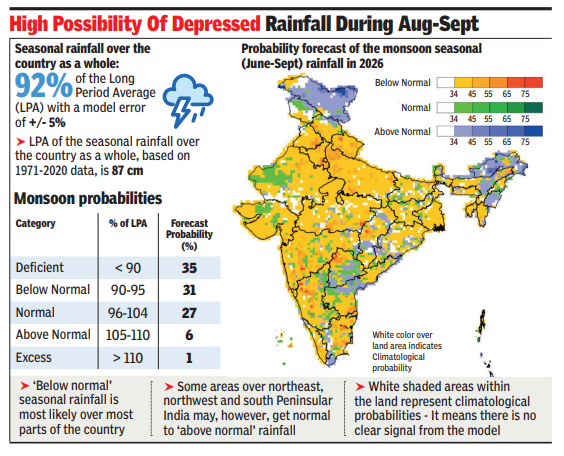
This scenario is most likely to impact irrigation, drinking water availability in arid and semi-arid zones, reservoir capacity and hydro-power potential at a time when the country is already staring at high input (diesel and fertilisers) costs for farming operations and overall high energy costs due to the West Asia conflict. Depressed rainfall not only adversely impacts acreage of the summer-sown kharif crops but also that of rabi that is sown in winter due to less moisture content in the soil and less water for irrigation in reservoirs. Such a scenario may hit the overall foodgrain output even as the country has, over the years, taken multiple measures to make its farm sector drought-proof. Due to the possible development of El Nino – climate conditions associated with the warming of ocean surface in central and eastern tropical Pacific Ocean – there is a high possibility of depressed rainfall during the second half of the monsoon season (Aug-Sept), IMD said. In what may come as a silver lining, conditions in the Indian Ocean, known as India Ocean Dipole (IOD), may turn favourable around Aug. “A positive IOD leads to more rainfall. So, we expect that this will counter the impact of El Nino during the second half of monsoon season,” said Mohapatra. At present, neutral IOD conditions are present over Indian Ocean and the latest climate model forecast indicates positive IOD conditions are likely to develop towards the end of southwest monsoon season, but, the catch is, IOD is generally unpredictable.
Discover more from stock updates now
Subscribe to get the latest posts sent to your email.