World’s largest acidic geyser erupts after 6 years, sending 30-foot blasts across Yellowstone |
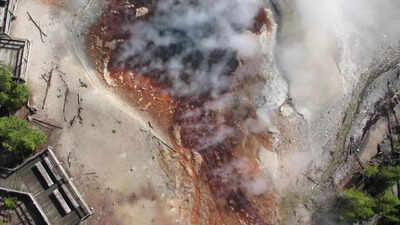
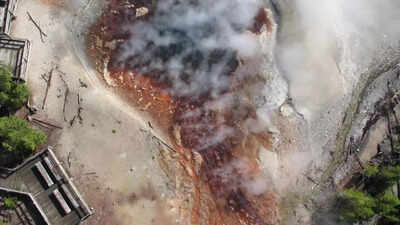
The ground at Yellowstone does not always move quietly, and sometimes it waits for years before suddenly coming back to life. That is exactly what has happened at Echinus Geyser, the world’s largest acidic geyser, which has erupted again after nearly six years of relative silence. Visitors at Yellowstone National Park are once more witnessing powerful bursts of steaming water rising to 30 feet into the air. Scientists say this marks the geyser’s strongest and most consistent activity since 2017. For a park already famous for dramatic geothermal displays, this latest revival feels significant. It serves as a reminder that Yellowstone’s landscape is constantly shifting, even when it appears calm on the surface.
Echinus Geyser’s unusual shape and spiky surface
Echinus Geyser is not the typical cone-shaped geyser often seen in travel photographs. Instead, it has a broad pool that measures around 66 feet across and is surrounded by jagged, spiky silica formations. These formations resemble sea urchins, which is how the geyser earned its name. When it becomes active, it erupts every few hours, sending acidic water between 20 and 30 feet high. Although it is not the tallest geyser in the park, the sight of its steaming column rising from a brightly coloured pool is still striking.Mineral deposits, including iron, aluminium, and arsenic cause the vivid red, orange, and yellow shades around the rim. Despite its intense appearance, experts say the water’s acidity is similar to that of everyday liquids such as vinegar or orange juice. It looks far more dangerous than it actually is, though it remains extremely hot.

What makes Echinus Geyser’s eruption possible
Most acidic hot springs do not develop into geysers because the chemistry typically works against them. Strong acid tends to dissolve the underground silica structures that are needed to trap steam and build pressure. Without this natural plumbing system, water cannot erupt forcefully and instead simply bubbles at the surface.Echinus appears to maintain a delicate balance between neutral groundwater and acidic gases rising from below. Scientists believe this unique mixture allows the underground system to stay intact while still producing regular eruptions. Park officials have noted that this unusual chemistry also contributes to the geyser’s colourful mineral patterns. Because of this rare combination of factors, large acidic geysers like Echinus are extremely rare worldwide.
Echinus Geyser’s changing eruption pattern over the years
Echinus has experienced fluctuating behaviour over the decades. During the 1970s, it reportedly erupted at predictable intervals of 40 to 80 minutes. Observers could almost set their watches by it. In the 1980s and 1990s, its eruptions grew much stronger, with some reaching heights of up to 75 feet and lasting more than 90 minutes. Activity then slowed considerably in the early 2000s.By December 2020, the geyser had fallen quiet once again. In early February 2026, scientists from the United States Geological Survey began detecting temperature increases in runoff channels, which suggested renewed underground movement. Soon after, visible eruptions resumed. During the current cycle, bursts are reaching between 20 and 30 feet and lasting around two to three minutes. Researchers say the pattern appears similar to what was recorded during the geyser’s 2017 revival.
Echinus Geyser activity sparks concern but experts say Yellowstone remains stable
The return of Echinus activity coincided with an eruption from Steamboat Geyser, which is recognised as the tallest active geyser in the world. The timing of these two events led to speculation among some observers about possible volcanic unrest.Geologists have stressed that there is no indication of increased volcanic threat. In February, Yellowstone recorded 74 small earthquakes, with the largest measuring only 2.4 in magnitude. Experts explain that geyser eruptions are controlled mainly by shallow underground water systems and seasonal changes rather than by magma movement. According to scientists, Yellowstone’s overall volcanic activity remains at normal background levels.
Echinus Geyser safety warning for visitors
Although the renewed eruptions are drawing attention from photographers and nature enthusiasts, park officials are reminding visitors to exercise caution. Water temperatures at Echinus can exceed 200 degrees Fahrenheit, which is hot enough to cause severe burns instantly. The ground in the Norris Geyser Basin is thin and can be unstable.Visitors are strongly advised to remain on designated boardwalks at all times. While the colourful pools may appear inviting, the terrain is unpredictable and potentially dangerous. For now, Echinus Geyser is once again putting on a dramatic display. Its return highlights the ever-changing nature of Yellowstone and reinforces the idea that this remarkable landscape is constantly evolving beneath our feet.
Discover more from stock updates now
Subscribe to get the latest posts sent to your email.