Work first or degree first? What one student’s dilemma teaches about career planning


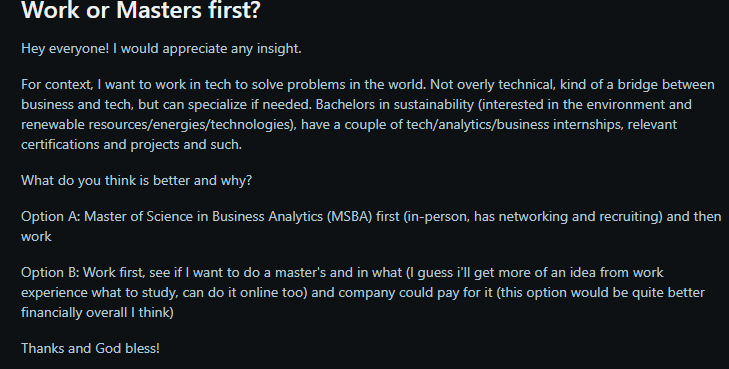
A Reddit post doing the rounds this week reads like a private conversation many final-year students are having with themselves. The writer has a bachelor’s degree in sustainability, a stack of internships across tech, analytics and business, and a clear ambition: work in technology to solve environmental problems. Not hardcore coding, but the space where business strategy meets data and systems.The dilemma is familiar. Go straight into a Master of Science in Business Analytics — in person, with campus recruiting and networking — or take a job first, earn, learn on the ground, and possibly return for a master’s later, maybe even with company sponsorship.
There is no template answer. But there is a way to think this through.

When a master’s makes strategic sense
An in-person analytics programme can change how recruiters see you. For someone whose undergraduate degree is in sustainability rather than engineering or computer science, a formal analytics credential signals technical competence. It fills in gaps that hiring managers might otherwise question.It also compresses exposure. In one intense year, students work on live datasets, industry projects and case competitions. Many programmes have dedicated placement pipelines. If the goal is to enter climate-tech firms, renewable energy analytics teams or ESG data roles, that network matters.There is another angle. Some students thrive in academic settings. If you already know you enjoy structured learning and want to build quantitative depth before entering the market, delaying work may not feel like a loss.But the cost is not abstract. Tuition, living expenses and a year without salary are tangible trade-offs. A master’s should feel like a targeted move, not a reflex after graduation.
Why work experience can sharpen your direction
The Reddit writer says they want to be a bridge between business and tech. That phrase covers a wide spectrum. Product management. Sustainability consulting. Data analytics. Operations roles in clean energy startups. Even policy-tech intersections.It is difficult to choose the right graduate degree without first seeing how these roles function day to day.A year or two in industry often brings clarity that no classroom can provide. You discover what excites you and what drains you. You learn whether you enjoy working with engineers, presenting to clients, or digging into spreadsheets for hours. That insight can shape not just whether you pursue a master’s, but which one.There is also a financial dimension. Starting work builds savings and reduces pressure. In some organisations, further education is partly funded. That changes the economics entirely.The trade-off is patience. Certain roles may remain out of reach without a graduate qualification. Career progression could feel slower at the start.
Questions that matter more than “Which is better?”
Instead of asking which path is superior, students should examine three practical issues.First, what do entry-level job descriptions in your target sector actually demand? If most climate-tech analytics roles list a master’s as preferred or required, that is useful evidence.Second, how confident are you about your specialisation? If you are certain that business analytics is the precise skill set you need, an MSBA now could be efficient. If your interests are still evolving, work experience can prevent an expensive misstep.Third, what is your risk tolerance? Some graduates are comfortable investing heavily in education upfront. Others prefer earning first and keeping options open.The Reddit post reflects a generation that wants impact, not just income. That urgency is admirable. But careers in sustainability and tech are long games. A decision taken at 22 or 23 does not lock you into one identity.For many students with internships already under their belt, stepping into the workforce first provides information, income and industry context. A master’s pursued later often feels sharper, more intentional and better aligned.For others, especially those aiming for roles where analytics depth is non-negotiable, going straight into a strong programme may fast-track entry.The right move is the one that fits your clarity, finances and appetite for risk — not what classmates are doing, and not what sounds impressive at reunions.
Discover more from stock updates now
Subscribe to get the latest posts sent to your email.