


Which Dividend Pharma Stock Should a Value Investor Choose Today?

Key Points
- Values aren’t always easy to find in the pharma sector.
- Bristol Myers Squibb has stable revenue, plus a strong dividend payout.
-
Its pipeline of drugs needs to keep growing to offset concerns around its legacy portfolio.
- 10 stocks we like better than Bristol Myers Squibb ›
The pharmaceutical sector has a reputation for offering high-growth opportunities, but is also known for being risky. However, there’s more to that sector than meets the eye.
There are pharmaceutical companies that can fit into a value investor’s portfolio. Broadly speaking, these companies look undervalued, with high dividend yields and the ability to generate steady revenue.
Will AI create the world’s first trillionaire? Our team just released a report on the one little-known company, called an “Indispensable Monopoly” providing the critical technology Nvidia and Intel both need. Continue »
A company that checks all three of those boxes at this moment is Bristol Myers Squibb (NYSE: BMY).

Image source: Getty Images.
Why Bristol Myers Squibb looks like a value stock
Bristol’s forward price-to-earnings (P/E) ratio — based on estimates for earnings — is around 9.5, which makes it look like a bargain compared to some other pharmaceutical stocks. For example, Johnson & Johnson has a forward P/E ratio of 21, while Merck‘s is 24.
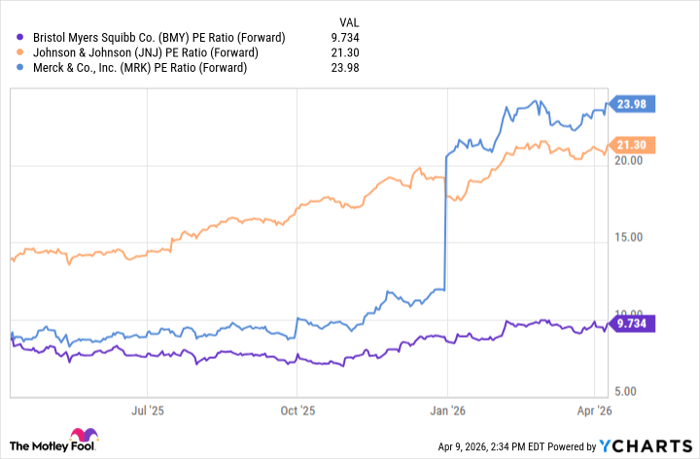

BMY PE Ratio (Forward) data by YCharts
Bristol Myers Squibb’s dividend yield is an enticing 4.2%, which is notably higher than those competitors’ yields. It has also increased its dividend payout for 17 consecutive years and has paid a dividend for 94 consecutive years.
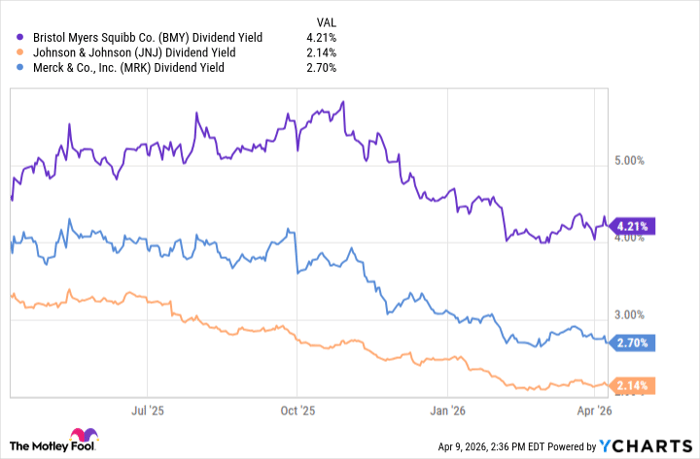
BMY Dividend Yield data by YCharts
In 2024, Bristol Myers Squibb reported $48.3 billion in revenue, followed by $48.2 billion in 2025. For 2026, Bristol expects revenue to fall between $46 billion and $47.5 billion. The slowing revenue is something to take note of, but what’s also worth noting is that the 2026 outlook is still fairly similar to previous years, highlighting Bristol’s consistency.
Just looking at the forward P/E, dividend yield, and stable revenue, on the surface, this seems like a strong value investment. Still, it’s always important to ask: Why does this opportunity exist? What is the rest of the market missing?
What the rest of the market is worried about is slowing legacy revenue, patent cliffs, and acquisition costs.
The challenges that created a favorable valuation
In 2024, Bristol reported revenue of $25.7 billion from its “legacy portfolio,” which fell sharply to $21.8 billion in 2025.
Eliquis, a blood thinner drug in that legacy portfolio that generated $14.4 billion in sales in 2025, faces an upcoming patent cliff. That’s worrisome.
Some investors are also worried about Bristol’s agreement to acquire Orbital Therapeutics for $1.5 billion, as the company is already sitting on more than $47 billion in debt.
When you add it all up, it’s no surprise that the forward P/E suggests future expectations are low compared to those of similar pharmaceutical stocks.
Those are all very real concerns, so the next step to see whether Bristol is truly a value is to explore how it’s addressing them.
Getting over the hurdles holding back the stock
Just as a quick refresher: Bristol’s legacy portfolio dropped from $25.7 billion in revenue in 2024 to $21.8 billion in revenue in 2025.
The good news for current shareholders or anyone considering investing is that revenue from its “growth portfolio” is, well, growing. Revenue for the growth portfolio jumped from $22.6 billion in 2024 to $26.4 billion in 2025.
That growth portfolio featured several drugs with worldwide sales of $1 billion or more.
The potential acquisition of Orbital Therapeutics isn’t cheap, but it could help Bristol build out its pipeline, which could help address the revenue lost from upcoming patent cliffs. Orbital is developing RNA medicines for the treatment of autoimmune diseases. Consulting firm Towards Healthcare projects that the global RNA therapeutics and vaccine market will reach over $205 billion by 2035.
“Our core business is strong and growing, and we have the potential to achieve industry-leading, sustainable growth into the 2030s and beyond,” Bristol CEO Christopher Boerner said in the company’s press release for its Q4 2025 and full-year 2025 results.
If things work out as planned, Bristol could be a true value at today’s price.
Should you buy stock in Bristol Myers Squibb right now?
Before you buy stock in Bristol Myers Squibb, consider this:
The Motley Fool Stock Advisor analyst team just identified what they believe are the 10 best stocks for investors to buy now… and Bristol Myers Squibb wasn’t one of them. The 10 stocks that made the cut could produce monster returns in the coming years.
Consider when Netflix made this list on December 17, 2004… if you invested $1,000 at the time of our recommendation, you’d have $555,526!* Or when Nvidia made this list on April 15, 2005… if you invested $1,000 at the time of our recommendation, you’d have $1,156,403!*
Now, it’s worth noting Stock Advisor’s total average return is 968% — a market-crushing outperformance compared to 191% for the S&P 500. Don’t miss the latest top 10 list, available with Stock Advisor, and join an investing community built by individual investors for individual investors.
*Stock Advisor returns as of April 12, 2026.
Jack Delaney has no position in any of the stocks mentioned. The Motley Fool has positions in and recommends Bristol Myers Squibb. The Motley Fool has a disclosure policy.
The views and opinions expressed herein are the views and opinions of the author and do not necessarily reflect those of Nasdaq, Inc.
Discover more from stock updates now
Subscribe to get the latest posts sent to your email.