


Warren Buffett’s Berkshire Hathaway Is Doubling Its Money in Coca-Cola, American Express, and Moody’s Every 21 to 30 Months — Here’s How
Key Points
- Warren Buffett retired as CEO on Dec. 31, having seen his company, Berkshire Hathaway, transform into a trillion-dollar powerhouse.
- Berkshire’s longest-tenured holdings — Coca-Cola, American Express, and Moody’s — are generating eye-popping yields relative to cost.
-
Time-tested dividend stocks often have well-defined competitive advantages.
- 10 stocks we like better than Coca-Cola ›
Before retiring as CEO on Dec. 31, billionaire Warren Buffett had the pleasure of seeing the company he and now-late right-hand man Charlie Munger had built, Berkshire Hathaway (NYSE: BRKA)(NYSE: BRKB), reach the trillion-dollar plateau.
While Berkshire’s former boss acquired roughly five dozen businesses spanning more than half a century, it’s his investing prowess that shareholders appreciated most. In particular, long-tenured holdings, including Coca-Cola (NYSE: KO), American Express (NYSE: AXP), and Moody’s (NYSE: MCO), have been nothing short of surefire moneymakers.
Will AI create the world’s first trillionaire? Our team just released a report on the one little-known company, called an “Indispensable Monopoly” providing the critical technology Nvidia and Intel both need. Continue »
What makes these three rock-solid businesses truly special is that the Oracle of Omaha’s company is doubling its initial investment in each of them every 21 to 30 months.
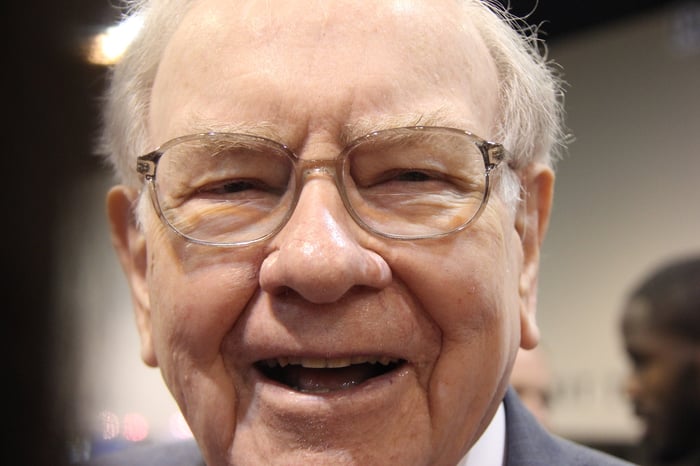
Warren Buffett retired as Berkshire Hathaway’s CEO on Dec. 31, 2025. Image source: The Motley Fool.

Time and dividends were always Warren Buffett’s greatest allies
Warren Buffett generated several eye-popping realized and unrealized gains during his decades as CEO of Berkshire Hathaway. But while Apple and Bank of America represent two of his largest nominal-dollar gains, it’s his longest-held investments that continue to deliver the most consistent reward.
Beverage behemoth Coca-Cola is Berkshire’s longest continuously held investment (since 1988), followed by credit-services titan American Express (since 1991) and ratings agency Moody’s (since 2000). Lengthy holding periods mean ultra-low cost bases for these stocks:
- Coca-Cola: approximately $3.25 cost basis per share
- American Express: approximately $8.49 cost basis per share
- Moody’s: approximately $10.05 cost basis per share
Buffett’s not-so-subtle secret is that he allowed time and steadily growing dividends to be his greatest allies. Coca-Cola has increased its base annual payout for 64 consecutive years, while Moody’s and American Express have boosted their payouts for 17 straight years and five consecutive years, respectively.
Based on projected annual payouts of $2.06/share for Coca-Cola, $3.80/share for Amex, and $4.12/share for Moody’s, these “forever” holdings are generating respective yields on cost of 63%, 45%, and 41%. In other words, the dividend income alone received from Coca-Cola, Amex, and Moody’s is doubling Berkshire Hathaway’s initial investment in these stocks every 21 months (for Coca-Cola), 27 months (for Amex), and 30 months (for Moody’s).

Image source: Coca-Cola.
Companies with well-defined competitive advantages are often dividend powerhouses
Although Warren Buffett has handed the baton to Greg Abel, Berkshire’s new CEO has made clear that he has no intention of selling these forever stocks.
The reason these companies are income powerhouses has to do with their well-defined competitive advantages. For example, Coca-Cola has operations in all but three countries, and its marketing team has done a phenomenal job of crossing generational gaps to engage with mature and young audiences. Arguably, no consumer goods brand has done a better job of connecting with consumers than Coca-Cola.
Meanwhile, American Express is able to benefit from both sides of the transaction aisle. It generates fees from merchants when processing payments and collects annual fees/interest income from its cardholders. Furthermore, Amex has historically had a knack for attracting affluent clientele who are less likely to alter their spending habits during minor economic disruptions.
Lastly, Moody’s two operating segments are ideally hedged for long-term success. When interest rates decline, and businesses or governments seek to issue debt, its debt-rating segment (Moody’s Investors Service) thrives. Conversely, when things become uncertain, its analytics operations (Moody’s Analytics) often enjoy an uptick in demand.
Should you buy stock in Coca-Cola right now?
Before you buy stock in Coca-Cola, consider this:
The Motley Fool Stock Advisor analyst team just identified what they believe are the 10 best stocks for investors to buy now… and Coca-Cola wasn’t one of them. The 10 stocks that made the cut could produce monster returns in the coming years.
Consider when Netflix made this list on December 17, 2004… if you invested $1,000 at the time of our recommendation, you’d have $510,710!* Or when Nvidia made this list on April 15, 2005… if you invested $1,000 at the time of our recommendation, you’d have $1,105,949!*
Now, it’s worth noting Stock Advisor’s total average return is 927% — a market-crushing outperformance compared to 186% for the S&P 500. Don’t miss the latest top 10 list, available with Stock Advisor, and join an investing community built by individual investors for individual investors.
*Stock Advisor returns as of March 20, 2026.
Bank of America is an advertising partner of Motley Fool Money. American Express is an advertising partner of Motley Fool Money. Sean Williams has positions in Bank of America. The Motley Fool has positions in and recommends Apple, Berkshire Hathaway, and Moody’s and is short shares of Apple. The Motley Fool has a disclosure policy.
The views and opinions expressed herein are the views and opinions of the author and do not necessarily reflect those of Nasdaq, Inc.
Discover more from stock updates now
Subscribe to get the latest posts sent to your email.