Union Budget 2026: VB-G RAM G gets ₹95,692.31 crore; experts warn it falls far short of allocation needed to guarantee 125 workdays
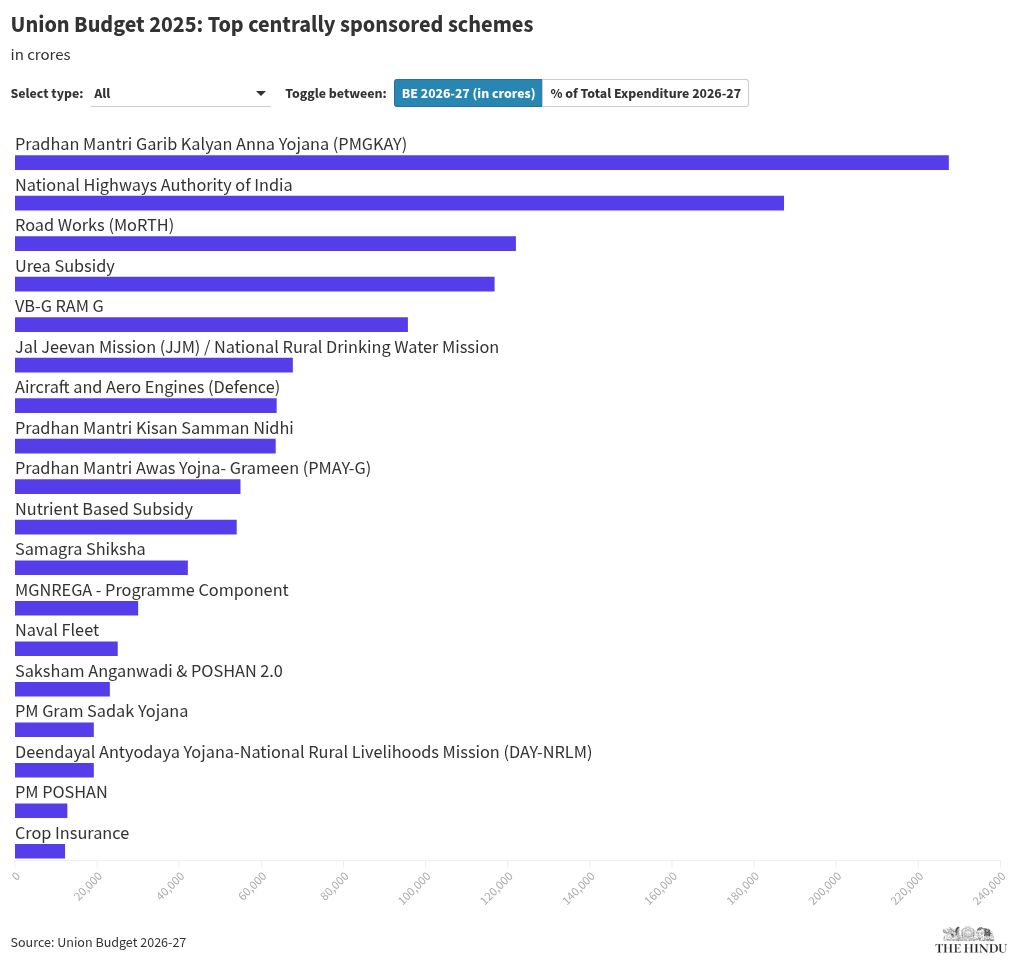
Together, the allocation for both rural employment schemes stands at ₹1,25,692.31 crore, compared with the Revised Estimate of ₹88,000 crore for the MGNREGA in 2025-26. However according to activists, the allocation is not expected to meet the government’s own target of providing 125 workdays to all workers enrolled under the MGNREGS. Calculations show that to meet this commitment, the government would need to allocate ₹2.30 lakh crore.
The VB-G RAM G Act replaces the Mahatma Gandhi National Rural Employment Guarantee Act (MGNREGA), 2005. Under the new law, any rural household willing to undertake unskilled manual work can register and seek employment. There are approximately 8.65 crore active job card holders who can demand work under the scheme.

“If all active job card holders are provided 125 days of employment, and the average cost per person per day is ₹355, the total expenditure required would be ₹3,83,844 crore. At a 60:40 cost-sharing ratio, the Government of India’s share would amount to approximately ₹2.30 lakh crore, with the remaining share to be borne by the states,” Chakradhar Budhha, a senior researcher at LibTech India, a consortium of activists and academics, said.
The new law has not yet been notified; once it is, State governments will have six months to roll out their version of the scheme. In the interim, the MGNREGA will continue. The budgetary allocation of ₹ 30,000 crore is intended to clear last financial year’s liabilities and cover ongoing expenditure.
Union Budget 2026: Allocations to Ministries in graphics
Union Rural Development Minister Shivraj Singh Chouhan described the Budget as “historic,” claiming a 21% hike in allocation for rural development, from ₹1,91,406 crore in 2025-26 to ₹2,31,423 crore in 2026–27.
The Minister highlighted that the total allocation for the MGNREGA in 2025-26 was ₹86,000 crore, while the Centre’s share for the coming year has crossed ₹95,600 crore and will exceed ₹1,51,000 crore once States’ contributions are included. “This is unprecedented and historic in itself, as it will give new momentum to rural India,” he said.
He added that, in line with the 16th Finance Commission’s recommendations, panchayats will directly receive over ₹55,900 crore. He also pointed to the expanded Lakhpati Didi initiative, which will promote women-led enterprises through the creation of SHE-Marts community-owned retail outlets that will improve market access and visibility for products of self-help groups.
Nikhil Dey, one of the founding authors of MGNREGA, said that there are current dues of about ₹15,000 crore plus in the next two months, there is likely to be an expenditure of about ₹15,000 crore, as per the last year’s trends. “Therefore, ₹30,000 crore allocation for the MGNREGA seems to have no relevance for next year,” Mr. Dey said.
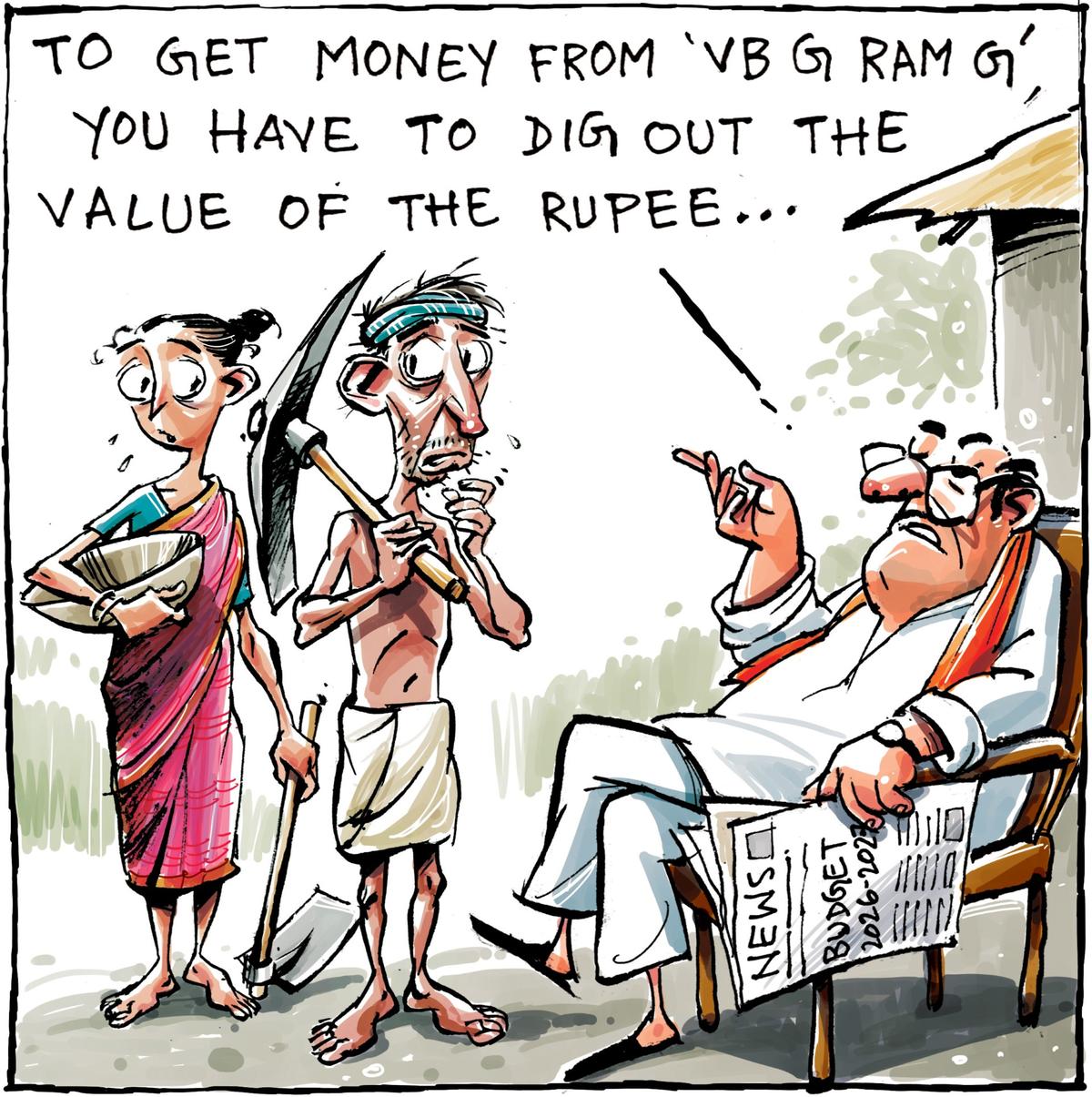
Illustration: Soumyadip Sinha
He further pointed out, that many States have already presented their budget without accounting for their share of the new rural employment scheme, since the Centre decides on what the “normative allocation” for each State will be as decided by the centre. “On paper, the Centre appears to have completed its role by fixing its budget share but has left major implementation and funding burdens on States, making the actual functioning of VB-G RAM G highly uncertain,” he added.
Published – February 01, 2026 06:44 pm IST
Discover more from stock updates now
Subscribe to get the latest posts sent to your email.