Union Budget 2026: ₹20,000 crore earmarked for carbon capture, storage scheme

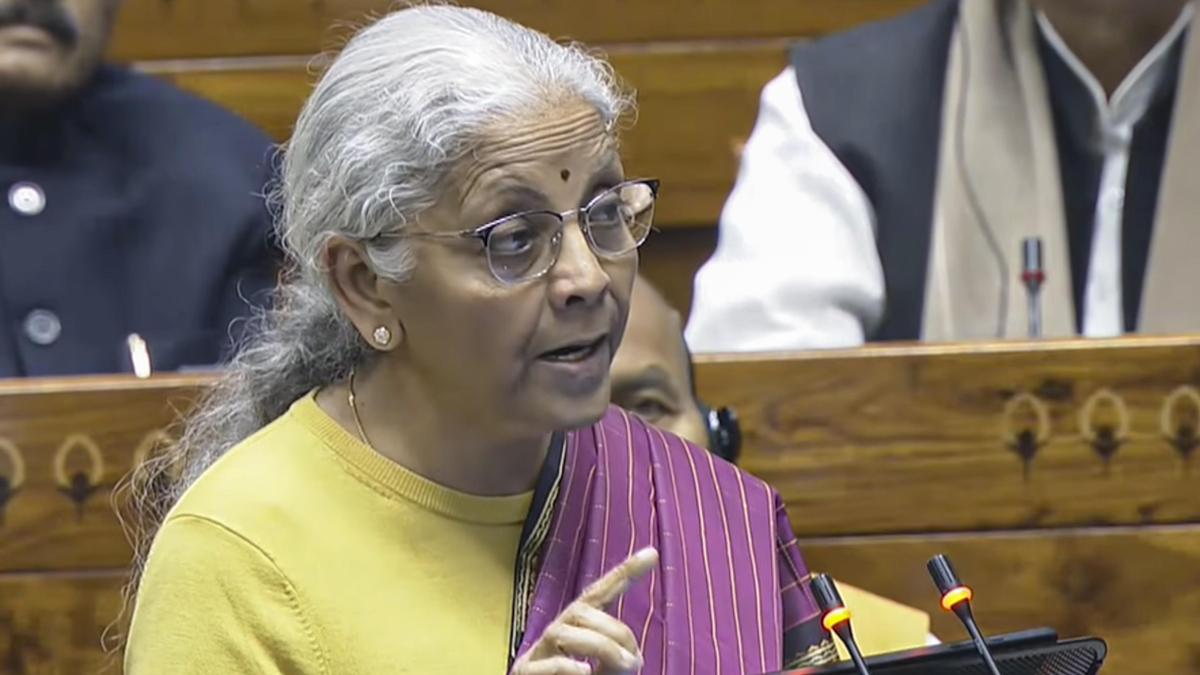
A screegrab of Finance Minister Nirmala Sitharaman presenting the ‘Union Budget 2026-27’ in the Lok Sabha, in New Delhi, on February 1, 2026. Photo Credit: Sansad TV via PTI
CCUS refers to a suite of technologies that capture carbon dioxide (CO₂) emissions from large point sources – such as power plants, steel, cement, chemicals, and refineries – and either use CO₂ as an input for products or permanently store it in geological formations.

Under the aegis of the Principal Scientific Advisor, an expert committee of the Department of Science and Technology (DST) had submitted a report in December 2025 to analyse what India needed to do regarding CCUS to aid meeting its net-zero goals for 2070. Net zero refers to no net carbon emissions.
The road map
The DST road map positions CCUS as essential for India’s “hard-to-abate” sectors (for instance, iron and steel industries) where deep emissions reductions are difficult through efficiency or renewable substitution alone. Reducing carbon emissions from these sectors has acquired urgency in the light of measures by the European Union to impose indirect tariffs on imports from countries that use higher carbon than its domestic manufacturers to forge iron and steel products.
India’s approach, as outlined by the DST, is explicitly research and development-led rather than deployment first. The road map proposes a three-phase programme focused on pushing CCUS technologies from laboratory scale to pilot and demonstration projects, and eventually to commercial readiness. It prioritises point-source capture – especially from cement, steel, fertilisers, and power generation – and emphasises indigenous technology development, centres of excellence, and shared transport and storage infrastructure. Integration of CCUS into existing industrial facilities – rather than greenfield plants – is a central design principle.

The anticipated costs, according to this estimate, would be around ₹4,500 crore over the next two years. Another tranche of ₹2,000 crore would be needed for demonstration products and geological storage would cost another ₹3,000 crore, the document notes.
An initial allotment of ₹500 crore has been made to the Ministry of Power to commence the research programme.
Move welcomed
Independent experts broadly welcomed the stress on CCUS in the Budget. “The ₹20,000-crore commitment over five years for CCUS, continued support for the National Green Hydrogen Mission, and the introduction of new financial mechanisms for battery energy storage systems and pumped storage together signal a pragmatic approach to addressing emissions from hard-to-abate sectors,” said Arunabha Ghosh, CEO, Council for Energy, Environment and Water.
According to the International Energy Agency, around 45 commercial facilities are already in operation applying CCUS to industrial processes, fuel transformation, and power generation.
CCUS deployment has trailed behind expectations in the past, but momentum has grown substantially in recent years, with over 700 projects in various stages of development across the CCUS value chain.
In 2023, announced capture capacity for 2030 increased by 35%, while announced storage capacity rose by 70%. This brings the total amount of CO₂ that could be captured in 2030 to around 435 million tonnes (MT) per year and announced storage capacity to around 615 MT of CO₂ per year.
Published – February 01, 2026 12:40 pm IST
Discover more from stock updates now
Subscribe to get the latest posts sent to your email.