UK inflation unchanged in February in last print before the Iran war
Jordan Pettitt – Pa Images | Pa Images | Getty Images
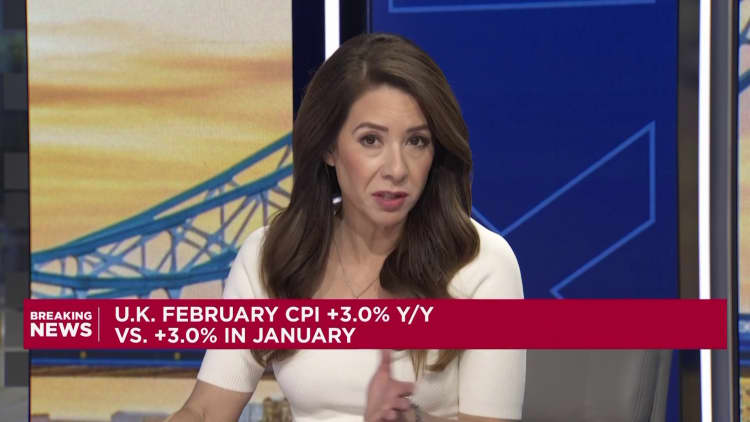
Economists polled by Reuters had expected the consumer price index to remain unchanged from the previous month.
Core inflation, which excludes energy, food, alcohol, and tobacco, stood at 3.2% in February, up from 3.1% in January.
“After last month’s slowdown, annual inflation was unchanged. The largest upwards driver was the price of clothing, which rose this month but fell a year ago,” Grant Fitzner, the chief economist at ONS, commented on X.

“This was offset by falls in petrol costs, with prices collected before the start of the conflict in the Middle East and subsequent rise in crude oil prices,” he added.
The inflation print covers the final monthly period data before the U.S. and Israel launched airstrikes on Iran in late February, prompting retaliatory strikes by the Iranian Republic. The British pound was down 0.17% against the dollar at $1.3385 following the data release.
An ongoing and almost total block on the Strait of Hormuz, a vital maritime passage for oil and gas out of the Middle East, has sent global energy prices soaring. The U.K. is particularly exposed to rising energy prices due to its reliance on oil and gas imports, and lack of gas storage facilities.

While economists expect the inflation rate to fall back somewhat in April due to a reduction in household energy bills linked to government cuts to “green levies,” consumer prices are broadly expected to rise significantly thereafter if the war continues.
“Brace for impact,” Deutsche Bank’s Chief UK Economist Sanjay Raja warned on Wednesday, stating that “inflation is poised for another unwelcome detour” from here on in, while ICAEW Chief Economist Suren Thiru noted that a “brutal inflation surge” is coming.
“February’s unchanged inflation is a false flag for the economy as these figures pre-date the eyewatering energy shock induced by the Middle East conflict and the subsequent financial pain facing consumers and businesses,” he said in emailed comments.
“While inflation should fall next month as the cut to green levies temporarily lowers energy bills, a brutal inflation surge looms with skyrocketing oil and gas costs likely to lift the headline rate above 4% by the summer,” he added.
BOE dilemma
While the war has rewritten inflation expectations in the U.K., the country was already experiencing a stubbornly high inflation rate compared to its neighbors on the continent.
Nonetheless, the rate of price rises was expected to slow this year towards the Bank of England’s 2% target, giving the central bank space to cut interest rates.
The war has put paid to expected cuts for now, however, with economists saying the BOE is likely to keep interest rates on hold at 3.75%, or could even hike again amid the revised inflationary outlook.
Zara Nokes, global market analyst at J.P. Morgan Asset Management, said U.K. inflation data “is in effect old news, with attention now firmly on what is coming down the tracks as a result of the conflict in the Middle East.”
“Nonetheless, the upside surprise in core inflation today will be of concern for the Bank given it shows we are still contending with sticky price pressures even before accounting for the recent spike in energy prices,” she added in emailed comments.
Andrew Bailey, governor of the Bank of England (BOE), during the Monetary Policy Report news conference at the bank’s headquarters in the City of London, UK, on Thursday, Aug. 1, 2024.
Bloomberg | Bloomberg | Getty Images
But Nokes said that while the energy shock will put upward pressure on inflation over the next couple of quarters, “we are very unlikely to see an inflation spike in the same magnitude as 2022” following Russia’s invasion of Ukraine.
“We are in a very different world; the labour market is in a much weaker position, and this therefore makes it far less likely that workers – concerned about rising costs – feel able to push for higher wages and thus entrench price pressures more broadly,” she said, advocating for the BOE to hold, rather than hike, rates.
Last week, the Bank of England’s Monetary Policy Committee voted “unanimously” keep its benchmark interest rate on hold, stating that “conflict in the Middle East has caused a significant increase in global energy and other commodity prices, which will affect households’ fuel and utility prices and have indirect effects via businesses’ costs.”
“Prior to this, there had been continued disinflation in domestic prices and wages. CPI inflation will be higher in the near term as a result of the new shock to the economy,” the BOE warned.
The BOE said its policymakers are “alert to the increased risk of domestic inflationary pressures through second-round effects in wage and price-setting, the risk of which will be greater the longer higher energy prices persist.”

ING Economist James Smith said “we don’t think it is at all clear the bar for rate hikes has been met, at current levels of oil and gas prices.”
“Admittedly nobody knows exactly where the threshold for hikes truly lies; last week’s meeting didn’t give much away. But last summer, Bank research suggested that second-round effects tend to become more pronounced when headline inflation exceeds 3.5 – 4%. This is a helpful line in the sand,” he added in emailed analysis.
At current energy prices, U.K. inflation would likely peak briefly at 4% in the fall, according to ING. Alternatively, under ING’s energy base case, where disruption starts to ease through the second quarter and energy prices begin to gradually fall back, a peak of 3.5% could be hit in September.
Discover more from stock updates now
Subscribe to get the latest posts sent to your email.