


Trump waives U.S. shipping law to steady oil market
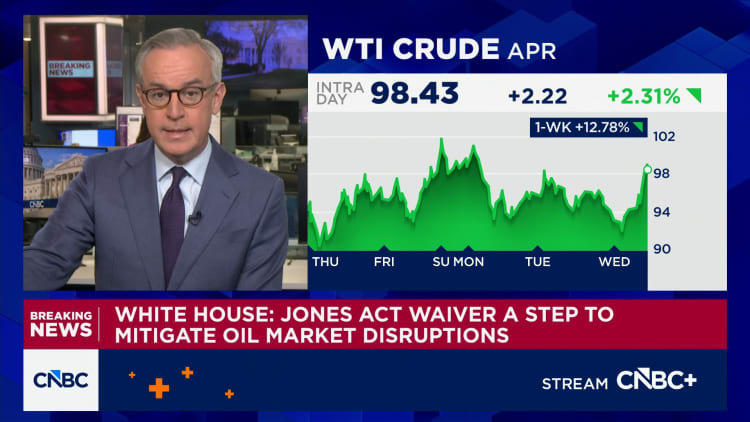

The temporary suspension of the Jones Act “will allow vital resources like oil, natural gas, fertilizer, and coal to flow freely to U.S. ports for sixty days,” White House press secretary Karoline Leavitt said in a statement.

The Trump administration “remains committed to continuing to strengthen our critical supply chains,” Leavitt said.
The Jones Act, signed into law in 1920 by then-President Woodrow Wilson, requires that the transport of goods between U.S. ports must be conducted by U.S. vessels.
The law was intended as an effort to grow the domestic shipping industry after World War I. The statute has been criticized as a form of protectionism, and some economists have recently argued that it impedes domestic trade.
Trump’s two-month waiver was announced as oil prices resumed their rise due to the Iran war, in which major energy infrastructure has come under attack and the Strait of Hormuz, a vital global oil-shipping route, has been effectively closed.
Brent prices, the international benchmark, rose over 6% on Wednesday morning, topping $109 per barrel. U.S. oil prices were trading 2.95% higher to $99.05 per barrel.
There are fewer than 100 Jones Act-compliant vessels, according to Daleep Singh, chief global economist at asset manager PGIM, so waiving the law frees up many more international tankers to carry fuel between U.S. ports.
But the impact of suspending the act may nevertheless be limited, Singh said. That’s because of a “mismatch” in which most U.S. refineries are built to process Middle Eastern crude while the U.S. mainly produces lighter shale oil.
“Put plainly: the U.S. can now move fuel around more easily, but it still can’t refine enough of what it produces for self-sufficiency,” Singh said in a client note Wednesday.
Trump in recent days has vented his frustration with U.S. allies over their reluctance to help secure the strait, which is currently effectively blocked by the threat of Iranian strikes on shipping vessels. The president at the same time has asserted that the U.S. does not need any help with its ongoing military operations.
— CNBC’s Spencer Kimball and Matt Peterson contributed to this report.
Discover more from stock updates now
Subscribe to get the latest posts sent to your email.