Theory of relativity for dummies: How Albert Einstein repainted space and time |
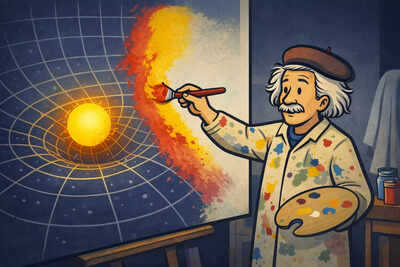
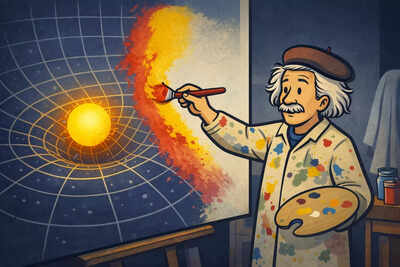
In 1905, a 26-year-old patent clerk named Albert Einstein looked at the universe and discovered that time was not what we thought it was. It was not linear. For centuries, everyone assumed the same thing about reality. Space was just there, like an empty room. Time was a steady flow, like a river moving at one universal speed. Whether you were in London, on a train, or floating in space, a second was a second. The universe ticked like a giant clock and all of us lived inside it.Relativity shattered that comfort. Much like relatives who stay for too long at your house shatter yours. Einstein realised that time is not a universal river, and depends on the observer. The shock came from studying light. Scientists discovered something strange: no matter how fast you moved, the speed of light stayed the same. You could chase it or run away from it, and it would not budge. The universe treated the speed of light as a limit written in stone.Einstein took that fact seriously. If light refused to change, then something else had to. The thing that gave way was time itself.Two people moving at different speeds do not measure time the same way. One clock can run slower than another depending on motion. That is not a trick. It is reality. A person travelling very fast actually ages slightly less than someone standing still.The difference is tiny at everyday speeds, which is why we never notice it. But at extreme speeds, the effect becomes real enough to measure. Astronauts return from space a fraction of a second younger than they would have been on Earth. The universe quietly bends time without asking our permission. The mathematician Hermann Minkowski described what Einstein had uncovered in words that sounded almost poetic:“Henceforth space by itself, and time by itself, are doomed to fade away into mere shadows.”Space and time were no longer separate things. They fused into a single structure: spacetime. Distance and duration became part of the same system. Moving through space changed how you moved through time.Then Einstein went further.In 1915 he reimagined gravity. Instead of thinking of gravity as an invisible pull between objects, he described it as a curve in spacetime. Massive things like stars and planets bend the fabric of the universe around them. Other objects simply follow those curves.The physicist John Archibald Wheeler later summed it up in one famous line:“Spacetime tells matter how to move; matter tells spacetime how to curve.”The Earth is not being dragged around the sun by a rope. It is rolling along the shape the sun creates in spacetime. Gravity becomes geometry.This sounds abstract, but it affects daily life. The GPS in your phone only works because engineers correct for relativity. Time runs differently for satellites in orbit than it does on Earth. Without Einstein’s equations, your location would drift by kilometres. Relativity is not science fiction. It is infrastructure.The deeper shock is philosophical. There is no master clock floating outside the universe. No single viewpoint that is perfectly correct. Every observer carries their own version of time, and the universe allows all of them to coexist. Reality becomes relational instead of absolute.The physicist Richard Feynman once said:“The imagination of nature is far, far greater than the imagination of man.”Relativity is one of the moments when nature proves it. Human intuition evolved at slow speeds and gentle gravity. We are tuned to a quiet corner of the cosmos. Einstein revealed that the universe is far stranger and more flexible than our senses suggest.Space can stretch. Time can slow. Matter can turn into energy. Black holes can warp reality so severely that even light cannot escape. These ideas were once shocking predictions. Today they are measured facts.And all of it began with a clerk asking a simple question: what would the world look like if the speed of light never changed?Relativity changed physics because it forced science to question its deepest assumptions. Space was no longer a fixed stage. Time was no longer universal. The background of reality became active, dynamic, alive.Einstein did not just solve a problem. He expanded the map of existence.The everyday world still feels solid. Your watch ticks normally. Your coffee cools at a predictable rate. Relativity hides in extremes. But knowing it is there changes how we picture the universe. The cosmos stops being a rigid box and becomes a flexible fabric that responds to motion and mass.Once that idea enters human thought, it never leaves. The universe becomes larger without moving an inch. Time becomes stranger without stopping. Reality gains depth without losing clarity.That is what relativity did to physics.It did not add a new rule.It revealed that the rules themselves were part of the story.

Discover more from stock updates now
Subscribe to get the latest posts sent to your email.