


The Hidden Driver Behind AMD’s Most Bullish 2026 Guidance
Key Points
- AMD forecasts accelerating data center revenue growth over the next five years.
- AI accelerators will play a big role, but booming demand for server CPUs will help the cause as well.
-
As AI shifts to agentic workloads, CPUs are making a comeback.
- 10 stocks we like better than Advanced Micro Devices ›
Shares of Advanced Micro Devices (NASDAQ: AMD) took a beating on Wednesday as investors digested the chip company’s fourth-quarter report. AMD’s results and guidance were generally solid, with revenue soaring 34% year over year in the fourth quarter and the company’s outlook calling for 32% growth in the first quarter of 2026.
One thing that stood out about AMD’s outlook was its expectations for the data center segment. This segment houses AMD’s EPYC server CPUs and its Instinct data center GPUs, and it grew revenue by 39% in the fourth quarter. AMD CEO Lisa Su expects growth to accelerate dramatically going forward. “…we are well-positioned to grow data center segment revenue by more than 60% annually, over the next three to five years and scale our AI business to tens of billions in annual revenue in 2027,” Su said during the earnings call.
Will AI create the world’s first trillionaire? Our team just released a report on the one little-known company, called an “Indispensable Monopoly” providing the critical technology Nvidia and Intel both need. Continue »
AMD’s AI accelerators will be a big part of the story as the company scales up its MI400 series chips and its Helios rack-scale solutions, but CPUs will play a surprisingly large role as well. As the AI industry has evolved from question-answer style chatbots to complex AI agents, the CPU is making a comeback and will help drive AMD’s growth.
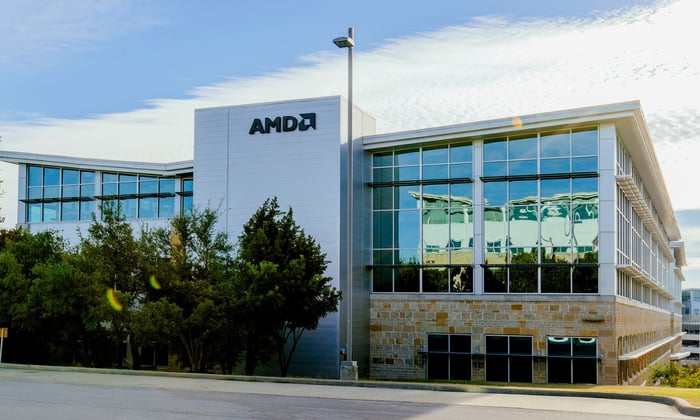

Image source: AMD.
AI agents are changing the story
In a standard AI chatbot, the user asks a question, and the chatbot returns an answer drawn solely from its training data. This process happens entirely on the GPU. Agentic AI is fundamentally different.
AI agents run in a loop. The user makes a request, and the agent must decide what to do first. Typically, an agent has a list of tools at its disposal. These tools could handle web searches, file access, data analysis, or running code written by the user or an AI agent. The big thing here is that this tool calling involves the CPU, not the GPU.
Here’s an example: Imagine an AI agent that produces an infographic of the 7-day weather forecast each day. First, it would make a tool call to some external API to fetch weather data. Then it would make another tool call to run a piece of code that converts the weather data to the right format. Then, yet another tool call might either run code that generates the graphic or tap an external AI image service. Finally, the result is returned to the user.
There’s plenty of GPU usage going on here. Between each tool call, it’s the AI agent that decides what to do next. But the action of using those tools happens on the CPU. The CPU is running code, searching the web, manipulating data, and making API calls. “Where, you know, when you have, these AI processes or AI agents that are spinning off a lot of work, in an enterprise, they’re actually going to a lot of traditional CPU tasks,” noted Su during theearnings call
Su expects the server CPU market to expand by “strong double digits” in 2026. AMD has been increasing its supply capacity to meet this demand, but CPUs could still be a bottleneck for AI infrastructure providers. Intel is also seeing booming demand for its server CPUs, and despite shifting manufacturing capacity away from PC chips, the market leader expects supply to fall short of demand.
Multiple ways to win
AMD has been gaining server CPU market share from Intel for years, and now an expanding market adds another tailwind for its server CPU business. Intel’s products have become more competitive, so market share gains may be tougher going forward, but a rising tide in the server CPU market will lift all boats.
In the data center GPU market, AMD must contend with an entrenched Nvidia. In the CPU market, AMD is in a stronger competitive position. Even if AMD’s AI accelerator ramp goes more slowly than expected, the company’s EPYC server CPUs can still drive strong growth in the data center segment and help it hit its bullish target.
Should you buy stock in Advanced Micro Devices right now?
Before you buy stock in Advanced Micro Devices, consider this:
The Motley Fool Stock Advisor analyst team just identified what they believe are the 10 best stocks for investors to buy now… and Advanced Micro Devices wasn’t one of them. The 10 stocks that made the cut could produce monster returns in the coming years.
Consider when Netflix made this list on December 17, 2004… if you invested $1,000 at the time of our recommendation, you’d have $436,126!* Or when Nvidia made this list on April 15, 2005… if you invested $1,000 at the time of our recommendation, you’d have $1,053,659!*
Now, it’s worth noting Stock Advisor’s total average return is 885% — a market-crushing outperformance compared to 192% for the S&P 500. Don’t miss the latest top 10 list, available with Stock Advisor, and join an investing community built by individual investors for individual investors.
*Stock Advisor returns as of February 7, 2026.
Timothy Green has positions in Intel. The Motley Fool has positions in and recommends Advanced Micro Devices, Intel, and Nvidia. The Motley Fool has a disclosure policy.
The views and opinions expressed herein are the views and opinions of the author and do not necessarily reflect those of Nasdaq, Inc.
Discover more from stock updates now
Subscribe to get the latest posts sent to your email.