




Stock markets trade lower on persistent foreign fund outflows, trade uncertainties

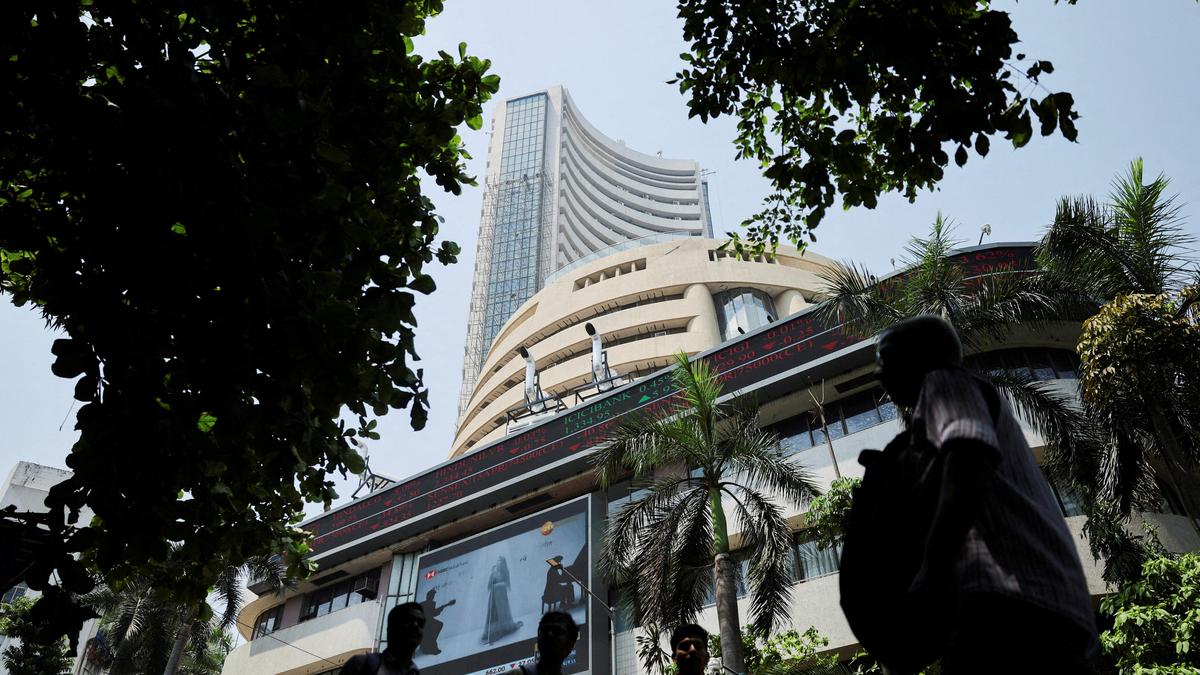
The Indian economy is expected to grow by 7.4% in the current fiscal, maintaining its status as the world’s fastest-growing major economy despite punitive U.S. tariffs and geopolitical tensions. Representational file image.
| Photo Credit: Reuters
The 30-share BSE Sensex declined 255.86 points to 84,705.28 in early trade. The 50-share NSE Nifty went down by 65.9 points to 26,074.85.
From the 30-Sensex firms, Tata Consultancy Services, Asian Paints, Maruti, Tech Mahindra, Infosys and UltraTech Cement were among the biggest laggards.
However, ICICI Bank, Adani Ports, Bharat Electronics and Hindustan Unilever were among the gainers.
Foreign institutional investors offloaded equities worth ₹1,527.71 crore on Wednesday (January 7, 2026), while domestic institutional investors bought stocks worth ₹2,889.32 crore, according to exchange data.
“From the fundamental perspective, there is good news for the economy and markets. Advanced estimates project the FY26 GDP growth at an impressive 7.4%. This reflects the underlying resilience of the economy despite Trump tariffs. However, this strong fundamental is unlikely to reflect in the market very soon since the much-awaited U.S.-India trade deal, which is critical for India’s sustained growth and macro-economic stability, is not happening. This and the continuing FII selling are impacting the market,” V.K. Vijayakumar, Chief Investment Strategist, Geojit Investments Limited, said.
The Indian economy is expected to grow by 7.4% in the current fiscal, maintaining its status as the world’s fastest-growing major economy despite punitive U.S. tariffs and geopolitical tensions.
The First Advance Estimates released by the Ministry of Statistics and Programme Implementation (MoSPI) on Wednesday (January 7, 2026) put GDP growth in 2025-26 (April 2025 to March 2026 fiscal year) at better than 7.3% forecast by the RBI and the government’s initial projection of 6.3-6.8%.
“With both the Nifty and Bank Nifty holding key support levels but encountering stiff overhead resistance, market sentiment remains cautious amid elevated geopolitical tensions, renewed tariff-related concerns, and continued foreign portfolio outflows,” Ponmudi R, CEO of Enrich Money, an online trading and wealth tech firm, said.
In Asian markets, South Korea’s Kospi index and Shanghai’s SSE Composite index traded higher, while Japan’s Nikkei 225 index and Hong Kong’s Hang Seng index quoted lower.
U.S. markets ended mostly lower on Wednesday (January 7, 2026).
Brent crude, the global oil benchmark, climbed 0.40% to $60.20 per barrel.
On Wednesday (January 7, 2026), the Sensex declined 102.20 points or 0.12% to settle at 84,961.14. The Nifty went down by 37.95 points or 0.14% to 26,140.75.
Published – January 08, 2026 10:23 am IST
Discover more from stock updates now
Subscribe to get the latest posts sent to your email.