Satellites ‘X-ray’ Antarctica, new map reveals hidden world under 2 kms ice
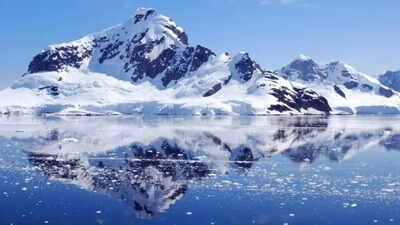
For most of us, Antarctica is a frozen white desert that is mysterious, remote and almost unfathomably cold. However, a groundbreaking new scientific map, published in Sciencein January 2026, is now revealing that beneath all that ice lies a dramatic, rugged landscape of mountains, deep canyons and hidden hills that looks more like a secret version of Earth than the barren, flat plain many once imagined. This stunning discovery comes from the major study “Complex mesoscale landscapes beneath Antarctica mapped from space”, led by Helen Ockenden and colleagues, that used advanced satellite data and ice-flow physics to essentially decode the bedrock beneath two kilometres of ice for the first time.
Antarctica: A hidden landscape emerges from the ice
Until now, scientists knew surprisingly little about what lies beneath the Antarctic ice sheet despite it covering about 98% of the continent’s surface. In fact, researchers used to know more about the surface of Mars than the bedrock underneath Antarctica’s frozen blanket.Using a new method called Ice Flow Perturbation Analysis (IFPA), scientists combined high-resolution satellite images with measurements of ice thickness to estimate how the ice moves and bends over the land below. From that, they effectively decoded the hidden landscape, revealing a much more complex world stacked beneath the ice.The results are awe-inspiring. The team identified nearly 72,000 hills, more than twice as many as previous maps showed and discovered vast valleys and steep mountain peaks hidden under kilometres of solid ice. One such feature is a canyon nearly 400 kilometres long, reminiscent of rugged alpine terrain rather than a frozen polar desert.The authors noted, “Our IFPA map of Antarctica’s subglacial landscape reveals that an enormous level of detail about the subglacial topography of Antarctica can be inverted from satellite observations of the ice surface, especially when combined with ice thickness observations from geophysical surveys.”
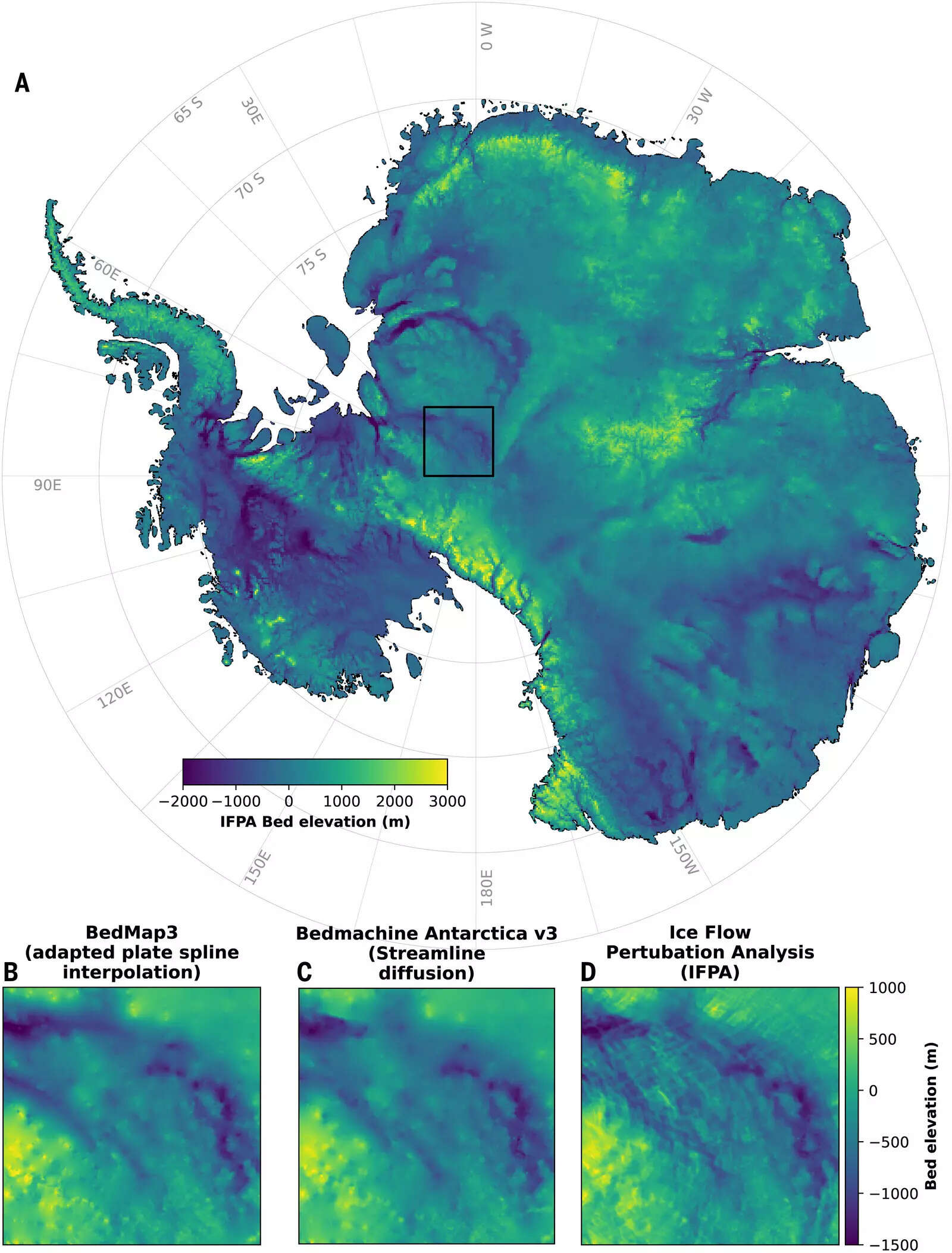
IFPA subglacial topography of Antarctica.(A) shows the IFPA subglacial topography for the whole Antarctic continent and (B to D) show a comparison of different bed topography maps for the Pensacola-Pole Basin region [outlined in black on (A). (B) displays Bedmap3, (C) displays BedMachine Antarctica v3 and (D) displays IFPA subglacial topography. The map production workflow is detailed in the methods; the main input datasets include the Gapless REMA ice-surface digital elevation model, the MEaSURES Antarctic ice-velocity product, the BedMachine Antarctica v3 bed-elevation map and all available geophysical survey measurements of ice thickness from Bedmap3 and CReSIS SAR surveys.

This approach uncovered a hidden world full of mountains, ridges and deep troughs in some places resembling the rugged terrain of Scotland or Scandinavia more than the flat ice sheet many imagine. The team identified tens of thousands of previously unmapped hills and features, painting a picture of a landscape both surprising and unexpectedly diverse under nearly 14 million square kilometres of ice.You might think this is just academic curiosity but it has real-world implications far beyond icy deserts and remote research stations. You might be wondering: Why should I care what’s under Antarctica’s ice? The answer is surprisingly personal, even if you have never been anywhere near the South Pole.Antarctica’s ice is one of Earth’s most critical climate regulators. Not only does it hold a huge reservoir of freshwater, its gleaming surface reflects a significant amount of sunlight back into space, helping to keep our planet cool. However, to predict how fast that ice might melt and what that means for rising sea levels, coastal cities and extreme weather events, scientists need to understand not just the ice itself but what’s underneath it.A rugged subglacial terrain creates friction, slowing ice flow in some places and speeding it in others. That affects how the ice sheet responds to warming temperatures and ocean currents, which in turn influences sea-level rise predictions. In other words, this is not just an obscure Antarctic detail, it is a piece of the climate puzzle that could help us understand what our coastal cities might look like decades from now.Understanding Antarctica’s hidden topography is crucial for predicting how its ice sheet will respond to climate change. The shape of the land beneath influences how ice flows toward the sea, which in turn affects sea-level rise projections. Rougher terrain with hills and canyons can slow ice flow in some places or speed it up in others, meaning models that don’t account for this detail may miss critical dynamics.
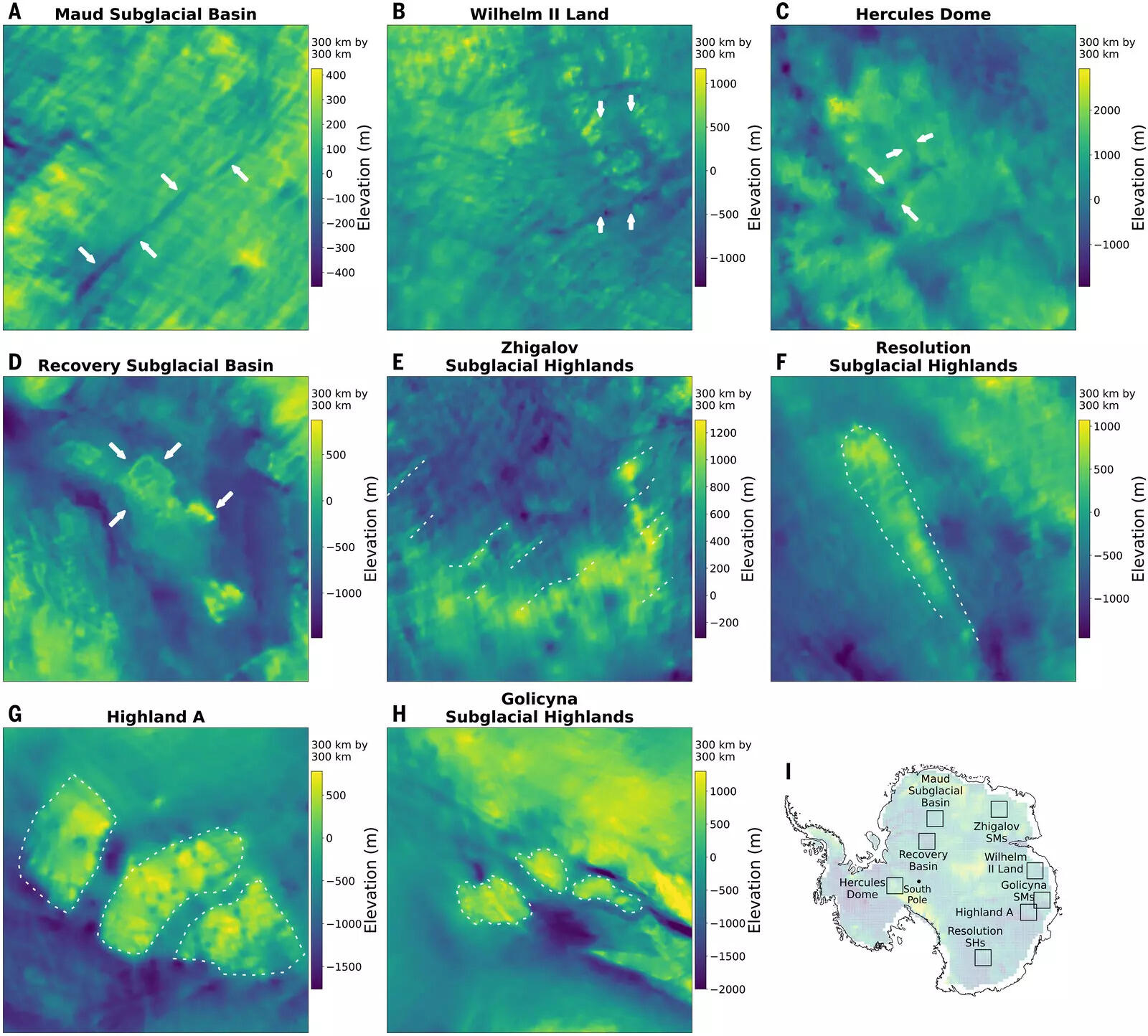
Selected examples of new IFPA subglacial topography.(A to C) Examples of channels incised into the subglacial substrate; (D and E) improved definition of subglacial topographic lineations likely related to tectonics; and (F to H) newly defined topography in subglacial highlands. Note that the panels vary in size from 100 × 100 km to 300 × 300 km. (I) Panel locations. Key linear features are annotated with white arrows and area features are outlined with dotted white lines. See supplementary figures for examples shown alongside topography from BedMachine Antarctica v3 (13) and Bedmap3 (8), as follows: Maud Subglacial Basin (fig. S16.11), Hercules Dome (fig S13.5), Recovery Subglacial Basin (fig. S16.12), Zhigalov Subglacial Highlands (figs. S24.28 and S28.36), Resolution Subglacial Highlands (fig. S22.23), Highland A (fig.S26.32), Golicyna Subglacial Highlands (fig. S27.34).
The study shows that ice-covered landscapes aren’t blank spaces, they hold detailed clues about Earth’s geological history and how vast ice sheets behaved in the past. By “listening” to how the ice surface moves and bends, scientists can now see what lies hidden beneath layers that have been locked in place for millions of years.This matters because precisely quantifying how ice interacts with the land underneath helps scientists forecast future changes to ice sheets and oceans, which impact coastal cities and ecosystems worldwide.
How technology made the invisible Antarctica visible
The innovation behind this discovery is almost as remarkable as the landscape it revealed. By using satellite sensors to monitor tiny movements in the ice surface and combining them with thickness measurements from previous field surveys, the scientists turned the ice sheet itself into a giant “X-ray.” This allowed them to generate an unprecedented map of the hidden terrain beneath.As one researcher put it, the ice acts like a recording tape where when it bends and flows over undiscovered bumps and ridges, those patterns reveal something about the hidden shape below. With advanced physics models and modern computing power, scientists finally had the tools to decode this natural record.
Antarctica’s landscape is more complex than we imagined
Before this study, portions of Antarctica’s bedrock landscape were so poorly mapped that scientists sometimes knew more about the surface of Mars than the land under Antarctica’s ice. Now, thanks to IFPA and global satellite datasets, that is changing fast. The new map reveals geological features hidden for eons, features that may hold clues about Earth’s past climates, how continents shifted over time and how current ice dynamics will play out in a warming world.
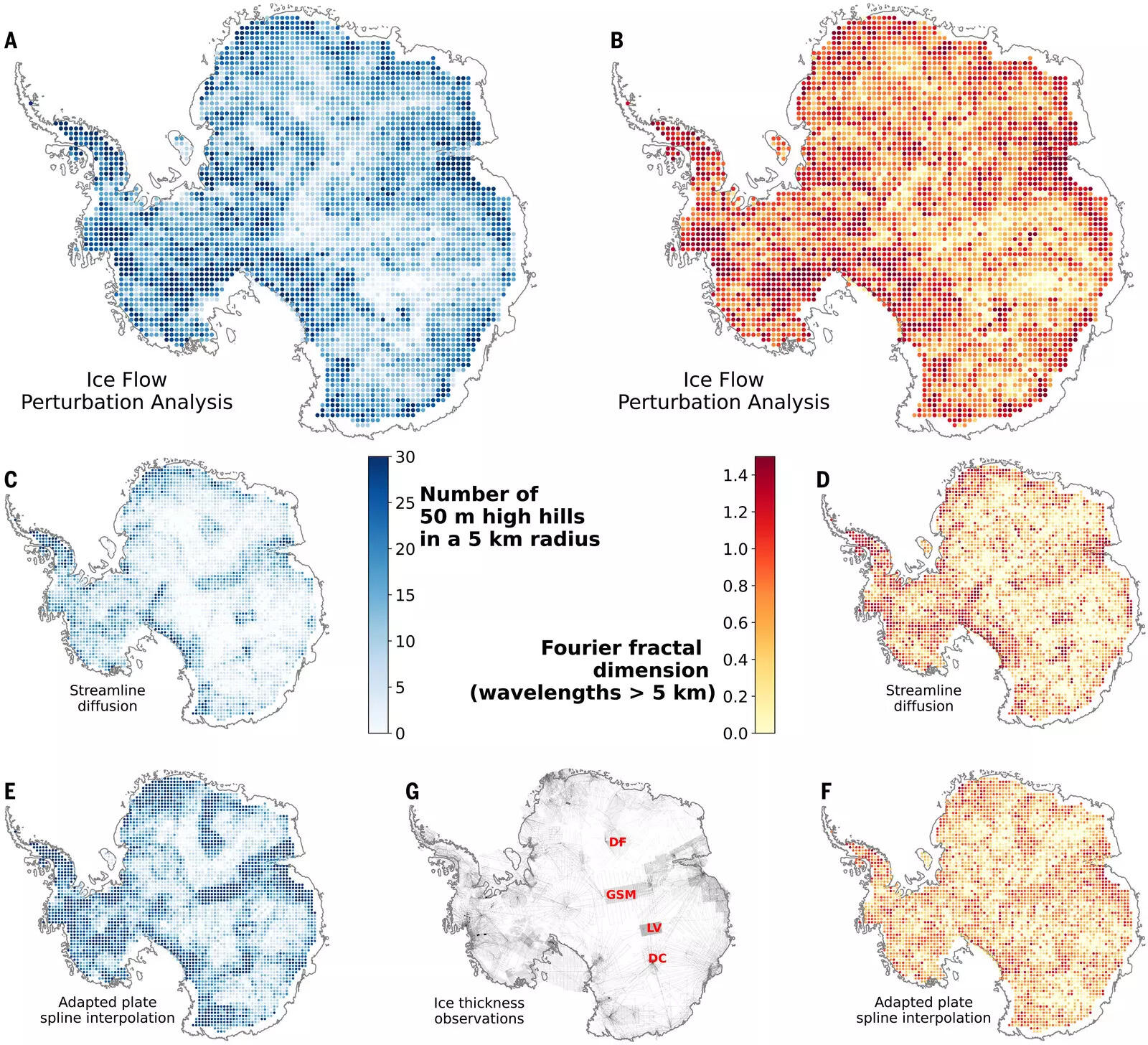
(A, C, and E) Number of 50-m hills within a 5-km radius and (B, D, and F) Fourier fractal dimension for wavelengths >5 km (a proxy for subglacial landscape roughness), extracted from (A) and (B) IFPA topography, (C) and (D) topography interpolated between geophysically derived bed picks using streamline diffusion (BedMachine Antarctica v3) (13), and (E) and (F) an adapted plate spline interpolation (Bedmap3) (7, 8). Each pixel represents a 50 km × 50 km region. (G) Locations of bed picks used to derive both interpolated topographies (From Bedmap3 thickness survey count) (8). The most densely surveyed regions of East Antarctica are annotated: DF, Dome Fuji; GSM, Gamburtsev Subglacial Mountains; LV, Lake Vostok; DC, Dome C. Note the significant correspondence between the spatial patterns in interpolated topographies (C) and (E) and geophysical survey locations (G). By contrast, (A) and (B) show that with IFPA we can now calculate subglacial landscape texture across Antarctica consistently, without major bias from geophysical survey locations.
As co-author Professor Mathieu Morlighem told Phys.org, understanding this landscape is “really important for ice-sheet models,” especially as governments and climate scientists seek ever-more accurate forecasts of ice melt and sea-level change.
Antarctica: A landscape worth exploring even if we can’t visit
The hidden world beneath Antarctica’s ice might never be a travel destination but it is now very much part of our global story. The rock beneath the ice holds clues not just about Earth’s geological past that were carved over millions of years but also its climate future. While tourists flock to glaciers in Iceland or fjords in Norway, this newly discovered Antarctic terrain reminds us that our planet’s most dramatic landscapes are often hidden, still waiting to be discovered.As scientists refine their maps and develop even sharper tools, we can expect even more revelations from beneath the ice. For anyone curious about climate change, Earth’s hidden history, or the way modern science connects the invisible and the impactful, this is a story worth following.
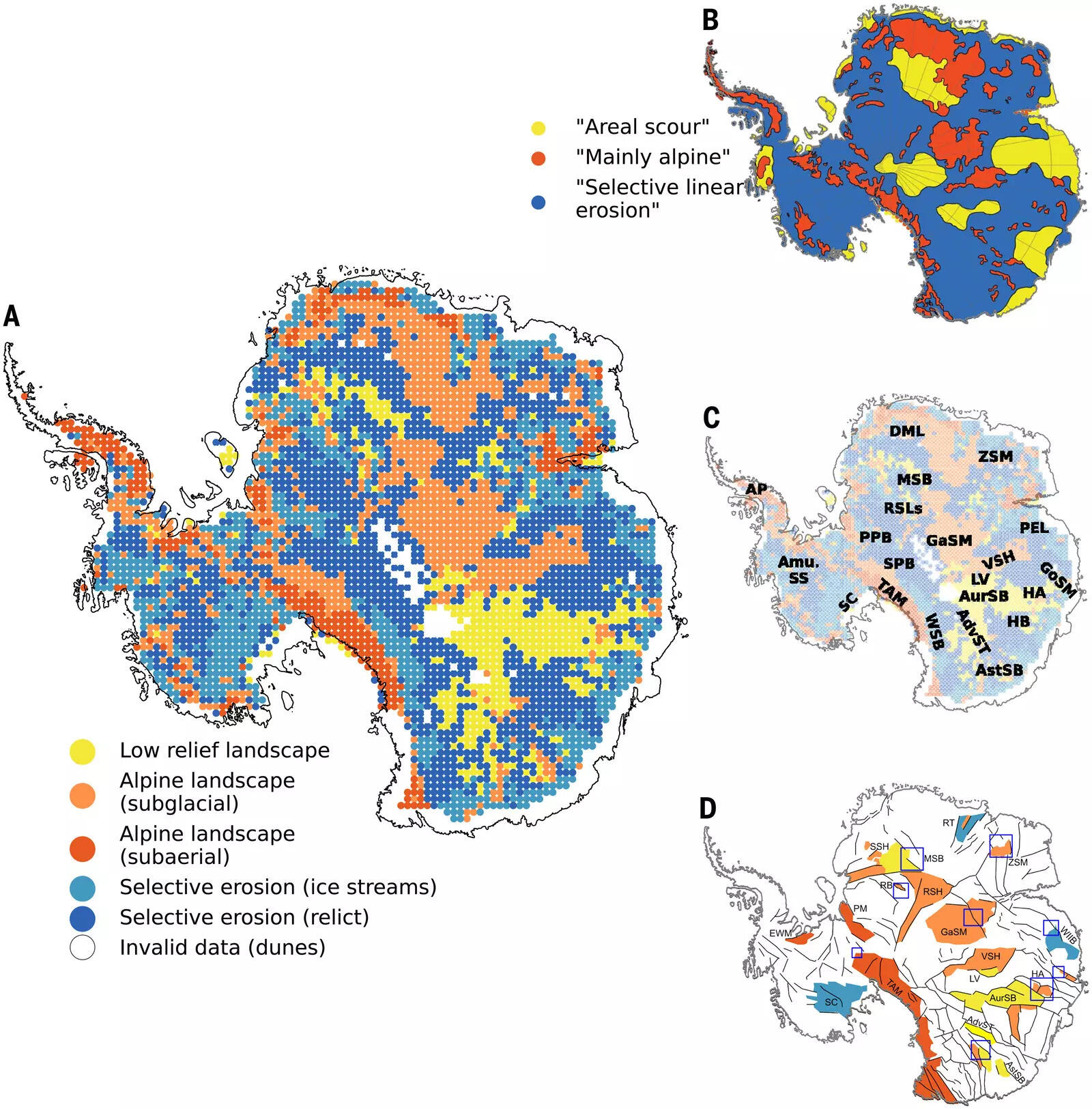
(A) Application to IFPA𝑚𝑒𝑠𝑜 subglacial topography. (B) Previous classification applied in 2013 to interpolated bed topography (Bedmap2) (60), adapted from Jamieson et al. (42). In each panel the classification shows regions of low-relief, alpine (both fully submerged–subglacial and partially submerged–subaerial) and selectively eroded landscapes. (C) Locations discussed in text. (D) Locations of tectonic boundaries across Antarctica, adapted from (34). We have colored some examples of regions where the geological structure mirrors the tectonic structures that we see. Adv. ST, Adventure Subglacial Trench; Amu. SS, Amundsen Sea Sector; AP, Antarctic Peninsula; Ast SB, Astrolabe Subglacial Basin; Aur SB, Aurora Subglacial Basin; DML, Dronning Maud Land; EWM, Ellsworth Mountains; GaSM, Gamburtsev Subglacial Mountains; GoSM, Golicyna Subglacial Mountains; HA, Highland A; HB, Highland B; LV, Lake Vostok; MSB, Maud Subglacial Basin; PEL, Princess Elizabeth Land; PM, Paxutent Mountains; PPB, Pensacola-Pole Basin; RT, Ragnhild Trough; RSH, Recovery Subglacial Highlands; RSLs, Recovery Subglacial Lakes; SC, Siple Coast; SPB, South Pole Basin; WIIB, Wilhelm II Basin; WSB, Wilkes Subglacial Basin; ZSM, Zhigalov Subglacial Mountains.
What was once thought to be a monotonous ice sheet is now revealed as a continent with deep valleys, jagged hills and geological complexity rivalling temperate landscapes. While this hidden terrain is unlikely to become a travel destination anytime soon, the knowledge it provides has implications for climate science, Earth history and our understanding of one of the planet’s final frontiers.The Science study’s revelations are a powerful reminder that Earth still holds secrets, even under kilometres of ice and that modern technology can help us uncover them with profound implications for the future.
Discover more from stock updates now
Subscribe to get the latest posts sent to your email.