




Rupee jumps 122 paise to close at 90.27 against the dollar on India-U.S. trade deal

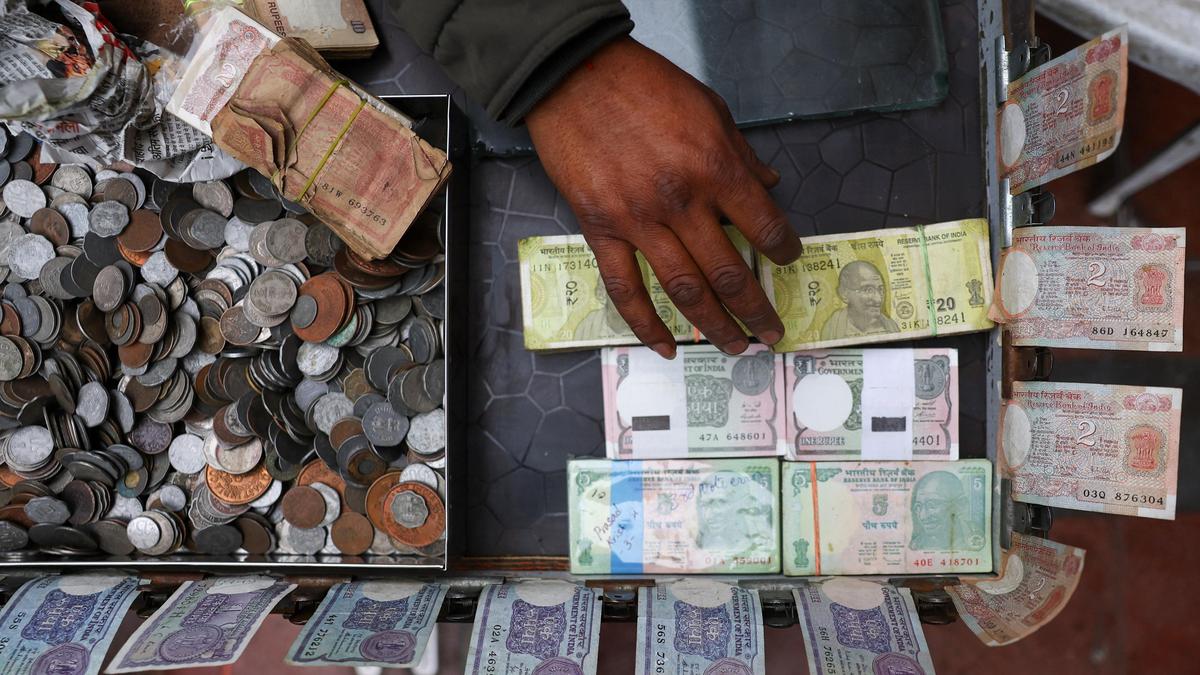
Image for representational purposes only.
| Photo Credit: Reuters
Forex traders said the Indian rupee rose to the highest levels in two and a half weeks and rallied by around 1.5% on the trade deal between India and the U.S.
Domestic indices also surged by around 2.75%, boosting domestic market sentiments. Further, weakness in crude oil prices and expected foreign inflows also favoured investor sentiment.
India and the U.S. agreed on a trade deal under which Washington will bring down the reciprocal tariff on Indian goods to 18%, lower than that for countries like China, Bangladesh and Vietnam.


At the interbank foreign exchange market, the rupee opened at 90.30 against the U.S. dollar, then gained some ground to touch an intraday high of 90.05 and a low of 90.52 against the greenback.
At the end of the trading session on Tuesday, the rupee was quoted at 90.27 (provisional) against the greenback, registering a gain of 122 paise from its previous close.
The rupee gained 44 paise to close at 91.49 against the U.S. dollar on Monday (February 2, 2026), a day after the Union Budget 2026-27 was presented.
Prime Minister Narendra Modi on Tuesday (February 4, 2026) said the India-U.S. trade deal is a “big decision” that will benefit everyone in the country, and asserted that his government always works in favour of the nation.

Forex traders said the India-U.S. trade deal will reopen the door for FII participation, and if capital flows recover in CY26, it would ease some pressure on the rupee.
“With the “reciprocal” tariffs on India’s exports to the U.S. now lowered, we estimate the current account deficit to narrow by around 0.25 per cent of GDP in CY26 to 0.8% of GDP. In addition, if capital flows recover in CY26 on the conclusion of the India-US trade deal, which would ease some pressure on the INR, and result in downside risk to our current USD/INR 12-month forecast of 94,” Goldman Sachs said in a research note.
However, things may not be completely smooth sailing for the INR, some experts believe.
“There could be hiccups along the way with this trade agreement – for example, it may not be easy for India to divert its Russian oil purchases quickly.
“The RBI’s FX policy could also complicate things. The RBI has been intervening in a rather unpredictable way over the past few months to prevent one-sided speculative positioning – both short and long – in the INR,” HSBC said in a research note, adding, “Our end-2026 forecast for USD-INR is 90”.
Meanwhile, the dollar index, which gauges the greenback’s strength against a basket of six currencies, was trading 0.05% lower at 97.57.
Brent crude, the global oil benchmark, was trading lower by 0.14% at ₹66.18 per barrel in futures trade.
On the domestic equity market front, the Sensex jumped 2,072.67 points to settle at 83,739.13, while the Nifty surged 639.15 points to 25,727.55.
Foreign Institutional Investors offloaded equities worth ₹1,832.46 crore on Monday (February 2, 2026), according to exchange data.
Published – February 03, 2026 05:02 pm IST
Discover more from stock updates now
Subscribe to get the latest posts sent to your email.