Rahul Akerkar on shaping India’s dining scene in his memoir Biting Off More Than I Can Chew

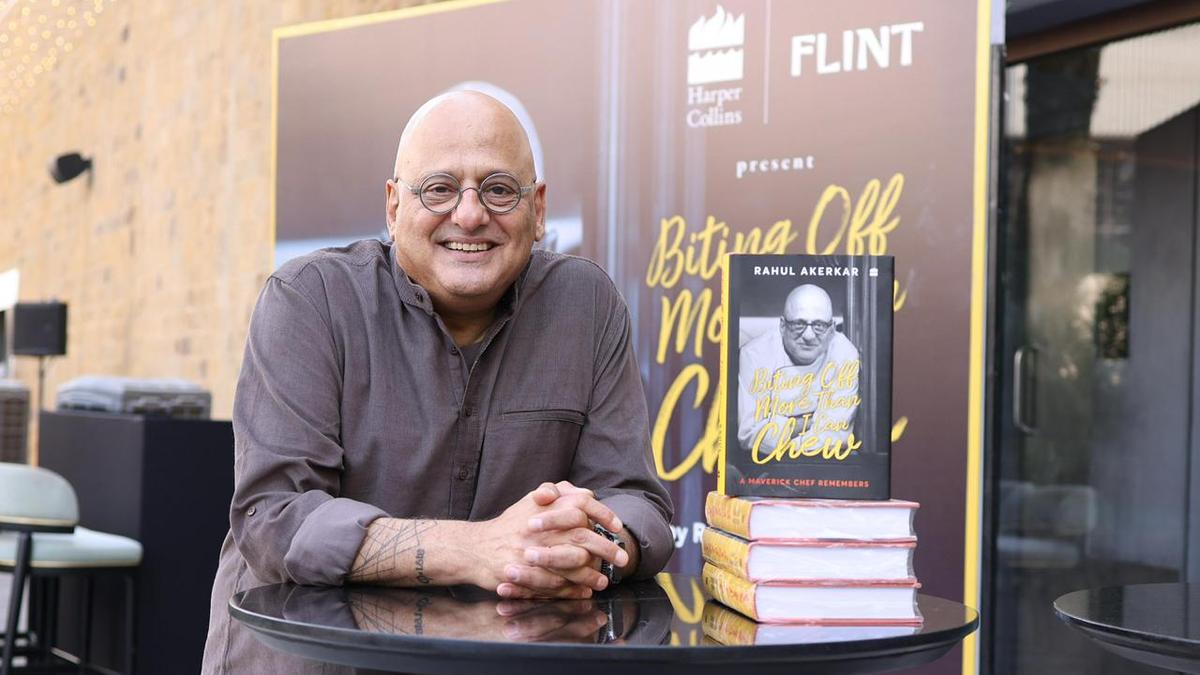
Chef Rahul Akerkar with his memoir Biting Off More Than I Can Chew
| Photo Credit: SPECIAL ARRANGEMENT
Long before he worked in New York’s professional kitchens and later transformed Mumbai’s dining scene with the modern European fine diner Indigo in 1999 in Colaba, his first lessons came from his grandmother’s kitchen in Nashik, where love meant feeding him one snack after another.

In the 1970s and the early ‘80s, when Rahul was in New York pursuing a degree in Biochemical Engineering he found himself in various professional kitchens, offering to work for free. “I would make a deal with the chef,” he recalls with a grin, “I’ll work for free for a month. If I’m good, pay me. If not, ask me to leave.” The chefs saw a free set of hands, and unbeknownst to him at the time, Rahul was building the foundation of a revolution. The young man would eventually return to India to open Indigo, a restaurant that did not just serve food — but one that also broke rules. He dared to trust that Indian diners were ready for something more than just the five-star hotel buffet or the local curry house.
In his unapologetically honest memoir, Biting Off More Than I Can Chew (published by Harper Collins), Rahul chronicles the wild ride from the launch of his first catering company from his mother’s kitchen and his first dining establishment, the multi-cuisine Under The Over, at Kemps Corner to the trailblazing Indigo, which featured on the list of the World’s 50 Best Restaurants in 2007, and the opening of other renowned eateries including Indigo Delicatessens, Neel, Qualia, Ode, Waarsa and his latest baby, Flint.
Having worked in New York kitchens and with no formal culinary training, it was not until he was really exposed to eating Indian food in Bombay that he started exploring that side of his roots and working with those flavours. “I didn’t overthink it, but I was very conscious about balance and how things came together on the plate. The reason I say that I don’t know if I westernised Indian or Indianised western, is because my cooking techniques were pretty much western — or let’s say non-Indian and non-Eastern. I stumbled upon the midpoint where the two culinary traditions merged,” he says.
His untimely departure from Indigo is well-documented, but as he reflects on its legacy, Rahul admits that at 67, there is a sense of been there, done that. “As much as I love what I do, there are days now where it’s like ‘oh, I’ve got to go to work’. I was a lot hungrier back then,” he admits candidly. Freshly returned from the US and operating in a Mumbai landscape devoid of “nuanced” standalone dining, his mind was a buzzing hive of idealism and untried ideas. And while a lot has changed since then in the culinary scene in India, some things remain the same — his self-professed ADHD and OCD, for instance, and his attention to detail. His North star continues to be deep respect for the palate of his patrons and never to take them for granted.
When asked what has truly forged his skills as a culinary leader, Rahul points not to his accolades or failures, but to his “struggles”. He likens the culinary craft to the arts, such as jazz or blues, which are born out of a certain degree of pain and persistence. “When you are enjoying success, you can get a little complacent. It is when you are struggling that you are constantly sweating the small things. You are more mindful and focussed,” he shares, leading him to his core philosophy that a reputation is never a permanent shield — “You’re only as good as your last meal,” he maintains.
Given a choice to do things all over again, would he still bite off more than he could chew? “Yes, I would, except that I would like to be a little more mindful about the business side of running restaurants,” he opines. While that may be so, let us not forget it was his refusal to play it safe that somewhat redefined a nation’s palate.
Published – April 07, 2026 07:00 am IST
Discover more from stock updates now
Subscribe to get the latest posts sent to your email.