



Nvidia’s Jensen Huang says markets ‘got it wrong’ on AI threat to software companies
Patrick T. Fallon | Afp | Getty Images
“I think the markets got it wrong,” Huang said, pushing back on fears that AI agents will cannibalize the enterprise software industry.

Instead, he expects a broad swath of software firms to use agentic AI to develop their software and boost efficiency, describing the move as “counterintuitive.”
“[Enterprises are] going to use agents to use those tools,” Huang told CNBC’s Becky Quick.
“What’s likely going to happen is that agents won’t replace the tools, but agents will use tools. The reason why we also say agents are tool users.”
He cited the internet browser and Microsoft‘s Excel as examples of tools that AI agents will use.
“All of these tools that we use today, whether it’s Cadence or Synopsis or ServiceNow or SAP, these tools exist for a fundamentally good reason. These agentic AI will be intelligent software that uses these tools on our behalf and help us be more productive,” Huang added.
“Nobody’s going to service better than ServiceNow, and they’re going to come up with agents that are really fine-tuned and optimized for the work that uses the tools that they have.”
“In the end, we need the tools to finish their work and put the information back in a way that we can understand,” he said.
Nvidia’s revenue for the fiscal fourth quarter climbed 73% to $68.13 billion from a year earlier, beating analysts’ estimates for $66.21 billion.
The company issued an upbeat guidance with revenue for the fiscal first quarter to be $78 billion, plus or minus 2%, well above analysts’ forecast for $72.6 billion.
Investors had grown weary that the massive run-up in spending on AI hardware might not be sustainable, stoking fears of a bubble building in the sector.
Shares of software service providers have taken a beating in recent weeks. While analysts have sounded the alarm that AI will “eat” software over the long term, views on that risk and the fundamentals behind the latest sell-off appeared divided.
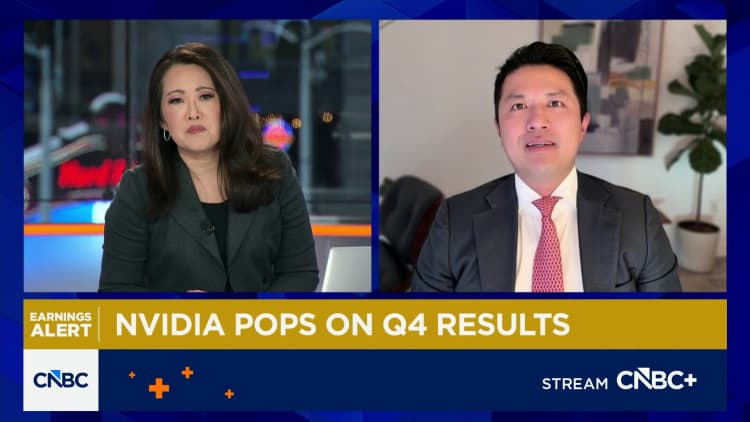
“People need to remember that all everything — whether it’s the railroads, canals, the internet, all of these things tend to get overbuilt — and then we figure out who the winners and losers are going to be,” Dan Niles, founder and portfolio manager of Niles Investment Management, told CNBC after Huang’s interview.
Niles warned that not all companies will emerge unscathed as AI threatens to automate workflows, squeeze prices, and lower barriers to new rivals entering the market.
“There’s some real companies that are going to go to zero in the software space,” Niles said. He added that the most resilient players will be in the database and cybersecurity sectors.
Nvidia shares rose as much as 2% in extended trading after the quarterly earnings report.

Discover more from stock updates now
Subscribe to get the latest posts sent to your email.