No, Tesla Isn’t Moving Away From the EV Market; in Fact, it’s Accelerating Hard Toward it
Key Points
It’s a misconception that Tesla (NASDAQ: TSLA) is moving away from electric vehicles (EVs), because all the evidence suggests the company intends to realize the vision once shared by other leading automakers. They are responding to events and a failed strategy, but Tesla is continuing on its long-held aspirations. Here’s why.
Tesla doubles down on EVs
One bear case for Tesla has it that the company is failing in its core EV market, and CEO Elon Musk is pushing robotaxis, and Optimus robots for that matter, to try and deflect from its declining EV sales, as it shifts away from an EV market it’s finding it increasingly difficult to compete with.
Where to invest $1,000 right now? Our analyst team just revealed what they believe are the 10 best stocks to buy right now, when you join Stock Advisor. See the stocks »
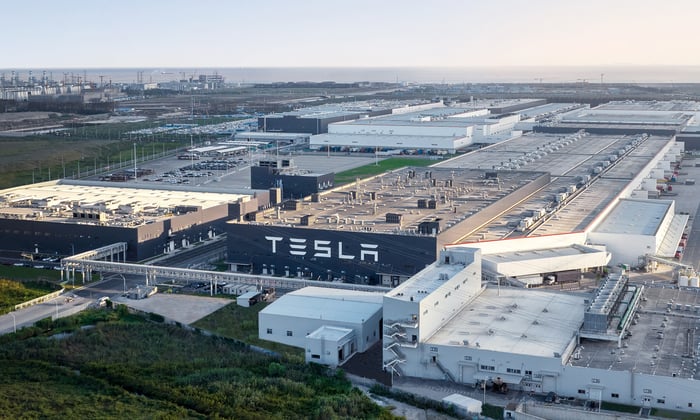
Image source: Tesla.

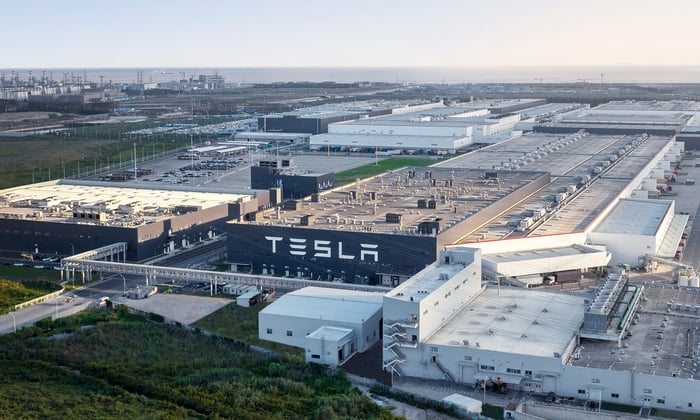
In reality, management has just committed to a mammoth $20 billion capital spending program, which includes investment in its lithium refinery in Corpus Christi, Texas, a lithium iron phosphate (LFP) battery factory in Sparks, Nevada, and the Gigafactory in Texas to begin Cybercab production. The lithium refinery will supply EV production, and the LFP factory could be used to supply LFP batteries for Cybercab and other Tesla EVs.
These are massive investments made to support Tesla’s vision of where the EV market is heading. But here’s the thing: It’s a vision that much of the rest of the industry once promised.
Automakers and robotaxis
In 2019, Ford’s CEO Jim Farley told investors to prepare for a “launch of a commercial self-driving service in 2021,” only to back off investing in it in 2022. Meanwhile, General Motors only abandoned its robotaxi development in late 2024.
There’s a reason automakers have thrown billions into developing a robotaxi: Simply put, the most cost-effective use of an EV is to leverage its lower per-mile cost advantage by running it more, and that’s even more cost-effective if it’s a robotaxi.
It’s not so much that Tesla is walking away from EVs, but more like the legacy automakers have been forced to walk away from robotaxis and are refining their EV strategy in response to weak sales performance. The reality is that the slew of EV models that hit the market, and helped cause multibillion-dollar writedowns ($19.5 billion at Ford, $6 billion at GM, and $27 billion at Stellantis) are a demonstration of the legacy automakers’ failures in the EV market. Only GM established a foothold in the U.S. EV market (about 13% share compared to Tesla’s 46% share). , but that could decline as it resets its EV strategy.
Image source: Tesla.
Where next for Tesla?
While legacy automakers are resetting their strategies to produce more targeted, lower-cost EV models, Tesla’s focus is fundamentally different. While it’s also introducing new, lower-cost variants of its Model Y and Model 3, while discontinuing its luxury Model S and Model X, the company’s main aim is to build out its robotaxi business, including Cybercab.
There’s no guarantee it will be successful, but the key point here is that Tesla’s strategy is consistent with its purpose and belief in the EV market, and also with the aims its peers sought but failed to achieve.
Don’t miss this second chance at a potentially lucrative opportunity
Ever feel like you missed the boat in buying the most successful stocks? Then you’ll want to hear this.
On rare occasions, our expert team of analysts issues a “Double Down” stock recommendation for companies that they think are about to pop. If you’re worried you’ve already missed your chance to invest, now is the best time to buy before it’s too late. And the numbers speak for themselves:
- Nvidia: if you invested $1,000 when we doubled down in 2009, you’d have $492,341!*
- Apple: if you invested $1,000 when we doubled down in 2008, you’d have $50,381!*
- Netflix: if you invested $1,000 when we doubled down in 2004, you’d have $424,262!*
Right now, we’re issuing “Double Down” alerts for three incredible companies, available when you join Stock Advisor, and there may not be another chance like this anytime soon.
*Stock Advisor returns as of February 22, 2026.
Lee Samaha has no position in any of the stocks mentioned. The Motley Fool has positions in and recommends Tesla. The Motley Fool recommends General Motors and Stellantis. The Motley Fool has a disclosure policy.
The views and opinions expressed herein are the views and opinions of the author and do not necessarily reflect those of Nasdaq, Inc.
Discover more from stock updates now
Subscribe to get the latest posts sent to your email.