



NASA’s Juno scan reveals what lies below frozen surface of Jupiter’s moon |
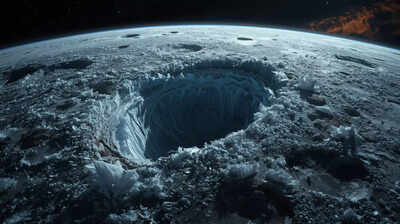
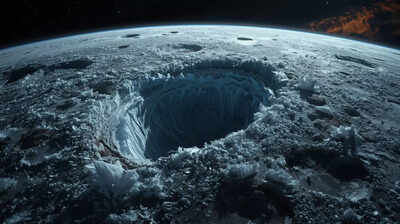
New measurements from NASA’s Juno spacecraft have offered a clearer picture of what lies beneath the frozen surface of Jupiter’s moon Europa. During a close flyby in 2022, Juno gathered microwave data that allowed scientists to probe the moon’s icy crust to depths never measured before. The analysis suggests the ice shell in the observed region is roughly 29 kilometres thick. For years, estimates ranged widely, from just a few kilometres to several tens of kilometres, with little agreement. This new work narrows that uncertainty. Europa has long drawn attention because evidence points to a salty ocean beneath its ice. Understanding the structure above the ocean matters. Ice thickness shapes how heat moves, how cracks form, and how material might travel between the surface and the sea. The findings were published in Nature Astronomy.
NASA finally gets a clearer view beneath Jupiter’s moon ’s icy shell
Europa is slightly smaller than Earth’s Moon, yet it has occupied planetary science for more than forty years. Early hints from the Galileo spacecraft suggested a conductive ocean hidden below the surface. Images showed fractured terrain, ridges, and regions where the ice looks disrupted. These features fuelled ideas about cracks and movement within the shell. But without knowing how thick the ice was, those ideas remained hard to test. Thin ice implies easy exchange. Thick ice suggests a quieter, more insulated world.
Juno used an instrument built for Jupiter

The breakthrough came from an instrument not designed with Europa in mind. Juno’s microwave radiometer was built to study Jupiter’s deep atmosphere. It measures thermal emissions at different frequencies, each probing a different depth. During the Europa flyby, the instrument captured signals from a few metres below the surface down to several kilometres. By comparing how brightness changed with frequency, scientists could infer temperature changes and reflections within the ice.
Ice appears thick but not uniform inside
The data fit best with a conductive ice shell around 29 kilometres thick, with an uncertainty of about 10 kilometres. That thickness applies to the region Juno observed, not necessarily the entire moon. The measurements also point to small-scale structures inside the ice. Cracks, pores, or other discontinuities appear to extend a few hundred metres below the surface. These features are small, likely centimetres in size, and do not penetrate deep enough to reach the ocean.
Cracks exist but may not carry nutrients far
For years, surface fractures raised hopes that material from the surface could reach the ocean below. Oxygen and other compounds might feed potential life. The new results temper that idea. While shallow scatterers are present, they seem limited in depth and volume. On their own, they are unlikely to act as long-lasting pathways between surface and sea. That does not rule out deeper fractures elsewhere, but it narrows what can be inferred from surface patterns alone.
Salty ice slightly changes the picture
The model assumes mostly pure water ice, but Europa’s ice is probably salty. When salinity is included, the estimated thickness drops by around five kilometres. That shift sits within the uncertainty range. It suggests that while chemistry matters, it does not overturn the broader conclusion. The shell remains thick enough to insulate the ocean, even if its upper layers are more complex than once thought.
The importance of ruling things out
One of the quiet strengths of the study is what it excludes. Very thin ice shells, once proposed to explain surface chaos, are harder to support with these measurements. At the same time, extremely thick shells with little internal structure also struggle to match the data. The result sits between extremes. It does not simplify Europa. It constrains it.
What this means for future missions
NASA’s upcoming Europa Clipper mission will focus directly on habitability. Knowing the likely thickness of the ice helps shape expectations. Instruments can be tuned. Models can be refined. The Juno flyby covered only part of the moon, but it provides a firm reference point. Europa remains layered, fractured, and cold. Its ocean is still hidden. The ice above it, now measured more carefully, looks less mysterious than before, but no less important.
Discover more from stock updates now
Subscribe to get the latest posts sent to your email.