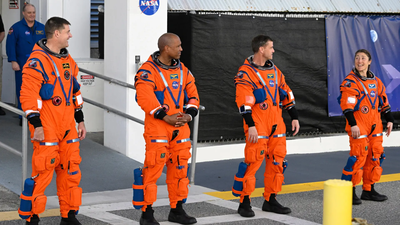



NASA’s Artemis II mission: Crew honours Jeremy Hansen with ‘astronaut gold pin’, an elite spaceflight award |


The Artemis II mission has achieved an historic milestone that heralds a new epoch, and a mark of tradition and accomplishment for Canada as well. A significant milestone along this great journey, as the Orion spacecraft transitions into its trans-lunar trajectory, Commander Reid Wiseman, with his fellow veteran crew members, honoured Mission Specialist Jeremy Hansen with the prestigious astronaut gold pin to symbolise that he is now an astronaut who has travelled to space. This honour makes Jeremy Hansen the first Canadian to officially earn the right to be considered an astronaut, as he was the first Canadian astronaut in history to be named to a crew that orbited the Moon. This accomplishment is both an individual achievement and a solid confirmation of the strength of international collaboration that has made human exploration of the Moon possible once again after fifty years, following the last human presence in deep space.
Artemis II crew honours Jeremy Hansen with a gold astronaut pin

The presentation of the gold astronaut pin to Jeremy Hansen occurred as the crew validated the Orion spacecraft’s life-support systems in high-Earth orbit. According to the Canadian Space Agency (CSA) and NASA, the gold pin is a ‘transition of status’ from a silver-pin candidate to a space-faring veteran. Jeremy Hansen has been a fighter pilot (CF-18) for 18 years, so he is now officially part of Canada’s first deep space mission.
Astronauts are testing Orion’s life support in high radiation
As the Artemis II mission continues to travel toward the Moon, the astronauts are performing critical evaluations of the Environmental Control and Life Support System (ECLSS) onboard. The Artemis II Technical Report describes this mission as the first time humans will operate ECLSS in a deep-space radiation environment.Throughout this mission, the astronauts will be measuring carbon dioxide scrubbed, positive pressure, and oxygen pressure to make sure they can sustain 4 astronauts during the lunar flyby, and collecting important information that will enable astronauts to spend long periods of time on the Lunar Gateway.
Artemis 2 is shattering the Apollo 13 distance record
As the mission progresses, the crew will break the previous distance record set by Apollo 13 by flying over 10,400 kilometres (6,400 miles) behind the Moon. At 400,000 kilometres from Earth- the distance they will be from Earth at this stage of the mission- the crew will have travelled farther than any human has ever travelled from Earth. One of the challenges in this phase of the mission is to test the communications and navigation systems onboard Orion for deep-space operations, while providing Mission Control in Houston with a high-bandwidth telemetry uplink with the crew, even at extreme distances from the Moon.
How the Artemis Accords built a global crew
The awarding of the pin on a NASA mission to a Canadian citizen is a direct result of the Artemis Accords. In return for Canada providing the next-generation robotic Canadarm3 for the Lunar Gateway, NASA agreed to fly Canadian astronauts on its missions for the next 10 to 15 years. This is a reflection of the change from the single-country model for lunar exploration that existed in the 1960s to a model based on collaboration and sustainability for long-term human presence on the Moon, and future missions to Mars.
Discover more from stock updates now
Subscribe to get the latest posts sent to your email.