NASA solves a 2,000-year-old supernova mystery hidden inside a massive cosmic bubble |
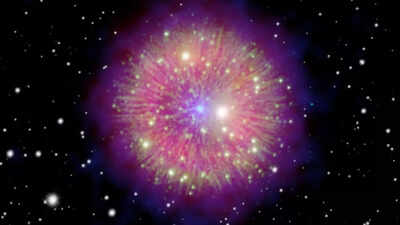
The ‘guest star’ of 185 AD has been one of astronomy’s most unresolved cases for over 1800 years. Ancient Chinese chroniclers recorded a mysterious light that lasted eight months, but an examination of the debris field created (RCW 86) has shown that the debris remains too substantial in size compared to the time elapsed. However, a recently released research piece utilising NASA‘s Chandra X-ray Observatory has finally unveiled the mystery: the explosion of the star occurred inside a low-density ‘hidden bubble,’ created by the star’s own stellar wind.Since there was no remaining gas to stop the explosion, the material moved out rapidly from the explosion’s centre, resulting in extensive expansion of the material from the explosion. When the material finally reached the edge of the hidden bubble, the shock wave from the original explosion ‘bounced back’ into the centre of the hidden bubble, and subsequently re-heated the gas that had been ejected from the star and revealed the hidden physics behind the cosmic rebound of a 2000-year-old star.
The 2,000-year-old ‘guest star’ mystery from 185 AD has finally been explained

For nearly twenty centuries, this mystery remained a ‘cold case’ until NASA’s X-ray vision unmasked the truth. In 185 AD, astronomers in China documented an unexplained star that appeared (and then disappeared) for 8 months in the sky. This event will now be known as the first recorded supernova in history.When telescopes discovered the remnant of this supernova (RCW 86), the debris was found to be 85 light-years wide! Scientists were confused- how could a star explode just 2,000 years ago, but now be so large (the size of the debris field made it seem much older than it actually is – approximately 10,000 years old).
Why this supernova broke the size records
The supernova was much larger than expected because the surrounding area where the star existed before the explosion was much more conducive to a larger expanding supernova event.The windblown cavity: Before the star died, the star acted as a giant leaf blower, prior to exploding and blowing away most of the surrounding gas and dust, creating a large empty bubble of low-density space in which to explode.Zero resistance: The total speed (and therefore the total size) of the exploded material would be significantly greater than that of a typical supernova because of the near-zero resistance after explosion of the material, which would be travelling at speeds in excess of 10 million kilometres/hour through the space created by the star itself before the explosion.
The ‘bounce back’ effect
This is the most exciting discovery in 2026, which has an extremely exciting characteristic- it is hitting a ‘wall’ and bouncing back into itself!The rapidly moving debris from the explosion eventually impacts the ‘bubble’ at the point when the gases inside are once again dense with gas. Similar to how water behaves when hitting a cliff, a ‘reverse shock wave’ was created by the explosion pushing back toward the centre.This newly created ‘bounce’ then heated the very cold gas inside the ‘bubble’ to several million degrees and caused the gas to emit X-rays. It was because of this ‘bounce’ that NASA’s Chandra telescope was able to detect this hidden ‘bubble’- it saw X-rays emitted from the thermal gas at millions of degrees being produced by the impact.
Why this supernova matters
The discovery not only gives us a single snapshot into one supernova, but it also helps us determine the overall structure of the Universe.The Type Ia Supernova is an excellent tool to use for determining distances of galaxies, as astronomers have determined the absolute brightness of this particular type of supernova.By observing how the explosion shape was altered by its surrounding environment, astronomers can better calibrate these stars as ‘standard candles’- cosmic rulers used to measure the expansion of space. This precision is key to solving the mystery of dark energy, the force pushing our universe apart.
Discover more from stock updates now
Subscribe to get the latest posts sent to your email.