Iran war-induced fertilizer shortage threatens farm state Republicans
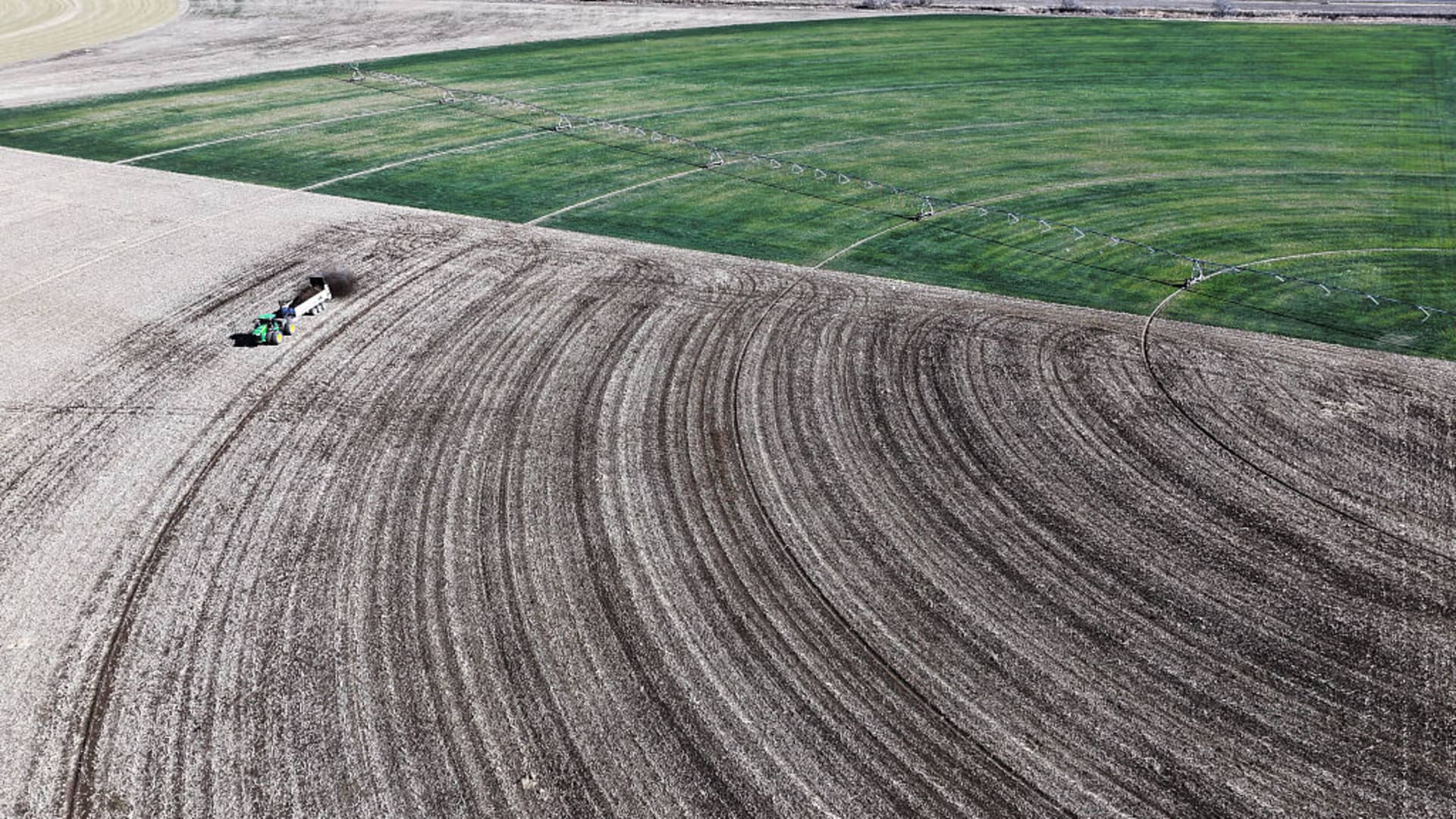
RJ Sangosti | The Denver Post Via Getty Images | Denver Post | Getty Images
Now, Democrats trying to win the U.S. midterm elections in November see another new opportunity to pound the affordability crisis and turn the tide after years of losses in the states that produce crops and livestock.
The Strait of Hormuz is a critical channel for fertilizer, including about 50% of global nitrogen-rich urea fertilizers, according to the Fertilizer Institute, the industry’s trade association. The strait has been effectively impassable since President Donald Trump launched the assault, which is now in its third week with no end in sight.
The closure has spiked fertilizer prices just before planting season, potentially scrambling decision-making for farmers across the U.S. And it comes on top of already low commodity prices that have lingered for years and eaten into farmers’ margins.
“We’re in uncharted territory,” Matt Frostic, a Michigan farmer who sits on the board of the National Corn Growers Association, said in an interview with CNBC. “It’s like a code red.”

Frostic said he purchased nitrogen fertilizer, critical for corn crops, in January for around $350 per ton. That same product, he said, is now closing in on $600 per ton.
The murky farm outlook also comes eight months before the midterm elections that could cost Trump control of both the House of Representatives and the Senate. Democrats, who are trying to win competitive seats in farm-heavy states such as Iowa, Minnesota and Nebraska, are jumping on the high fertilizer prices as a new example of the affordability issue that continues to haunt Trump and Republicans.
“There are tons of people just like me in our district who are like, I don’t get it. I don’t understand. It was already hard, and now they’re making it harder, and nobody knows why,” said Jake Johnson, a public school teacher who is running for Congress in Minnesota’s first District against incumbent Republican Rep. Brad Finstad.
“Our number one job as a campaign and what we want to talk about to every single person we talk to is we need ways to make things cheaper,” Johnson said.
The rural entreaties from Democrats come after years of bleeding support in the country’s rural, agrarian states in the middle of the country. Trump in 2024 won nearly every state in the Midwest, with exceptions in Minnesota and Illinois. He also dominated the county-by-county contest, according to the Center for Politics, winning 2,660 counties compared with former Vice President Kamala Harris’ 451, which were centered in the most populated parts of the U.S.
Democrats want to win rural America
Turning the tide in rural America has been a longtime goal for Democrats, but has often proved elusive. In Iowa in 2018, Democrats won 3 out of the 4 congressional seats in the state. Now, Republicans control all four. But with Trump’s economic approval plummeting and Democrats leading in the generic ballot, Democrats have high hopes this year.
Johnson said farmers in particular are recoiling from Trump’s tariff campaign, which saw his White House authorize a roughly $12 billion bailout last year. The war now adds a new inflationary wrinkle.
“A vote for me is a vote to end tariffs, and it’s a vote to end the war,” he said. “We do have to start by undoing the obvious damage that the status quo has foisted upon us.”
Republican presidential candidate and former U.S. President Donald Trump takes the stage during his Iowa caucus night watch party in Des Moines, Iowa, U.S., January 15, 2024.
Evelyn Hockstein | Reuters
Republicans, meanwhile, are scrambling to push even more aid to farmers just months after last year’s infusion. An additional farmer bailout, estimated at around $15 billion, was being discussed before the war broke out to address low crop prices — and lawmakers are now seeking to attach it to a potential Iran supplemental spending bill. The White House is floating a $200 billion spending request for the war.
“Clearly there’s going to be a supplemental for the conflict in Iran,” Sen. John Hoeven, R-N.D., who leads the Senate Appropriations subcommittee responsible for funding the Agriculture Department, said in an interview.
To get approval for such a package in the Senate, Hoeven said he expects more than war spending will need to be included. He pointed to disaster assistance that Democrats want and aid for farmers as likely add-ons.
Finding a fertilizer price solution
Sen. John Boozman, R-Ark., the Senate Agriculture Committee chair, said he’s working with the administration to quickly find a solution to the fertilizer issue.
“The good news is everybody understands what a problem this is for our farmers,” Boozman said in an interview. “Because of that, everything’s on the table. We’re looking at all the options that are available, and hopefully we’ll decide on a plan soon.”
Boozman did not detail what those plans would be. His counterpart in the House, Rep. G.T. Thompson, R-Ark., said Trump is “aggressively” trying to work on getting the Strait of Hormuz back open.
Thompson noted Trump’s efforts to court “other countries in order to make those transport ships and tankers be able to pass safely during that narrow strip.”
He also said any tariffs on fertilizer should be removed ahead of planting season.
“We really shouldn’t have tariffs on fertilizer or any of the components,” he said.
Treasury Secretary Scott Bessent on Fox Business Thursday said Agriculture Secretary Brooke Rollins “will likely be making an announcement on fertilizer in the next few days.”
Bessent noted the Trump tariffs largely exempt nitrogen-based fertilizer, which is critical to growing corn.
But opening the strait to allow fertilizer to flow is a tall order for the administration, despite efforts to free trapped cargo ships. And the risks for U.S. farmers and food consumers continue to rise.
“Without strategically prioritizing the delivery of critical farm inputs such as urea, ammonia, nitrogen, phosphate, and sulfur-based products, the U.S. risks a shortfall in crops,” American Farm Bureau Federation President Zippy Duvall said in a recent letter to Trump. “Not only is this a threat to our food security — and by extension our national security — such a production shock could contribute to inflationary pressures across the U.S. economy.”
Agriculture price shocks similar to 2022
Joe Glauber, a former chief economist at the Agriculture Department under the Obama administration and a research fellow emeritus at the International Food Policy Research Institute, said the shock is similar to when Russia invaded Ukraine — but noted that the accompanying commodity price spikes are now missing.
“We hit record levels in 2022,” Glauber said. “But the other thing that was really high in 2022 were grain prices, and so farmers, even though they were paying really high fertilizer costs, they were able to more or less get by because they were getting good returns from what they were selling.”
Glauber said farmers are right to be worried if they’re only considering their balance sheet — what they grow and what they sell. But he noted the influx in government payments to farmers, like the one being considered now in Congress, has been huge in recent years.
“It’s a different story if you include government payments,” Glauber said. “And there’s just been a ton of government payments.”
Frostic, the Michigan farmer, said he’s aiming for Congress to pass a “consumer choice” bill that would allow drivers to buy ethanol gasoline, known as E15, year-round. Ethanol is typically priced cheaper than regular gasoline, and the bill would potentially lift commodity prices by giving farmers a new market to sell into.
And Frostic, while saying he was grateful for government payments, said the bailout may fall short and that he’d rather make money by selling his crop.
“I would rather sell my products and make money than have the government write me a check to make me whole,” he said. “It distorts the market too much, it can kind of pick winners and losers, and typically when we get checks like that, it’s a pass-through.”
Discover more from stock updates now
Subscribe to get the latest posts sent to your email.