


India-U.S. trade deal will not include sensitive agricultural items and dairy: Goyal
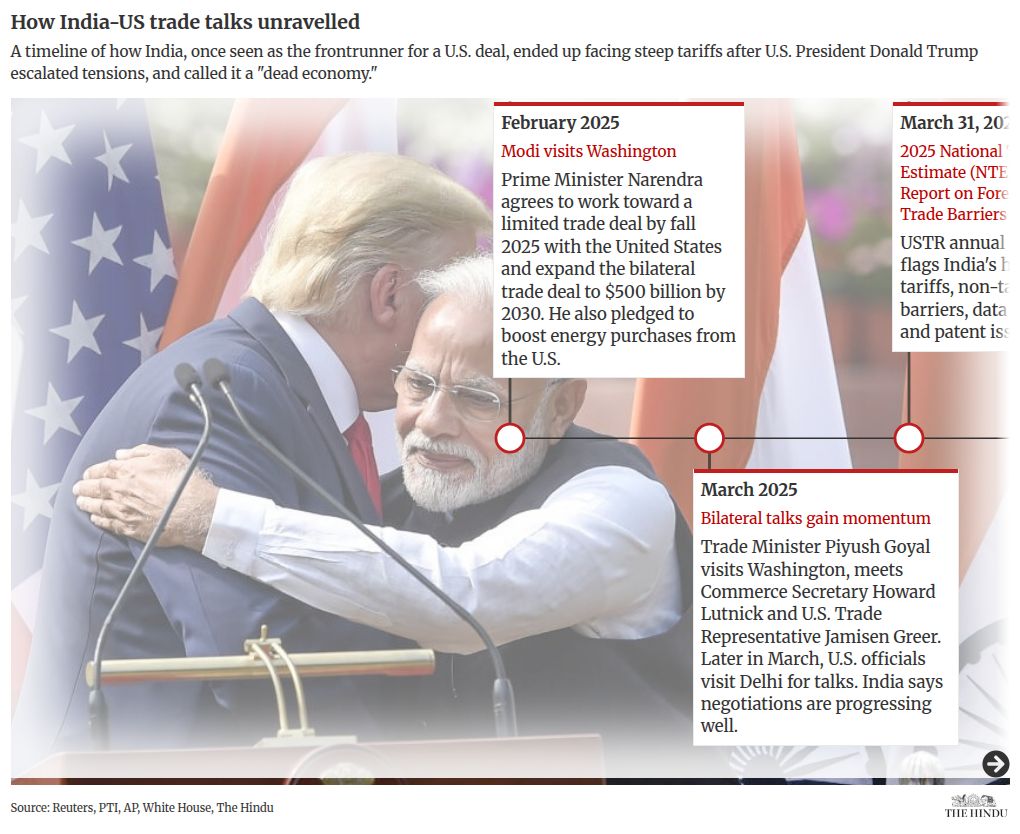
Under the deal, the U.S. has agreed to lower its 25% ‘reciprocal’ tariffs on India to 18% and entirely remove the additional ‘penalty’ tariffs of 25% it had imposed on India for its import of Russian oil.
“Best deal”
“The trade deal finalised by India with the U.S. is the best among India’s neighbours and its competitors,” Mr. Goyal asserted while speaking at a press briefing. “PM Modi has always protected the agriculture and dairy sectors and has never compromised on their interests. In the U.S. trade deal as well, India’s sensitive sectors of agriculture and dairy have been excluded,” he said.

Beyond this, Mr. Goyal did not specify any other details of what India had conceded to the U.S. Nor did he address Mr. Trump’s claims that India would stop buying Russian oil, increase oil purchases from Venezuela, and increase overall purchases from the U.S.

Blame on Opposition
He also attacked Lok Sabha Opposition Leader Rahul Gandhi, the Congress, and its allies, saying it was because of their actions in Parliament on Monday (February 3, 2026) that he was conveying the information on the trade deal via a press conference and not on the floor of the House.
“Ordinarily, we would have wanted to speak in Parliament about this,” he said. “But, as you all saw, the way the Opposition, especially the Rahul Gandhi-led Congress party and their allies, the DMK, the Trinamool Congress, and the SP, behaved in Parliament, reaching the Speaker’s dias and insulting him, we have had to speak before you outside the House.”
Also read: On mute: On the U.S., geopolitical turmoil, India’s response
Final stages being worked on
Mr. Goyal said that the deal was in the “final stages of detailing” between the negotiating teams of the two countries.
“As soon as the final understanding of the deal is inked, the joint statement is finalised, and technical processes are completed, full details will be shared,” the Minister said.
Impact of tariffs
In a rare public admission, Mr.Goyal acknowledged the impact of the U.S. tariffs on several sectors.

“Our farmers and exporters were all affected by the 50% tariffs,” he said, adding, “Our marine exporters were facing difficulties. The textile sector had also been facing the need for reduced tariffs. This is a deal that will protect the interests of every Indian and provide huge opportunities for all the people of India, and will protect the sensitive sectors, including agriculture and dairy.” Mr. Goyal said, “It will open up huge opportunities for our labour-intensive export sectors such as textiles, apparel, plastics, home decor, leather and footwear, gems and jewellery, organic chemicals, rubber goods, machinery, and aircraft components.”
Trump’s assertions
Mr. Goyal also sought to address questions from the Opposition as to why the deal was first announced by Mr. Trump. “The reciprocal tariff was set by the U.S., and they were the ones who had to reduce tariffs, so when they did reduce it to 18%, that news would obviously come from the U.S,” he explained.
In his post on Truth Social, Mr. Trump also made several assertions about what Mr. Modi had allegedly agreed to on India’s behalf. One of these was that India would buy “over $500 billion dollars [sic] worth of U.S. energy, technology, agricultural, coal, and many other products”.
According to sources in the Indian Government, the $500 billion worth of purchases is to be spread over five years from when the deal comes into effect, and is a sign of “India’s intent to import” equipment for data centres, increase civil nuclear cooperation, and increase the imports of advanced AI chips.
Published – February 03, 2026 09:09 pm IST
Discover more from stock updates now
Subscribe to get the latest posts sent to your email.