



H-1B Visa 2027: USCIS opens March registration window with new rules; deadline March 19 |


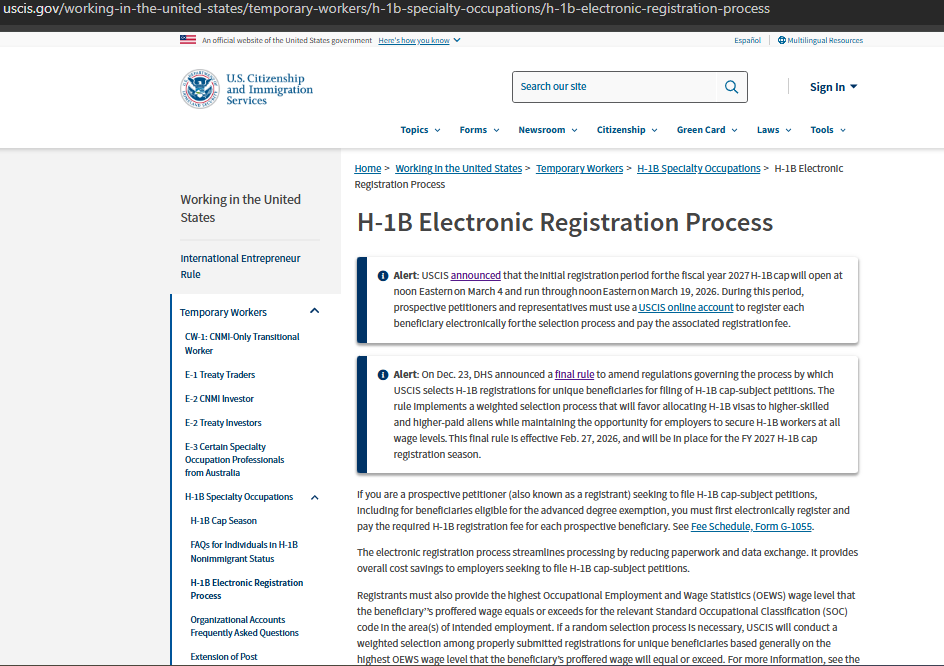
The US Department of Homeland Security earlier introduced a new rule changing how H-1B visa program registrations are selected, introducing a weighted system that prioritises higher-skilled and higher-paid applicants. The rule, announced on December 23, amends existing regulations governing the selection process used by US Citizenship and Immigration Services (USCIS) for H-1B cap-subject petitions. It officially took effect on February 27, 2026, and will apply to the Fiscal Year 2027 H-1B cap registration season.
New weighted selection process

Under the new regulation, USCIS will implement a weighted selection system instead of relying entirely on a random lottery when choosing H-1B registrations. The new approach gives preference to higher wage levels, meaning applicants offered higher salaries will have greater chances of being selected. The aim is to favour highly skilled workers while still maintaining opportunities for employers to hire H-1B workers across different wage levels. Employers registering H-1B candidates will now need to provide the highest Occupational Employment and Wage Statistics (OEWS) wage level that the worker’s offered salary meets or exceeds for the relevant Standard Occupational Classification (SOC) code in the intended area of employment. If USCIS determines that the number of registrations exceeds the annual cap and a selection process is required, the agency will conduct a weighted selection based primarily on the wage level associated with the job offer.Read more: Thailand waives overstay fines for travellers hit by Middle East flight disruptions
Electronic registration requirement
As in previous years, employers must first complete an electronic registration process before filing an H-1B cap-subject petition. Prospective petitioners, also known as registrants, must submit an online registration through their USCIS account for each beneficiary and pay the required $215 registration fee per candidate.Only employers whose registrations are selected during the process will be allowed to submit full H-1B petitions for the beneficiaries they registered. This electronic registration process has been initiated to simplify the process, minimize paperwork, and decrease costs for employers that wish to recruit foreign workers.

FY 2027 H-1B registration period
The registration period for the FY 2027 H-1B cap season will commence from 12:00 pm Eastern Time on March 4, 2026, and continue until 12:00 pm Eastern Time on March 19, 2026. During this period, the employers and representatives are required to register the beneficiaries and pay the required fee. USCIS has clarified that there is no need to submit the registration on the first day, as the selection process will commence only after the registration period ends.The selection process starts once the initial registration period is over. If a beneficiary is selected, each registrant who submitted a registration for that individual will receive a selection notice and will be eligible to file an H-1B cap-subject petition on their behalf.Read more: Etihad suspends Abu Dhabi flights until March 6 amid regional airspace closures
Decline in Registrations for FY 2026
Data released by the USCIS shows that the number of H-1B registrations for the FY 2026 cap season has declined compared to the previous year. Approximately 57,600 unique employers submitted registrations for FY 2026, slightly higher than the roughly 52,700 employers in FY 2025. However, the number of eligible unique beneficiaries fell sharply to about 339,000, compared to around 442,000 in FY 2025. Likewise, the total number of eligible registrations was reduced to 343,981, from the previous year’s total of 470,342, showing a reduction of 26.9 percent. There was, reportedly, an average of 1.01 registrations per beneficiary this year for FY 2026, which was around 1.06 for FY 2025. This means, on an average, each beneficiary only had approximately one registration submitted on their behalf. The changes in the selection process are likely to continue the evolution of the H-1B system by placing more emphasis on wages, with the same cap and registration process.
Discover more from stock updates now
Subscribe to get the latest posts sent to your email.