Global economy shows signs of steady but subdued growth
The report noted that a sharp increase in United States tariffs “created new trade frictions, though the absence of broader escalation helped limit immediate disruptions to international commerce.”
Risks remain high
Unexpected resilience to the tariffs shock, supported by solid consumer spending and easing inflation, helped sustain growth but underlying weaknesses persist.
Subdued investment and limited fiscal space are weighing on economic activity, meaning that the world economy could settle into a persistently slower growth path than in the pre-pandemic era.
A partial easing of trade tensions has helped limit disruptions to international commerce but the impact of higher tariffs, coupled with elevated macroeconomic uncertainties, is expected to become more evident this year.
The report noted that financial conditions have eased amid monetary loosening and improved consumer sentiment, but risks remain high, given elevated asset valuations especially in sectors linked to rapid advances in artificial intelligence (AI).

Uncertainty and vulnerabilities
Meanwhile, high debt levels and borrowing costs are constraining policy space, particularly for many developing economies.
“A combination of economic, geopolitical and technological tensions is reshaping the global landscape, generating new economic uncertainty and social vulnerabilities,” said UN Secretary-General António Guterres.
He warned, however, that “many developing economies continue to struggle” which is putting progress towards achieving the Sustainable Development Goals (SDGs) at risk.
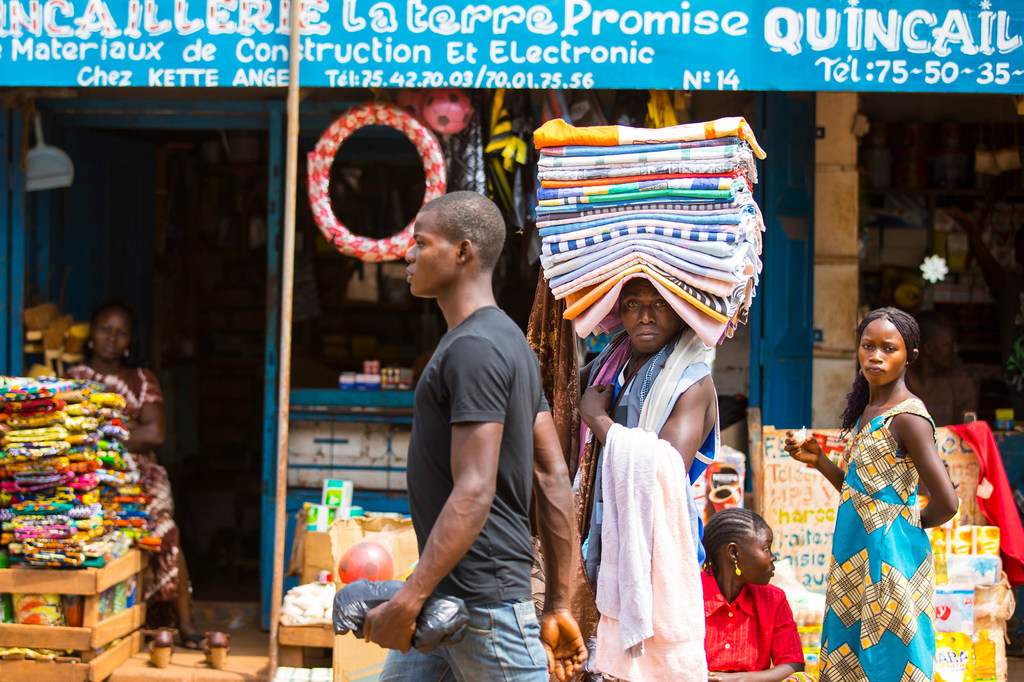
A trader walks through a market in the Central African Republic.
Uneven regional outlook
The report finds that economic growth in the United States is projected at 2.0 per cent in 2026 – compared to 1.9 per cent in 2025 – supported by monetary and fiscal easing, though a softening labour market will likely influence momentum.
In the European Union, economic growth is forecast at 1.3 per cent, down from 1.5 per cent in 2025, as higher US tariffs and ongoing geopolitical uncertainty dampen exports.
Meanwhile, in East Asia, growth is projected at 4.4 per cent, down from 4.9 per cent the previous year, as the boost from front-loaded exports fades. The region’s largest economy, China, is expected to grow by 4.6 per cent – slightly lower than in 2025 – supported by targeted policy measures.
Growth in South Asia is forecast at 5.6 per cent in 2026, easing from 5.9 per cent in 2025. This is being led by India’s 6.6 per cent expansion which the experts said is driven by resilient consumption and substantial public investment.
In Africa, output is projected to grow by 4.0 per cent – a slight uptick from 3.9 per cent in 2025, but high debt and climate-related shocks pose significant risks.
In Latin America and the Caribbean, output is expected to expand by 2.3 per cent this year, slightly down from 2.4 per cent in 2025, amid moderate growth in consumer demand and a mild recovery in investment.
International trade slows
The report found that global trade proved resilient in 2025, expanding by a faster-than-expected 3.8 per cent despite elevated policy uncertainty and rising tariffs.
This expansion was driven by the front-loading of shipments early in the year and robust growth in services trade, however momentum is expected to ease and trade growth is projected to slow to 2.2 per cent.
At the same time, investment growth has remained subdued in most regions due to geopolitical tensions and tight fiscal conditions.
The report noted that monetary easing and targeted fiscal measures have supported investment in some economies, while rapid advances in AI fuelled pockets of strong capital spending in a few large markets.
However, any potential gains from AI are likely to be unevenly distributed, which could widen existing structural inequalities.
Rising prices reduce purchasing power
The report also underscored that high prices remain a key global challenge even as disinflation continued.
Headline inflation – that is, the overall rise in all goods and services in an economy – declined from 4.0 per cent in 2024, to an estimated 3.4 per cent in 2025 and is projected to slow further to 3.1 per cent this year.
“Even as inflation recedes, high and still rising prices continue to erode the purchasing power of the most vulnerable,” said Junhua Li, UN Under-Secretary-General for Economic and Social Affairs.
“Ensuring that lower inflation translates into real improvements for households requires safeguarding essential spending, strengthening market competition, and tackling the structural drivers of recurring price shocks.”
Global action now
The report calls for deeper global coordination and decisive collective action amid the current era of trade realignments, persistent price pressures and climate-related shocks.
It highlights that many poorer nations, landlocked countries and small island developing states “remain particularly constrained by debt burdens, limited policy space, and exposure to external shocks,” thus underscoring the need for greater international support to promote resilient and sustainable growth.
The authors point to the Sevilla Commitment, the outcome document of the Fourth International Conference on Financing for Development held in Spain last year, as a blueprint to strengthen multilateral cooperation, reform the international financial architecture, and scale up development finance.
Discover more from stock updates now
Subscribe to get the latest posts sent to your email.