Get to Know a Mid-Major: Big Sky Conference
You know all about the Power 6 conferences in college basketball. You hear about those more than any other, and those groups often dominate the March Madness conversation. There are 31 other conferences out there, however, and our goal is to get you up to speed on the teams, players and fights in the standings to know before the conference tournaments, Selection Sunday and the official start of March Madness.
It’s time for you to get to know a mid-major: this time, it’s the Big Sky conference.
There are 10 basketball schools in the Big Sky conference, a distinction that has to be made because a couple of affiliate member schools are there for football, specifically, and another for golf. In the fight for Starch Madness, though, we are just talking about 10 schools. And yes, Big Sky will regularly refer to its conference championship tournament as Starch Madness. As the old saying goes, when in Idaho.
All 10 full-member basketball teams make it to the conference tournament, so no one has to worry about failure to qualify. However, the six teams atop the conference receive a first-round bye and get to jump right to the quarterfinals, which does mean the last four are basically having a play-in round before the meat of the tourney, with 9 facing 10 and 8 facing 7. The top seed then plays the lowest remaining seed in the quarterfinals, the second-seed faces the winner of the higher-seed first-round matchup, and No. 3 faces No. 6 while No. 4 takes on No. 5. So, there is still a clear incentive to finish at the top of the conference or as close to it as possible, even if there is just the one bye, because a second reward for a quality regular season is what should be an easier quarterfinals opponent.

Leaders:
- Points Per Game: Terri Miller, Portland State, 19.5
- Rebounds Per Game: Tre-Vaughn Minott, Portland State, 8.7
- Assists Per Game: Quinn Denker, North Colorado, 7.0 (9th in D-I)
- Steals Per Game: Prophet Johnson, Sacramento State, 2.6
- Blocks Per Game: Evan Otten, Idaho State, 1.8
In each of the last three seasons, the winner of Starch Madness was the lone Big Sky representative in March Madness. And that’s not going to change this year, either, since the current top team in the conference through Feb. 8 is 10-1 Portland State, which also leads the conference in the NCAA Evaluation Too, or NET, as the 120th team. Meaning, the Vikings are at the very back of the first-third of all D-I men’s basketball teams, and about 50 spots outside of the bubble, minimum. Montana State, next up in the conference at 8-4, is 147th in NET, while Northern Colorado — 5-7 in the conference and in eighth — is 154th. Montana, tied for second with Montana State, comes in at 165th in NET, then Idaho (5-6, fifth in Big Sky) is 171st in NET. Weber State might be 6-6 in conference play, but it’s 208th in NET and has lost all of its Quad 1 and Quad 2 games. Idaho State, 3-9 in Big Sky, is 217th in NET, while Eastern Washington is tied for sixth at 5-6, and is 237th in NET. Sacramento State is also 5-6 and barely top-250 in NET while Northern Arizona brings up the rear both in the standings — it’s tied with Idaho State at 3-9 — and in NET at 300th.
Portland State’s best trait is its defense, as it ranks 54th in KenPom’s Defensive Rating. However, a not insignificant chunk of that has to do with the teams that the Vikings play: the version of Defensive Rating adjusted for strength of schedule has Portland State 299th. Still, if this is about which team is likely to come out of the conference itself, the Vikings have had the best defense in the Big Sky, especially against other Big Sky opponents. It does, however, have the worst offense of the bunch: Northern Colorado’s Offensive Rating has it at 111.6 points per 100 possessions, 127th in D-I, with Eastern Washington, Idaho State and Weber State all in the top-150 while Portland State comes in at 256th.
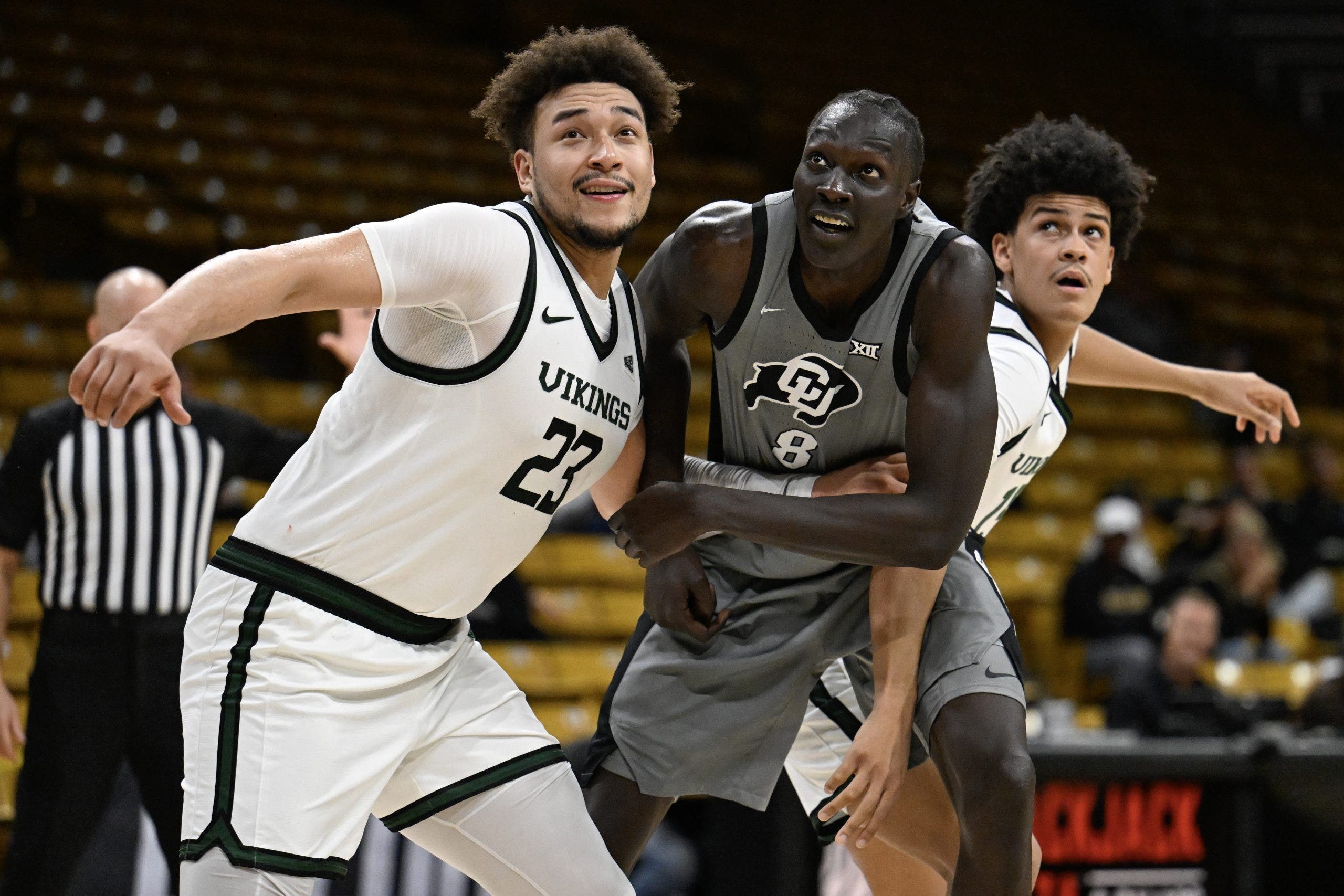
Defensively, though, the next-best team in the conference — Montana State — allows over six more points per 100 possessions than Portland State. If you can score 80 points, you can probably beat the Vikings. They are holding opponents to under 70 on average, however, so that’s been easier said than done, especially since Portland State has the conference’s leading scorer in 6-foot-8 senior forward Terri Miller, as well as senior guard Javlin Henderson, who is averaging 17.1 points and 6.1 assists per game.
Still! Montana is responsible for beating Portland once already, and the two will face off again on Feb. 28. It’s unlikely Portland State drops the top seed in Big Sky before Starch Madness kicks off, but Montana — or whichever team — only needs to beat the Vikings once once that tourney begins to punch a ticket to the NCAA Men’s Basketball Tournament.
Leaders:
- Points Per Game: Naomi White, Northern Arizona, 22.2 (10th in D-I)
- Rebounds Per Game: Kourtney Grossman, Eastern Washington, 13.1 (3rd in D-I)
- Assists Per Game: Benthe Versteeg, Sacramento State, 4.5
- Steals Per Game: Taylee Chirrick, Montana State, 4.2 (2nd in D-I)
- Blocks Per Game: Jaecy Eggers, Eastern Washington, 1.5
Whereas the men’s side of the Big Sky is full of teams that would only make it to March Madness by way of the automatic bid, the women’s side does have a team that’s on the bubble, anyway, and therefore the possibility — however small — that an at-large bid could be granted unlike the last three years. The chance is real small, though, as not winning the tournament might be enough to get the selection committee looking at one of the stacked Power 6 conferences instead to see which team has been left out of the mix, rather than the runner-up in a mid-major.
Said bubble team is Montana State, which is 10-2 in conference play, half-a-game behind Idaho, and 67th in NET as well as 68th in Net Rating. It’s 95th in Offensive Rating and 54th in Defensive Rating, both of which sophomore guard Taylee Chirrick can take a lot of credit for. A team effort on both ends, of course, but Chirrick is averaging 18.1 points, 7.3 rebounds, 3.7 assists and 4.2 steals per game this season: the last of those trails only Notre Dame’s Hannah Hidalgo, but Chirrick is tops on the Bobcats in the other three categories, while her 18.1 points per game are also second in Big Sky.
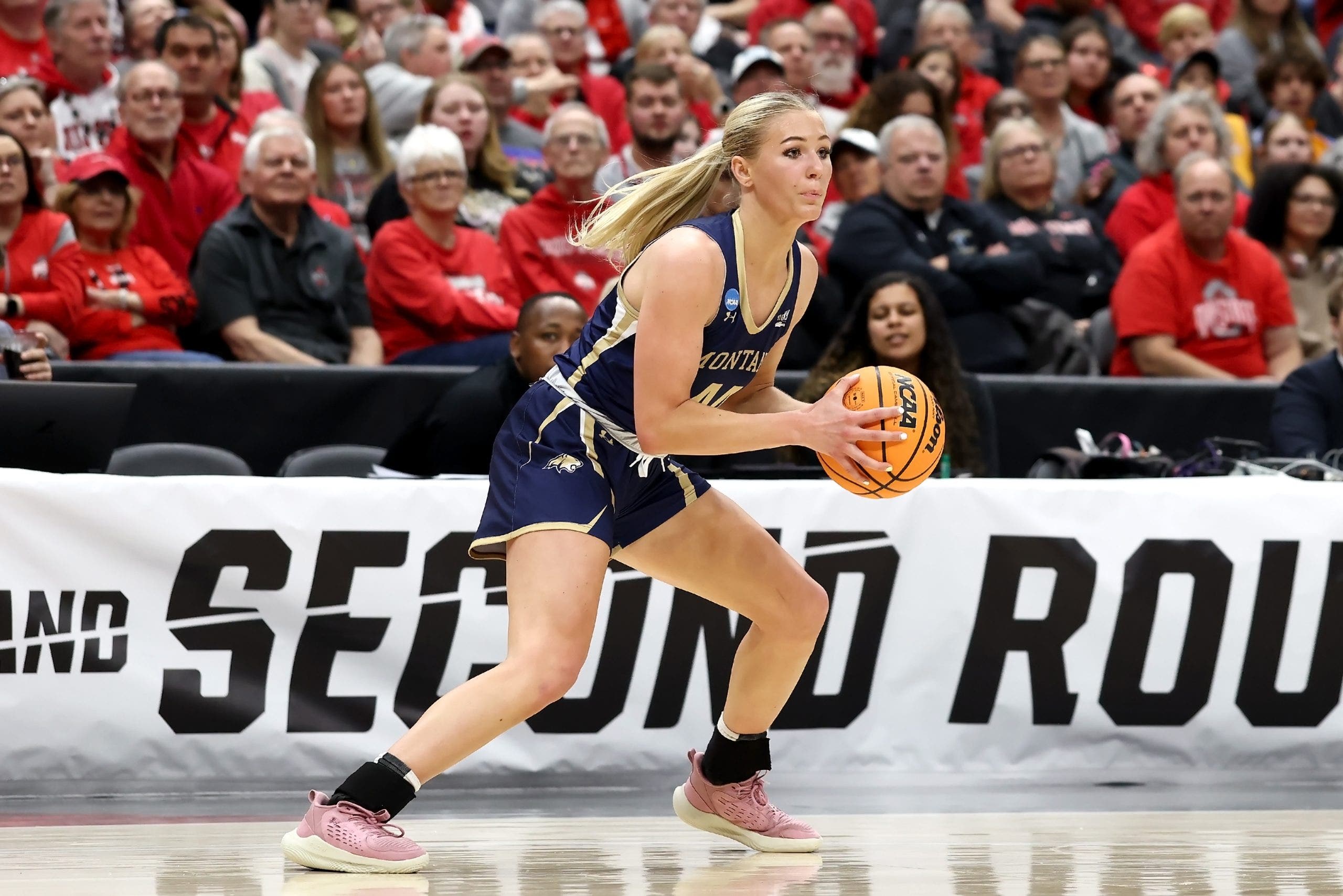
Taylee Chirrick, a sophomore, already has one March Madness tournament under her belt.(Photo by Kirk Irwin/Getty Images)
Whatever you want to use as a reference — Player Efficiency Rating (PER), win shares, plus/minus, individual offensive or defensive rating — Chirrick is the best player in the conference. She’s second in Offensive Rating behind Idaho’s Debora Reis Dos Santos, but is first in Defensive Rating, as well as the leader in both offensive and defensive win shares as well as offensive and defensive plus/minus. There is no one else in the conference this productive in the conference on both sides of the ball, and that has helped Montana State stick out as more than just the team currently in second in Big Sky.
There are games to play, though. Montana State has lost twice in Big Sky play — to Idaho in overtime and to third-place Idaho State by 19 points — so it isn’t invulnerable. Those are also the conference’s top-150 teams by NET, by the way. Northern Colorado (8-4) is in fourth, followed by Sacramento State (5-6), Eastern Washington (5-6), Northern Arizona (4-8), Montana (4-8), Portland State (2-9) and Weber State (1-11). The conference is far more top-heavy than deep, but the drama is going to come from whether or not Montana State can avenge its conference losses in the conference tournament, when it truly matters, or if the Bobcats just aren’t a great matchup for either Idaho or Idaho State, despite the presence of a gamechanger like Chirrick.
Discover more from stock updates now
Subscribe to get the latest posts sent to your email.