



Get To Know a College Basketball Mid-Major: West Coast Conference

You know all about the Power 6 conferences in college basketball. You hear about those more than any other, and those groups often dominate the March Madness conversation. There are 31 other conferences out there, however, and our goal is to get you up to speed on the teams, players and fights in the standings to know before the conference tournaments, Selection Sunday and the official start of March Madness.
It’s time for you to get to know a mid-major: this time, it’s the West Coast Conference.
The West Coast Conference faces upheaval next season when the reformed Pac-12 stocks itself with new members, but in 2025-2026 it’s still the home of Gonzaga. The men’s basketball team has been the conference champion and recipient of the WCC’s automatic bid to March Madness 22 times since 1995, has finished as regular-season champion 26 times since 1994 and has appeared in the NCAA Men’s Basketball Tournament 27 times since ‘95. While the women’s team isn’t quite as accomplished, it’s still won the WCC tourney 10 times since 2007, has been the regular-season champ 20 times and appeared in the NCAA Women’s Basketball Tournament on 15 occasions.
That is a whole lot of history changing addresses, but as you will see, it also leaves quite the void to fill — which school can step up is a question for next year, though. The focus now is on which teams can do something in the present against either Gonzaga squad while that’s still a challenge to overcome.

All the West Coast teams make it to the conference tournament, but a stepladder setup is used where the top two seeds get a bye into the semifinals, the third- and fourth-ranked seeds get a bye to the quarterfinals, and the other teams have to fight it out with a play-in for the bottom two schools, and then second and third rounds for the other six teams to sort things out.
Leaders:
- Points Per Game: Graham Ike, Gonzaga, 19.7
- Rebounds Per Game: Andrew McKeever, Saint Mary’s, 9.5
- Assists Per Game: Joel Foxwell, Portland, 6.9 (T10th in D-I)
- Steals Per Game: Ty-Laur Johnson, San Diego, 2.3
- Blocks Per Game: Will Heimbrodt, Seattle, 2.5 (10th in D-I)
Gonzaga actually is not in first place in the West Coast Conference through Feb. 11, as Santa Clara has one more win and the same number of losses, at 13-1. Gonzaga is the team to beat in the conference, however, as the Bulldogs rank 6th in the NCAA Evaluation Tool and 11th in KenPom. And yet, nothing is guaranteed there. Gonzaga already lost to Portland (5-9, 213th in NET), and has had close calls against San Diego (5-9, 219th), Seattle (4-9, 134th) and San Francisco (6-7, 106th). Saint Mary’s (CA) only lost to Gonzaga, 73-65, and is third in the WCC at 11-2 as well as second in the conference in NET (28th).
The Bulldogs beat Santa Clara 89-77 for the Broncos’ lone loss in WCC play, but that’s a tourney-caliber team, too, as they rank 41st in NET 38th in KenPom. Gonzaga hasn’t played Pacific yet (8-6, 101st). Washington State, however, is 6-8 thanks to dropping two games against Gonzaga, neither of which was close, but it’s still 137th in NET. The Bulldogs have to play Santa Clara, Pacific, San Francisco, Portland and Santa Clara again before the season ends — maybe Gonzaga runs the table like the ratings suggest it should, or maybe some of those near-losses become actual ones the second time around.
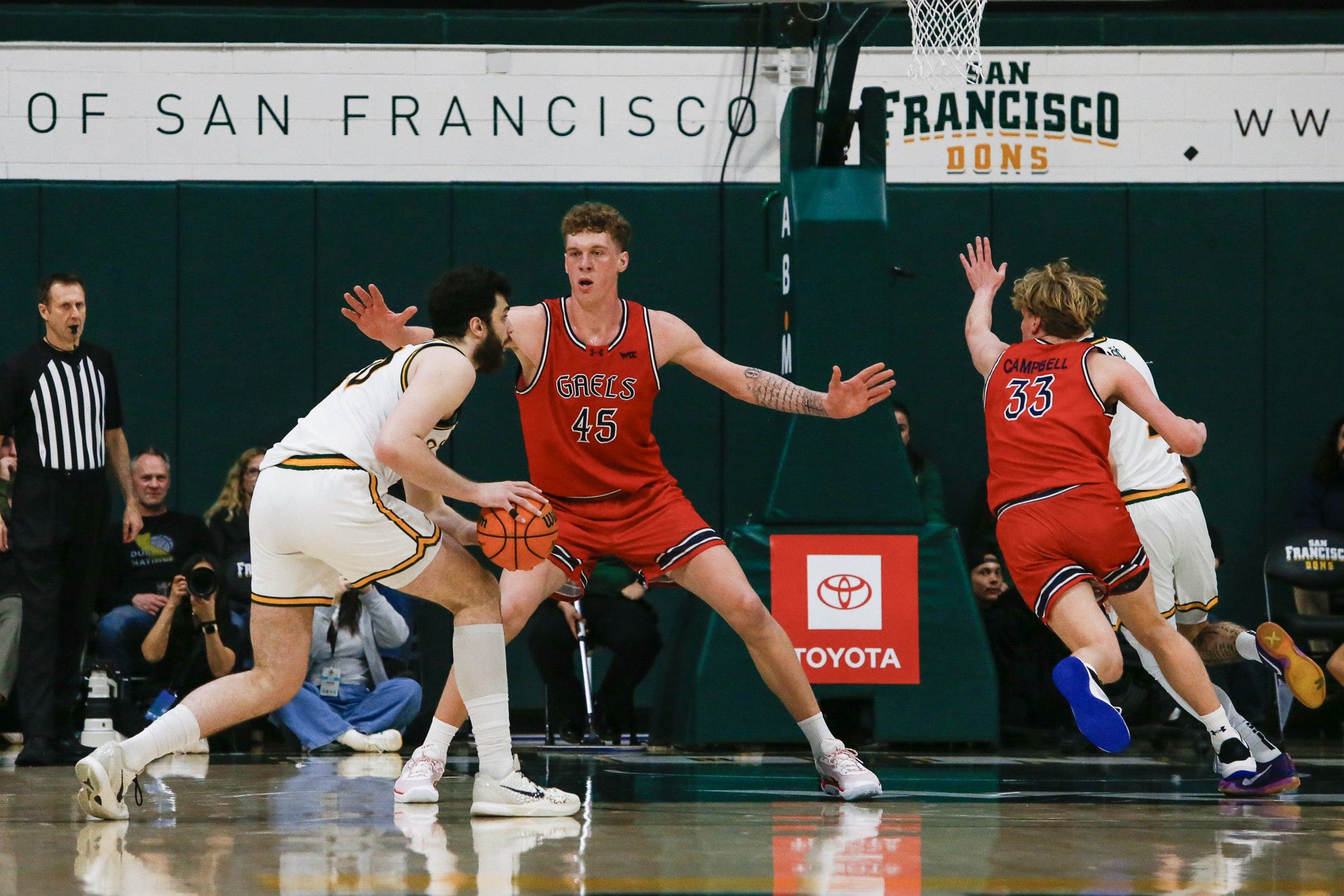
The good news for the likes of Santa Clara and Saint Mary’s (CA) is that the West Coast Conference has had an at-large bid in each of the last three tournaments, so if the regular season ends on a high note and one or both have a good showing in the conference tournament, whichever goes further might end up in March Madness even if Gonzaga is crowned champion one last time. Conversely, a rough end to the season for Gonzaga, and one of these two winning the WCC tournament could still mean two teams in March Madness… just without one of those being the expected one.
Of course, those aren’t the only three possibilities for conference champion. Washington State and San Francisco both have top-100 Offensive Ratings via KenPom. Seattle ranks 29th in Defensive Rating, while Loyola Marymount and Pacific are both top-100. With everyone making it to the tournament, and so much of the conference clustered together talent-wise, there is room for more than a couple of schools to shock everyone, as Portland already did against Gonzaga earlier this season.
Leaders:
- Points Per Game: Lauren Whittaker, Gonzaga, 19.5
- Rebounds Per Game: Lauren Whittaker, Gonzaga, 10.1
- Assists Per Game: Ashley Hawkins, Santa Clara, 6.0
- Steals Per Game: Dyani Ananiev, Portland, 2.6
- Blocks Per Game: Julia Dalan, Portland, 3.4 (1st in D-I)
There aren’t the same high-end teams in the women’s portion of the West Coast Conference, but there is still significant clustering. Gonzaga is 10-2 and first in the WCC, as well as 62nd in NET. LMU is second, at 9-3 and 137th in NET. Oregon State is also 9-3, but 91st in NET. Portland (8-4, 116th) and Santa Clara (8-4, 73rd) are tied for the final bye. Both are two losses and a win up on sixth-place San Francisco (171st), followed by Pepperdine (6-6, 121st), Saint Mary’s (CA) (5-7, 172nd), Pacific (4-8, 226th), Washington State (4-9, 225th), San Diego (3-10, 270th) and Seattle (1-12, 337th). That’s six top-150 teams, with the highest-ranked of the bunch in bubble territory if it should fail to secure the conference championship.
Gonzaga has the 52nd-ranked team by Offensive Rating, thanks to scoring an adjusted 104.24 points per game. Santa Clara isn’t far behind, however, at 102.23, with Loyola Marymount and Oregon State both top-100, as well. Portland has the best defense in the conference, limiting opponents to 85.98 points per 100 possessions, followed by Gonzaga at 86.21. Oregon State and Santa Clara both keep opponents under 90 points per 100 possessions, as well.

Lauren Whittaker is at the heart of Gonzaga’s offense and defense. (Photo by Oliver McKenna/Icon Sportswire via Getty Images)
Gonzaga’s strength is in its long game: despite the 7th-most attempts from deep in the WCC, Gonzaga is second in made 3s and first in 3-point percentage, at 39.8%. It’s also the best rebounding team in the conference, which freshman forward Lauren Whittaker can take a lot of credit for. She leads the conference in rebounds per game (10.1) as well as points (19.5), and while she’s not part of the 3-point party, she’s killer from inside the arc, leading the West Coast at 54.4% shooting and 59.8% on 2s, and has the top effective FG% in the WCC, as well, at 58.6%.
The issue is a lack of depth: Whittaker leads the West Coast in Player Efficiency Rating (PER) at 38.8, and no one is particularly close, but no one else on the team does two things especially well, leaving a significant portion of the burden to her. There are worse problems to have — such as, say, not having a Lauren Whittaker — but that’s why Gonzaga isn’t even better despite her presence.
While the WCC had just an automatic bid in 2025, in the previous two NCAA Women’s Basketball Tournaments, it also had an at-large bid. As of now, that could go to Santa Clara if it doesn’t win the conference tourney, but Oregon State would need to have a wild end to the year to force the issue for the Beavers. Becoming tournament champion remains the best chance any of these teams have of playing in March Madness, but unlike with most mid-majors, it doesn’t take a lot of squinting to see an at-large bid appearing.
Discover more from stock updates now
Subscribe to get the latest posts sent to your email.