From roll call to rebellion: Georgia students to join America’s National Shutdown walkouts today
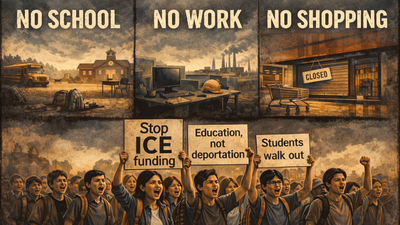
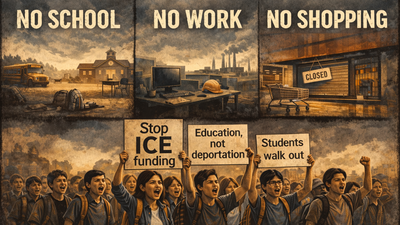
In Georgia, the school day is being asked to do double duty: To carry on as usual, and to register a political argument. Thousands of students across the state say they intend to walk out of classes on Friday to protest Immigration and Customs Enforcement operations—an action being folded into a wider, deliberately disruptive call branded the “National Shutdown”, reports USA Today.The premise of the Shutdown is unambiguous and intentionally theatrical: a day of refusal. No school. No work. No shopping. The point is not simply to demonstrate displeasure, but to make routine itself wobble—if only for a few hours—by asking people to withdraw their attendance, their labour, and their spending. It is a protest designed to travel through the ordinary channels of American life: The classroom roll call, the shift schedule, the grocery receipt. The organising language, too, is built for circulation: an appeal framed as both solidarity and warning, with ICE positioned not as a neutral enforcement body but as a force that should be denied public legitimacy and public money.In metro Atlanta, school districts are responding with the kind of bureaucratic clarity that arrives when institutions feel their perimeter being tested. The walkout may be political, but the schools’ messaging is procedural: You can have your views, but you cannot abandon the instructional day without consequences. The USA Today report notes that district communications have warned of disciplinary action for students who leave class or campus during school hours. It is the familiar grammar of administration—rights acknowledged, rules reasserted, consequences enumerated—delivered in the tone of an email that wants to sound calm while preparing for a problem it cannot fully control.And then there is scale, which is where a protest becomes a governance event. According to a participation list maintained by the Party for Socialism and Liberation (PSL) Atlanta, more than 100 schools in Georgia are expected to participate in Friday’s walkouts, suggests the USA Today report.The action is not set up as a single synchronized mass exit, but as a day of staggered departures, scheduled at different points—sometimes by the clock, sometimes by the timetable logic of school itself. In one of the earliest planned moments, USA Today notes, Stephenson High School in DeKalb County is listed as beginning at 9:30 a.m. Elsewhere, the instructions are looser: After the third period, at a transition point, when the corridor is already a moving body.The walkouts are primarily planned for high schools, which is where the drama of student protest has always been most legible: Teenagers stepping out of the institution that is designed to contain them, turning attendance into a choice rather than a requirement. However, according to USA Today, the PSL list also suggests that colleges are expected to join—Agnes Scott College, Emory University, Georgia State University’s Atlanta campus, Georgia State University’s Armstrong campus, and the University of Georgia among them—adding an older, more politically seasoned layer to the day’s choreography.What makes this episode more than a youth-led flashpoint is that it’s really a collision between two competing ideas of order—both convinced they are the adults in the room. The students frame the walkout as a moral response to state power they experience as coercive: If the machinery feels violent, withdrawal becomes a form of testimony. School districts, meanwhile, treat discipline as a safety protocol, not a referendum: A way to keep campuses legible, accountable, insurable. Each side speaks the language of protection, but they mean different things by it—protecting communities from harm, protecting schools from breach; protecting speech, protecting learning. So the argument isn’t only about ICE. It’s about what a school is allowed to become when politics arrives not as a debate topic for a civics class, but as a practical instruction—stand up, step out, and turn attendance into dissent.

Discover more from stock updates now
Subscribe to get the latest posts sent to your email.