February 2026 Review and Outlook
Executive Summary
- U.S. equities deliver mixed headline performance amid significant internal rotation
- Market leadership broadens as equal‑weight, mid‑cap, and value exposures outperform
- Market breadth improves with seven of 11 large cap sectors within 0.5% of their respective 52-week highs
- Mega‑cap growth and AI‑adjacent software weigh on cap‑weighted indices
- Treasury yields decline meaningfully, led by the long end
- Energy prices strengthen amid geopolitical risk, reinforcing real‑asset leadership
- Earnings growth remains solid despite increasing dispersion beneath the surface

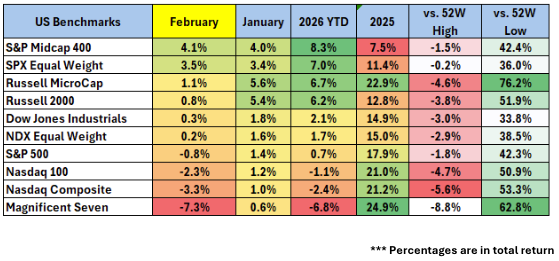
U.S. equity markets delivered a mixed performance in February, with headline indices masking a significant degree of rotation and dispersion beneath the surface. Amongst large caps, the Dow Jones Industrials(+0.3%) edged modestly higher, the S&P 500 (-0.8%) declined for the second time in the past three months, and the Nasdaq 100 (-2.3%) posted its worst monthly decline since March 2025. The cap-weighted indices were restrained by the continued corrective price action in select large cap growth stocks as evidenced by the Magnificent Seven Index (-7.3%) which registered its worst decline since March 2025. Conversely, the S&P 500Equal WeightIndex (+3.5%) had its best monthly performance since May 2025and outperformed the cap-weighted S&P 500 for the fourth consecutive month. The S&P Midcap 400(+4.1%) outperformed with its best month since May 2025.
Importantly, February did not resemble a broad risk‑off environment. Instead, market action was characterized by rotation rather than liquidation. Investors continued to reallocate away from concentrated leadership and toward a broader mix of cyclicals and defensives, as reflected in strong gains across energy, utilities, materials, staples, industrials, and health care. This shift suggests confidence in the durability of economic activity, even as debate persists around the return profile and timing of large‑scale AI investment.
From a macro perspective, the backdrop remained supportive but nuanced. Economic data pointed to an economy that is cooling gradually rather than contracting, while inflation progress remains uneven. Treasury yields declined meaningfully during the month, with the 10‑year yield falling back below 4%, reinforcing expectations for a patient Federal Reserve. Against this backdrop, February appeared less like a turning point for equities and more like an extension of an ongoing transition toward broader participation and more selective leadership.
February’s divergence was driven largely by continued weakness in mega‑cap growth, particularly within technology‑adjacent segments. Software emerged as a notable laggard as concerns around artificial intelligence disruption intensified, fueling valuation compression and risk reduction across the group. The widely followed iShares Expanded Tech-Software Sector ETF (ticker: IGV) declined 14.6% and 9.9% in January and February, respectively.
From its October high, the IGV declined more than 35% before bottoming in the final week of February, when it reached a two-year low on Tuesday, February 24th. That session proved pivotal, as the ETF reversed higher to finish the day up 1.9% on record volume of 50.6 million shares, roughly 3.6 times its 50-day average. This surge in turnover coinciding with a reversal off support suggests selling pressure may have been largely exhausted. The upside follow-through over the next two sessions (gains of 3.1% and 2.2%) further reinforces the view that near-term momentum is beginning to turn. From a longer-term perspective, the weekly chart adds to the constructive setup, with price stabilizing at a clearly defined two-year support level. Given the magnitude of the prior decline, conditions appear favorable for a meaningful mean reversion bounce, which could support investor sentiment in the near term.



The growth-versus-value divide sharpened dramatically in February, underscoring the market’s pivot toward fundamentals over speculative momentum. Russell 1000 Value climbed 2.6%, buoyed by strong showings in cyclical areas, while Russell 1000 Growth plunged 3.4% due to AI-related selloffs in tech-heavy holdings. Similarly, the Russell 2000 Value rose 1.9%, far outstripping Russell 2000 Growth’s modest 0.2% dip. This value resurgence, which began in late 2025, gained traction as investors questioned the sustainability of massive AI investments by hyperscalers.
Sector Performance

Sector‑level performance underscored both strong rotational dynamics and improving market breadth, with 7 of the S&P 500’s 11 sectors finishing the month within 0.5% of their respective 52‑week highs – a notable sign of underlying strength beneath the surface. Defensive and commodity‑linked groups led the advance with Utilities surging 10.3%benefiting from stable demand and their appeal as bond proxies amid declining yields. Energy gained 9.4%supported by rising oil prices tied to U.S. – Iran geopolitical tensions and continued infrastructure investment.Materials advanced 8.4% on commodity rebounds and policy‑backed manufacturing activity. Consumer Staples (+7.9%), Industrials (+7.1%), and REITs (+6.4%) also posted solid gains, reflecting confidence in resilient consumer spending and a nascent real estate recovery. On the downside, Financials (-3.7%) lagged amid mixed earnings and profit‑taking, while Technology (-3.9%), Communication Services (-5.1%), and Consumer Discretionary (-5.4%) came under pressure as AI‑related concerns broadened beyond hardware into software, media, and e‑commerce.

Small-cap sectors in the Russell 2000 echoed this cyclical tilt but with even greater dispersion. Materials led with an 8.9% rise, supported by commodity strength and domestic focus. Communications jumped 8.7%, defying large-cap trends due to niche opportunities in regional telecoms. Energy (+4.2%), Consumer Staples (+3.9%), and REITs (+3.8%) advanced on similar macro tailwinds. Industrials and Consumer Discretionary gained modestly at 2.9% and 2.4%, respectively. Laggards included Healthcare (-1.0%), Technology (-1.7%), Utilities (-1.9%), and Financials (-3.6%), where AI concerns and profit taking pressures weighed more heavily. This small-cap sector breadth reinforces the narrative of a “real economy” revival, with energy and materials particularly buoyed by geopolitical events and fiscal impulses.
Rates, Precious Metals, Bitcoin and Oil
February saw a meaningful rally in Treasuries as rates moved decisively lower, reinforcing the market’s shift toward a slower‑growth, easier‑policy narrative. The 10‑year Treasury yield fell 30bps to 3.94%, marking its largest monthly decline since February 2025, while the 2‑year yield declined 15bps to 3.38%, its lowest level since August 2022. The larger move in the long end points to falling term premiums and potentially increased confidence that inflation pressures are moderating, while the decline in the front end reflects growing conviction that policy rates will come down later in 2026.
Precious metals recovered from last month’s extreme volatility with gold gaining 7.9% in February for its 13th monthly gain over the past 14 months, reinforcing its role as both an inflation hedge and a beneficiary of easing financial conditions. Silver outperformed, rising 10.1%, and has now advanced for ten consecutive months, highlighting improving cyclical and industrial demand alongside monetary tailwinds. The sustained strength across both metals suggests investor positioning continues to favor real assets amid falling yields and elevated geopolitical conflict.
Bitcoin remained under pressure, declining 10.8% in February, marking its fourth monthly decline in the past five months and extending the post‑cycle correction. From a technical perspective, the pullback has been significant: the February low represents a 52% decline from the cycle highs reached in early October, following an extraordinary +715% advance from the 2022 lows to the October 2025 peak. Importantly, price has retraced back toward the ~$65,000 level, a technically meaningful zone that aligns with prior cycle highs from April and December 2021, and which later acted as firm resistance from March through September 2024. This former resistance‑turned‑support area carries heightened technical significance on a long‑term monthly chart, and the current consolidation suggests the market is testing whether that level can serve as a durable base.

Energy prices remained firm, with WTI crude rising 2.8% in February following a 13.6% gain in January. Strength has accelerated into March, with crude already up an additional 6.8%, driven by heightened geopolitical risk following last weekend’s U.S. – Iran conflict.
Crude oil has strengthened meaningfully in 2026 (+24% YTD) and has recently moved above a 2 ½ year downtrend line originating from the 2023 highs, marking an important technical development. This break suggests downside momentum has eased, and shifts focus on whether prices can build on this move with follow‑through. Attention now turns to the $78.50 area, which has capped advances since October 2024 and represents a key reference level for confirming a broader trend reversal. A sustained move toward and ultimately through this zone would strengthen the case for a transition from a prolonged downtrend to a more durable uptrend. Momentum indicators are increasingly supportive, with weekly RSI at its highest level since June 2022, underscoring improving upside momentum as crude works higher.

Economic Data
February’s economic data pointed to a slowing but still resilient U.S. economy, a backdrop markets interpreted constructively. Business activity remained expansionary, with February flash PMIs showing manufacturing at 52.4 and services at 53.0, leaving the composite index at 53.1. Growth data remained supportive, as Q4 GDP was revised up to a 2.8% annualized pace, driven by 2.4% personal consumption growth, while industrial production rose 0.4% m/m in January and capacity utilization edged higher to 76.5%, consistent with ongoingmomentum.
The consumer continued to provide stability. December retail sales increased 0.4% (MoM) pointing to steady underlying demand entering 2026. Personal income and spending both rose 0.3% (MoM), while sentiment improved modestly in February. The University of Michigan confidence rose to 57.3, and Conference Board confidence increased to 87.1. Housing data were mixed but showed tentative signs of stabilization, with NAHB builder sentiment improving to 38 and home prices continuing to rise modestly.
Labor and inflation data reinforced expectations for a patient policy stance. January nonfarm payroll growth slowed to 65,000, with prior months revised lower, and the unemployment rate edged up to 4.4%, signaling cooling but not stress. Inflation continued to ease unevenly: January CPI and core CPI both rose 0.3% (MoM), leaving headline inflation at 2.5% (YoY), while core PCE inflation stood at 2.9% (YoY). Producer prices firmed modestly, but inflation expectations remained anchored, supporting the view that the Federal Reserve can lower rates later in 2026.
Corporate Earnings
S&P 500 earnings for Q4 2025 were solid and broadly supportive of equity performance, reinforcing the narrative of continued profit growth even as surprise rates normalized. With 96% of companies reporting, the index is tracking 14.2% earnings growth (YoY), marking the fifth consecutive quarter of double‑digit growth. While the 73% EPS beat rate and 6.8% aggregate earnings surprise were modestly below longer‑term averages, earnings have been revised meaningfully higher since quarter‑end, reflecting stronger‑than‑expected results across most sectors.
According to FactSet, earnings growth remained highly concentrated, led by the “Magnificent 7,” which delivered 27.2% earnings growth in Q4 versus 9.8% for the remaining 493 companies. Technology was the dominant driver, with the Information Technology sector posting 33.4% earnings growth. At the index level, all eleven sectors reported year‑over‑year earnings growth, highlighting improving breadth beneath the headline concentration
Looking Ahead
Looking ahead, the message of the marketremains constructive, even as headline index performance has grown more uneven. February’s priceaction reinforced a key theme that has been developing since late 2025: equity market leadership is broadening rather than deteriorating. Beneath the surface, improving breadth, sustained rotation across styles and sectors, and resilient earnings trends suggest the current environment is better characterized by consolidation and rebalancing than by a meaningful risk-off shift.
The continued rotation away from concentrated leadership toward equal-weight, mid-cap, value, and cyclical exposures reflects a healthier internal market structure. With a majority of sectors trading near their respective 52week highs, participation has expanded meaningfully, reducing dependence on a narrow group of mega-cap names to drive overall returns.
From a macro perspective, economic data continues to point toward gradual cooling rather than contraction. Growth remainspositive, the labor market is easing without signs of stress, and inflation progress, albeit uneven, has moderated sufficiently to support a more stable rate backdrop. Falling Treasury yields have reinforced these dynamics, providing valuation support for interest-sensitive and defensive areas while easing financial conditions more broadly.
Corporate earnings remain a critical anchor. Despite increasing dispersion beneath the surface, profit growth has stayed solid at the index level, with all major sectors reporting YoY earnings growth. While concentration among the largest contributors persists, the expansion of earnings participation across the broader market aligns with the improving breadth seen in price action.
Taken together, the current setup suggests markets are transitioning through a period of leadership rotation and internal normalization rather than signaling the end of the cycle. While volatility may persist as investors digest incoming economic data, earnings updates, and geopolitical developments, the weight of the evidence continues to favor a constructive intermediate-term outlook, supported by broadening participation, healthy rotation, and resilient fundamentals.
The information contained herein is provided for informational and educational purposes only, and nothing contained herein should be construed as investment advice, either on behalf of a particular security or an overall investment strategy. All information contained herein is obtained by Nasdaq from sources believed by Nasdaq to be accurate and reliable. However, all information is provided “as is” without warranty of any kind. ADVICE FROM SECURITIES PROFESSIONAL IS STRONGLY ADVISED.
Discover more from stock updates now
Subscribe to get the latest posts sent to your email.