


Explained: How the Israel issue is splintering MAGA | World News
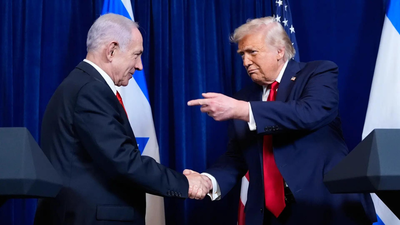
For nearly half a century, support for Israel was the closest thing the American right had to a theological constant. It bound together evangelical Christians, Cold War hawks, neoconservatives, and Republican donors into a durable, almost unexamined consensus. Donald Trump’s first term appeared to mark its triumph: Jerusalem recognised as Israel’s capital, the Abraham Accords signed, and Benjamin Netanyahu embraced as a political soulmate.And yet, in Trump’s second term, that old certainty is cracking. Not because Trump himself has turned against Israel. He has not. The fracture exists because the movement built around him is no longer ideologically unified on the question. Israel has become the issue exposing MAGA’s internal fault lines: generational, theological, ideological, and in some cases, disturbingly antisemitic.
The old MAGA–Israel bargain
To understand the rupture, it helps to recall how the alliance was formed. The modern Republican commitment to Israel was never just strategic. It was theological.From the late 1970s onwards, evangelical Christians, particularly those influenced by premillennial dispensationalism, came to see the modern state of Israel as part of a divine timetable. Israel’s survival and expansion were read as signs of biblical prophecy moving towards its final act. Supporting Israel was not merely good foreign policy. It was obedience.This belief system dovetailed neatly with Cold War geopolitics. Israel was framed as a democratic outpost against Soviet-backed Arab regimes. By the Reagan era, the alliance between the Christian Right, neoconservatives, and pro-Israel lobbying groups had hardened into Republican orthodoxy. Questioning Israel became politically radioactive inside the party.Trump inherited this structure and amplified it. He did not build the pro-Israel consensus. He weaponised it.

The new MAGA revolt
What has changed is not Trump’s position, but MAGA’s composition.The Republican Party that emerged after 2016 absorbed voters who were younger, more online, more conspiratorial, and less tethered to Cold War or Holocaust-era moral frameworks. Many of them arrived through anti-establishment anger rather than religious conviction. For this cohort, “America First” does not automatically translate into reflexive support for Israel.Surveys and focus groups of younger Republicans now show a sharp divergence. Older GOP voters remain overwhelmingly pro-Israel. Newer MAGA-aligned voters are far more sceptical and sometimes openly hostile. Their objections often begin with foreign policy arguments. Why spend billions abroad when America faces inflation, immigration, and cultural decline at home?But the line between isolationism and antisemitism has increasingly blurred. Online MAGA spaces circulate conspiracies about Jewish power, Israel’s influence over Washington, and shadowy financial networks. What was once fringe white nationalist rhetoric is now bleeding into broader right-wing discourse.
Media civil war on the right
This ideological drift has spilled into an open media war.Figures like Tucker Carlson have emerged as the most influential critics of Israel on the mainstream right. Carlson has attacked Christian Zionism as a form of theological corruption, arguing that American Christians have been manipulated into sacrificing national interest for a foreign state. His critiques are framed as intellectual and nationalist, but they overlap uncomfortably with ideas long associated with the antisemitic right.At the harder edge of this ecosystem sits Nick Fuentes, whose explicitly antisemitic worldview dispenses with policy arguments altogether and instead treats Israel and Jews as civilisational enemies. Fuentes remains toxic to much of the Republican establishment, but his ideas circulate freely online and increasingly seep into broader MAGA discourse, often laundered through euphemism and irony.On the other side stand voices like Ben Shapiro, who defend Israel as both a moral ally and a strategic necessity. The clashes between these camps, sometimes literal and played out on conference stages, have turned Israel into a loyalty test inside conservative media.Activists such as Candace Owens have gone further, adopting language that portrays Israel in almost metaphysical terms of evil. What once would have ended a conservative career now circulates freely within parts of the MAGA ecosystem.
Theology, rewritten
Beneath the politics lies a quieter but more consequential shift. Theology.Younger conservative Christians are moving away from dispensationalist readings of the Bible that placed Israel at the centre of God’s plan. Some are gravitating towards postmillennial or Christian nationalist frameworks that see America, not Israel, as the chosen civilisational project. Others, including high-profile MAGA figures, have turned towards Catholicism, which does not share evangelical Zionism’s end-times obsession.The result is a worldview where Israel is no longer sacred, nor even particularly special. In some interpretations, Judaism itself is framed as incomplete or obsolete. This idea has a long and ugly history in Christian Europe. When this theology merges with nationalist grievance, the outcome is not merely scepticism of Israel, but hostility towards Jews as a group.
Trump’s strategic silence
Trump has watched this fracture with characteristic pragmatism. He continues to back Israel unequivocally, hosts Netanyahu, and defends Israeli military actions without hesitation. But he has shown little interest in disciplining anti-Israel or antisemitic elements within his broader coalition.His likely successor in MAGA politics, JD Vance, has been notably noncommittal, avoiding clear statements that might alienate either camp. This ambiguity is not accidental. MAGA is now a coalition held together less by ideology than by resentment, and Israel has become one of the issues where those resentments collide.
Why this matters
The Israel split reveals something larger about MAGA’s future.For decades, Republican foreign policy was anchored by moral clarity. Sometimes simplistic, sometimes selective, but stable. That clarity is gone. In its place is a volatile mix of isolationism, online radicalisation, theological revisionism, and generational fatigue with inherited causes.Israel is not just another foreign policy debate inside MAGA. It is the test case for whether the movement becomes a disciplined nationalist project or drifts further into conspiratorial populism. It also raises a darker question. Who decides what, and who, is allowed inside the MAGA tent?Trump may still dominate the present. But the fight over Israel suggests that the post-Trump right will be far less predictable, far less coherent, and far more willing to tear up alliances once thought eternal.
Discover more from stock updates now
Subscribe to get the latest posts sent to your email.