E.U. edges out U.S. as New Delhi readies to slash duties on imported cars
New Delhi-based tech startup founder Ashita Gupta loves her cars. With prospects of luxury European cars becoming cheaper, Gupta, who drives an Audi A6, is considering buying another high-end vehicle.
It “doesn’t make sense” to spend so much money on a second car, but if an Audi R8 or Audi RS4 were to become “affordable” it would be worth purchasing, she says.
On Tuesday, India and the European Union announced the “mother of all deals,” that includes New Delhi slashing import duty on European cars gradually to 10% from 70%-110% at present. This would apply to a quota of 250,000 vehicles per year, and on cars priced above 15,000 euros ($17,952).
Sajjad Hussain | Afp | Getty Images
India has long shielded its auto market, the world’s third largest, by using prohibitive levels of tariffs on imports to safeguard domestic auto companies, while pushing global firms to build local manufacturing plants.
U.S. President Donald Trump, in fact, has often criticized India for protecting its local auto industry from imports and has demanded lower tariffs on American car companies, calling them “very unfair.”
Now, Brussels has edged out Washington in getting New Delhi to drop its hard stance on auto tariffs, securing a lucrative deal for European auto majors.

“EU brands now have a premium pass to the world’s third largest car market, while US companies are currently facing a huge levy,” Diwaker Murugan, auto analyst at Omdia, told CNBC. Omdia estimates India’s car market to touch 6 million by 2030, fueled by a young population with higher disposable incomes.
Bright deal, dim prospects?
Nearly 95% of cars sold in financial year 2025 were priced below 2 million rupees ($21,756), according to data from S&P Global-owned Indian research and ratings agency Crisil.
But even with the lowered tariffs the price of imported European cars will exceed this range as local taxes get added to the final price, according to auto experts. So, the total addressable market for European car companies will still be limited.
India’s mass car market is dominated by Maruti Suzuki and Hyundai — which have been manufacturing in India for more than two decades — and local players Tata and Mahindra whose high‑volume models fall under 2.5 million rupees.
The India-EU deal will “greatly help European automobile exports enter a market of 4 million passenger cars that, until now, has been protected by prohibitively high import tariffs,” European Automobile Manufacturers’ Association said in a statement, while pointing to curbs such as “quota limitations and residual tariffs that will limit the potential benefit to some extent.”
The top five European luxury brands, Mercedes-Benz, BMW, JLR, Audi and Volvo, sold 49,000 cars in India in financial year ended March 2025 compared with total passenger car sales of 4.3 million, according to data from S&P Global-owned Indian research and ratings agency Crisil.
European car companies dominate the luxury segment, but overall, their position is “increasingly under pressure” with a shrinking market share, said Puneet Gupta, director of technical research at S&P Global Mobility.
He explains that Indian and Korean manufacturers have “aggressively scaled up their presence through capacity expansion, frequent product launches, and rapid network growth” while the Europeans have been relatively cautious on investments in the last few years.
The free trade agreement, which is likely to come into force later this year, could make Europeans companies reassess their India business plans as trade barriers ease, said Gupta.
Hardeep Singh Brar, president and CEO, BMW Group India echoes this sentiment.
FTA could create opportunities to introduce new and niche products and, if demand scales, support deeper localization over time,” Brar told CNBC in an email exchange. The Indian arm of German carmaker BMW Group locally manufactures over 95% of its cars and yet it sold a little over 18,000 units in 2025 — and that was it highest so far.
Local concerns
This FTA potential, coupled with evolving consumer preferences, has caused some worry among Indian auto investors, as the move to slash tariffs so dramatically exposes market leaders to increased competition in high margin segments.
“The true battleground is the Premium SUV segment” which is priced above 2.3 million rupees, said Omdia’s Murugan. “By allowing European brands to land vehicles at competitive prices in this bracket, the agreement might create a confrontation between European badge-value and Indian flagship SUVs,” he added.
Some high-end variants of locally manufactured cars like Mahindra’ Scorpio or Tata Safari are priced close to 2.5 million rupee and are popular with customers.
After the deal was announced on Tuesday, shares of leading India auto companies including Mahindra & Mahindra, Hyundai Motor India, Maruti Suzuki and Tata Motors ended down between 1.5% and 4%.
According to Citi, local manufacturers will see competition “as the gap between high-end models from Indian OEMs and entry level models of EU OEMs (currently being imported) narrows.”
But industry leaders and trade bodies in India have welcomed the trade deal, as it still protects the majority of sales volumes.
Anish Shah, group chief executive and managing director of Mahindra Group, said the deal is a “huge positive for the auto sector” as it will give Indian carmakers duty free access to markets in Europe and attract European auto companies to invest in India.
While most experts agree that even with the lowered trade barriers, European car companies are unlikely to dent the dominance of local auto manufacturers in the near term, competition is set to intensify as customer preferences evolve.
Gupta, the tech startup founder, says she wants to see cars with better amenities come to India, and hopes that following the trade deal, European car companies would launch their latest models in India so that customers like her can have latest amenities at “reasonable” prices.
Top TV picks on CNBC

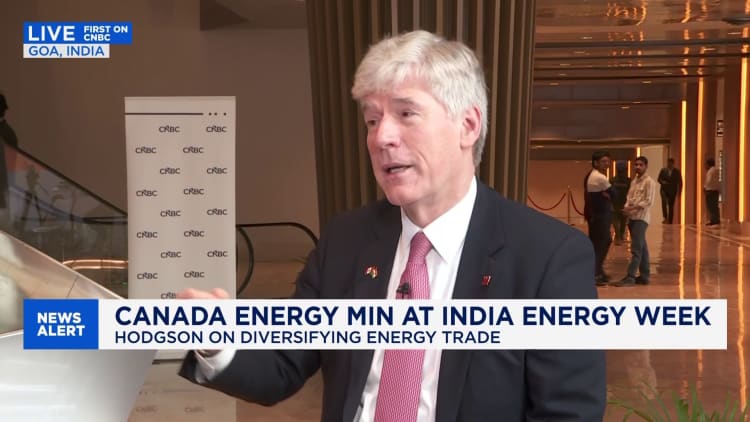
Tim Hodgson, minister of energy and natural resources of Canada, said the country was working to diversify trading relations with India and China, even as it deals with negative reactions from the U.S.

Oil India Chairman and Managing Director Ranjit Rath said India’s oil import dependence is unlikely to fall sharply but added that the country is positioning itself as a global refining hub.
Need to know
India-U.S. trade deal talks at a very advanced stage. A much-anticipated trade deal between India and the U.S. is at “a very advanced stage,” India’s Minister of Petroleum and Natural Gas Hardeep Singh Puri told CNBC Tuesday. He said he hopes the deal will be announced “sooner rather than later.”
India and EU close the “mother of all deals.” The European Union and India finalized a free trade deal on Tuesday that would remove or reduce tariffs on more than 90% of goods traded between the two. India will lower tariffs on imported European cars and the two sides will create a framework allowing for mobility of talent.
The U.S. SEC seeks to question Gautam Adani over fraud charges. The U.S. Securities and Exchange Commission has sought U.S. court approval to issue summons to Adani Group executives on charges of bribery and fraud. The U.S. regulator said that the Indian government has twice refused to deliver the earlier summons.
Quote of the week
We’ve always leveraged India as a strong innovation hub … If I take the energy supply chains, there are only two places on the planet where we have core research along with the energy players. One is Illinois in the United States, and second is Gurgaon in India.
— Anant Maheswari, president and chief executive of global regions at Honeywell
In the markets
Indian stocks were flat amid mixed trading in the region after the U.S. Federal Reserve kept interest rates steady. The Nifty 50 index and the BSE Sensex were little changed on Thursday as of 1 p.m. local time, and are down over 3% so far this year.
The benchmark 10-year Indian government bond yield ticked up slightly to 6.716%. The Indian rupee last strengthened marginally to 91.965 against the greenback.

— Lee Ying Shan
Coming up
Jan. 29: Fiscal deficit as of December end
Feb. 1: Indian government to present Union Budget for financial year 2027
Each weekday, CNBC’s “Inside India” news show gives you news and market commentary on the emerging powerhouse businesses, and the people behind its rise. Livestream the show on YouTube and catch highlights here.
SHOWTIMES:
U.S.: Sunday-Thursday, 23:00-0000 ET
Asia: Monday-Friday, 11:00-12:00 SIN/HK, 08:30-09:30 India
Europe: Monday-Friday, 0500-06:00 CET
Discover more from stock updates now
Subscribe to get the latest posts sent to your email.