


Defense stocks soar; U.S. strike on Venezuela heralds ‘hard power’ era

Rheinmetall, Germany’s largest arms manufacturer, gained over 9% by the closing bell in London, while military technology and surveillance specialist Hensoldt rose more than 8%. Italy’s Leonardo added more than 6%, while German counterpart Renk added around 8%.
Swedish fighter jet maker Saab added more than 6%.
Earlier, Japan’s IHI Corp led Asian defense stocks’ gains, advancing about 9%, followed closely by Mitsubishi Heavy Industries, which rose more than 8%. Kawasaki Heavy Industries, meanwhile, was up nearly 8%. In South Korea, Hanwa Aerospace closed 7% higher, while shares in Poongsan gained more than 2%.

In the U.S., meanwhile, fighter jet giant Lockheed Martin and military aircraft maker Northrop Grumman advanced more than 2% and 4%, respectively. The iShares U.S. Aerospace & Defense ETF (ITA) rose around 2%, notching a new all-time intraday record.

ITA, all-time chart
Fawaz Chaudhry, chief investment officer at Fulcrum Asset Management, said Maduro’s overthrow is a “signaling exercise” that will reshape geopolitics.
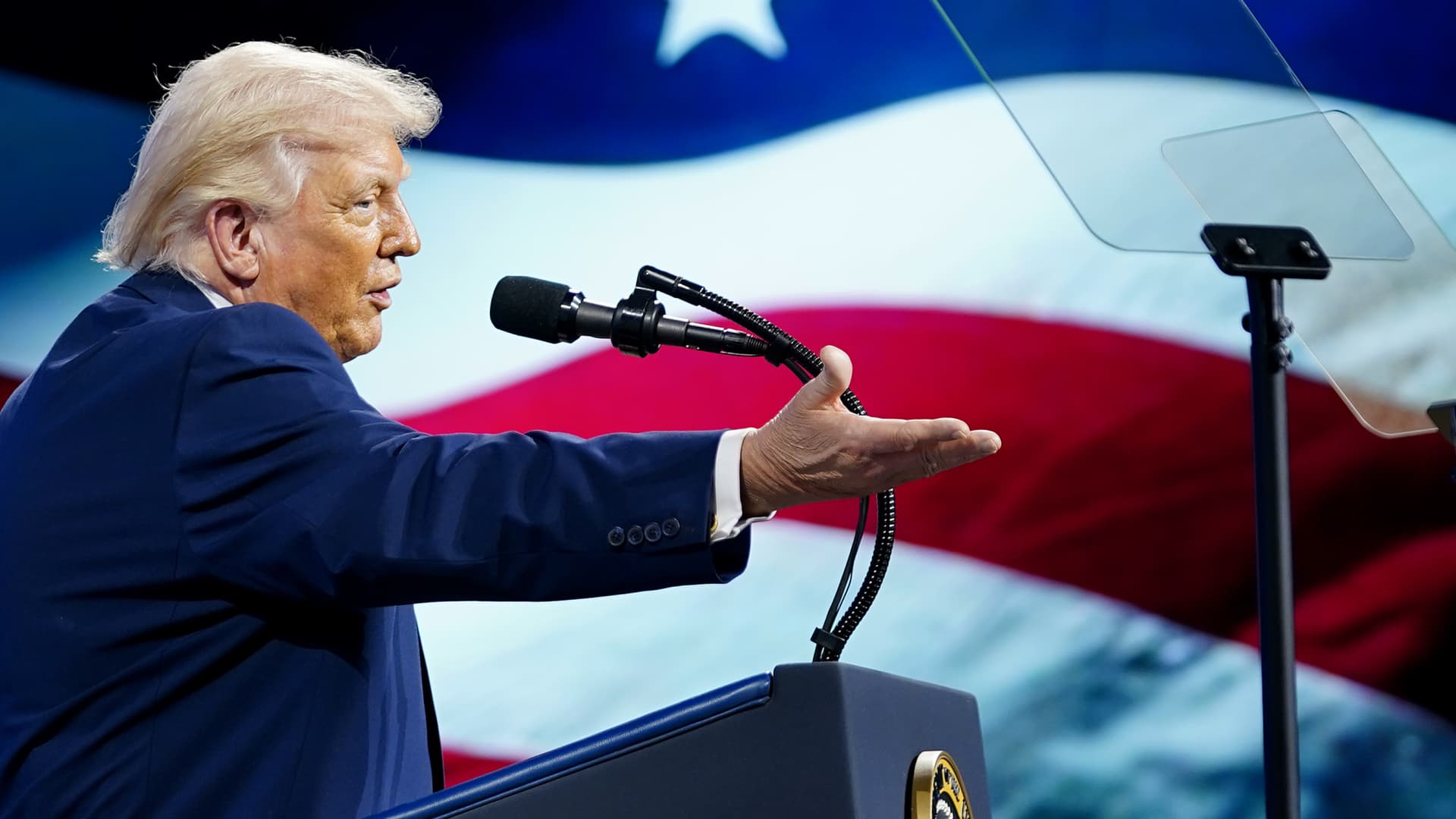
“As President Trump invoked the Monroe Doctrine, he’s talking about the near sphere in America taking control through hard power, through hard power assets,” Chaudhry told CNBC’s “Europe Early Edition” on Monday.
“We’re talking about a world trying to shift to a new era, where we will basically [have] hard power military assets, and go and take control, which basically is a different policy from before.”

Chaudhry expects that this more assertive U.S. foreign policy approach will mean “more rearmament of Europe, rearmament of Asia,” in the longer term, adding that defense stocks and military spending will continue to rise.
“What President Trump and what America just did in Venezuela will actually reinforce that. More military spending, more rearmament, of Europe, of Asia, so that trend will continue,” he explained.
New year, new world order
The gains made by European defense names mark a sharp reversal for the sector, which has struggled in recent weeks amid the prospect of a potential peace agreement between Ukraine and Russia.
Aoifinn Devitt, senior investment advisor at Moneta, expects defense spending to surge as a result of U.S. exceptionalism and the “gunboat diplomacy” theme on display in recent days.
“We know that the defense stocks did wobble when it looked like there might be peace in Ukraine. But ironically that theme, if anything, is going to be underscored especially [by] this rhetoric that is spreading things around to the neighboring countries,” Devitt told CNBC’s “Squawk Box Europe” on Monday.
More broadly, defense has several key structural tailwinds behind it, Devitt said, highlighting a ramp-up in Germany’s military spending, which has been “endorsed wholeheartedly” by the current German administration.
“New year, new world order – I think we all have to accept that. That will drive precautionary spending on defense,” Devitt observed. “Do we think that’s a productive use of funds, where we will actually generate jobs and generate long-term economic growth? Probably not. But it is actually where we need to go.”

Stephen Dover, chief market strategist and head of Franklin Templeton Institute, said that other countries with territorial interests elsewhere could be emboldened by the Trump administration’s unilateral use of force.
This action will also likely add to the uncertainty of the dollar’s role as a safe haven, Dover said in a note, “while raising further questions about deterioration of international institutional pillars.”
“The U.S. military’s recent action is therefore likely to reinforce the trend, well underway, for various countries worldwide to invest more in their national security. That has been one of our key investment themes since the Russian invasion of Ukraine.”
— CNBC’s Alex Harring contributed to this report.
Discover more from stock updates now
Subscribe to get the latest posts sent to your email.