Buried oceans of magma may be protecting alien planets from destruction |
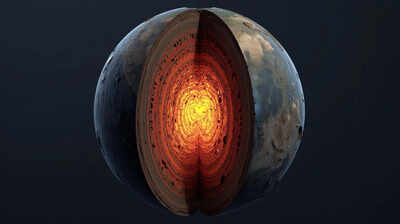
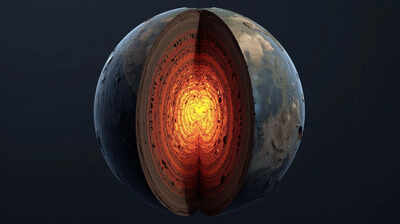
A layer of molten rock deep inside some rocky planets may be doing more than shaping their interiors. New research points to the possibility that these hidden magma oceans could help protect planets over long stretches of time. The idea is not centred on surface conditions or atmospheres, but on what happens far below, under pressures far beyond anything found on Earth. Scientists studying large rocky exoplanets, often called super-Earths, suggest that molten rock under extreme pressure may behave in ways that were not expected. Rather than acting as an insulator, it may conduct electricity. That shift alone opens up another way for planets to generate magnetic fields, which are often linked to long-term planetary stability.
Molten rock beneath super-Earths could protect planets against solar winds and cosmic radiation
The focus of the study is a structure known as a basal magma ocean. This is a dense, molten layer that can form near the boundary between a planet’s mantle and its core. On Earth, such a layer is thought to have existed only briefly after the planet formed. In larger planets, the picture may be different. Higher mass brings higher internal pressure, and that pressure appears to slow cooling. As a result, molten regions may remain in place far longer, possibly for billions of years, long after the surface has settled.
Magnetic fields may form without a metal core

Planetary magnetic fields are usually linked to liquid iron cores. Earth follows that pattern. Some larger rocky planets may not. Their cores could be fully solid or too fluid to sustain the kind of motion needed for a classic dynamo. This is where the magma layer comes in. If molten rock becomes conductive under pressure, its slow movement could also generate a magnetic field. It is not a replacement for a core driven field, but another path that might operate when the usual one does not.
Pressure alters the behaviour of molten rock
The research, led by Miki Nakajima at the University of Rochester and published in Nature Astronomy, looks closely at how mantle materials behave under extreme conditions. The team focused on minerals rich in magnesium and iron, common components of rocky planets. At pressures hundreds of gigapascals higher than those inside Earth, molten versions of these minerals showed electrical properties closer to metals than to rock. This shift in proximity was not a small adjustment but a change that could make a physical difference on a planetary scale.
Experiments briefly recreate alien conditions
To explore this, researchers used laser-driven shock experiments to momentarily recreate the pressures thought to exist deep inside super-Earths. These experiments took place at the Laboratory for Laser Energetics in Rochester. They were short and intense, and they were paired with computer simulations that filled in the longer story. Quantum mechanical models helped estimate how molten rock behaves over time, while planetary evolution models explored whether these magma layers could last long enough to matter.
Planet size shapes the outcome
The study suggests that size plays a quiet but important role. Planets between three and six times the mass of Earth appear most likely to maintain long lived magma oceans. In that range, internal heat and pressure balance in a way that keeps the molten layer from crystallising too quickly. The magnetic fields generated by such layers could be stronger than those produced by metal cores alone. Strength matters, but duration may matter more. A weaker field that lasts billions of years may offer more protection than a strong one that fades early.
Habitability depends on unseen processes
Magnetic fields are often discussed in relation to atmospheres and surface water. This work shifts attention inward. A planet’s ability to hold onto an atmosphere may depend as much on deep interior chemistry as on distance from its star. A magma-driven magnetic field does not guarantee habitability. It does, however, widen the range of planets that might remain stable long enough for other conditions to fall into place.
A slow influence beneath the surface
Basal magma oceans leave little trace at the surface. They do not shape landscapes or weather. Their influence is quieter, acting over timescales that are hard to observe directly. The study does not claim that such layers are common or that they solve the problem of planetary habitability. It suggests another mechanism that may operate in the background. Much remains uncertain. For now, the molten rock stays buried, shaping planetary futures without drawing attention to itself.
Discover more from stock updates now
Subscribe to get the latest posts sent to your email.