Broadcom sees AI chip sales ‘significantly’ over $100 billion in 2027
Lucas Jackson | Reuters

After the chipmaker reported better-than-expected results for the fiscal first quarter and issued a strong forecast for the current period, Tan said on his company’s earnings call that demand is picking up from large customers that are increasingly in need of Broadcom’s help in designing custom silicon.
“We have also secured the supply chain required to achieve this,” Tan said, regarding the 2027 sales target.
AI revenue in the first quarter more than doubled from a year earlier to $8.4 billion, while total sales increased 29% to $19.3 billion. The company expects AI semiconductor revenue of $10.2 billion this quarter.
Broadcom shares popped more than 5% in extended trading on Thursday after Tan’s comments.
Chip companies like Broadcom have faced a number of headwinds in recent months, including a shortage of the high bandwidth memory crucial for custom accelerators, and capacity constraints at the most advanced levels of chip manufacturing and packaging.
Broadcom helps its customers translate their chip designs into silicon, providing back-end support before the processors are sent off to be manufactured at huge fabrication plants by companies like Taiwan Semiconductor Manufacturing Company.

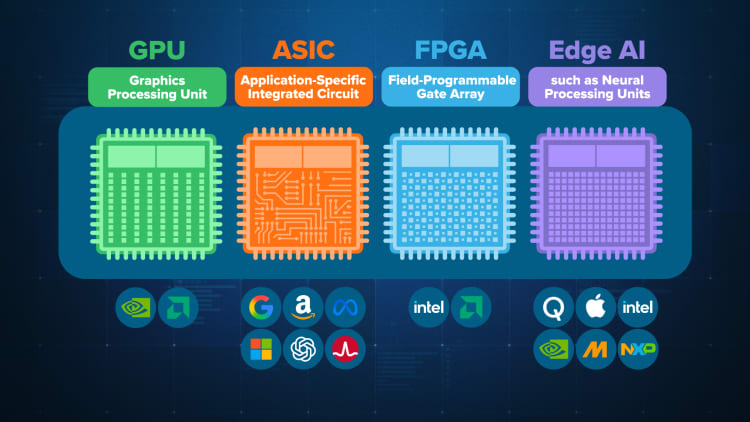
It’s a role that’s fueled Broadcom’s growth as more tech giants design in-house accelerators for AI. Tan said custom AI deployment is entering its “next phase” and is expected to speed up, as the company helps six key customers design their chips. Chief among those are Google, Meta, Anthropic and OpenAI, with Fujitsu and ByteDance likely as the final two.
Google was the first to the in-house chip game in 2015, with its tensor processing units designed alongside Broadcom. Google has made its chips available to cloud customers since 2018, with key customers now including Apple and Anthropic. Broadcom expects even stronger demand from next-generation Google chips in 2027.
Meta is also reportedly in talks to use Google’s TPUs, and Broadcom assists the social media company with developing its own MTIA accelerator. Analysts have cast doubt on the future of Meta’s custom silicon program, but the “MTIA roadmap is alive and well,” Tan said on the earnings call.
During the question and answer portion of the call, Bernstein Research analyst Stacy Rasgon pushed Tan on the specific sources of the projected $100 billion in AI chip revenue. He counted 3 gigawatts of capacity at Anthropic, 3 gigawatts at Google, at least 2 gigawatts with Meta, and 1 gigawatt from OpenAI, among others. Tan said the dollars per gigawatt “vary, sometimes quite dramatically,” but that his estimates were “not far” off.
While Tan said that the AI revenue boost would come from “just chips,” Broadcom makes much more than just AI accelerators. Ben Bajarin of Creative Strategies said it includes digital signal processors, data processing units and networking switches.
It’s “everything in that bucket,” Bajarin said.
— CNBC’s Jordan Novet contributed to this report.
WATCH: Broadcom CEO on Ai revenue

Discover more from stock updates now
Subscribe to get the latest posts sent to your email.