



Roman mosaic shows first known female beast-fighter, researcher says
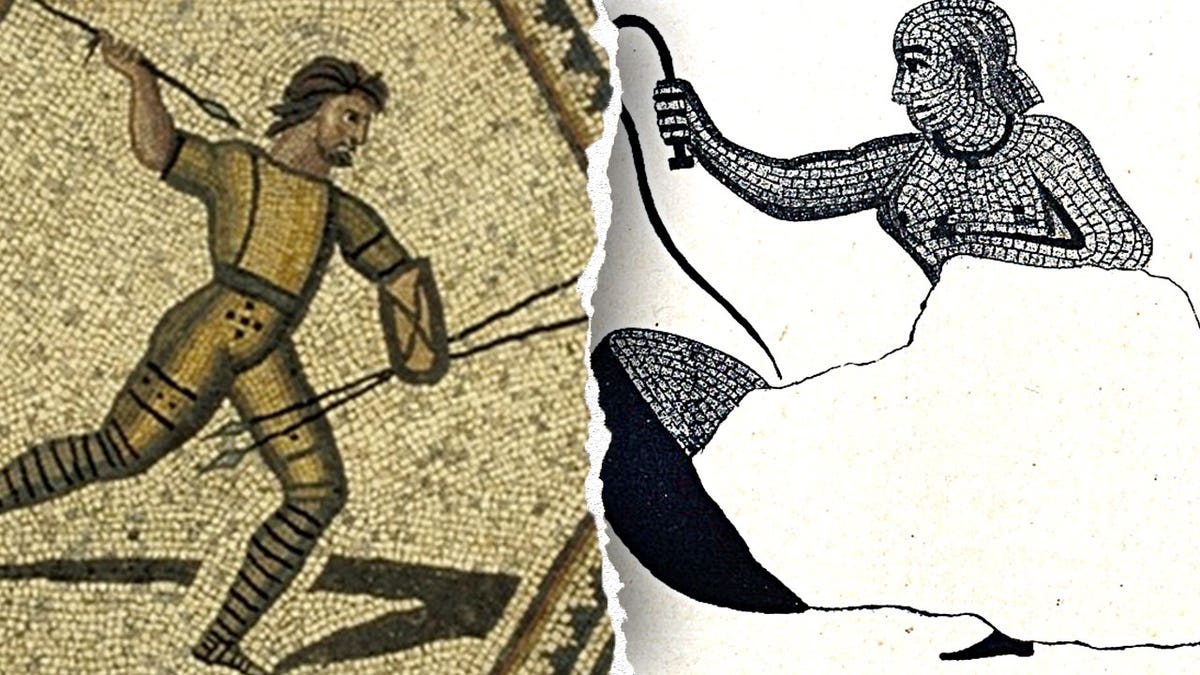
An ancient Roman mosaic shows a woman fighting a wild beast in the arena — a rare depiction of a female combatant and the first known visual representation of a woman battling animals, according to a researcher.
The mosaic, which dates to around 250 A.D., appears to show a woman confronting a leopard, with a photo of the damaged artwork showing her wielding a whip beside the animal.
Author Alfonso Manas, a researcher in Spain, argues that the mosaic is the first-known depiction of a woman fighting an animal in the Roman arena.
‘HIGHLY UNUSUAL’ CANNONBALL CACHE FOUND AT CONSTRUCTION SITE IN COASTAL CITY MAY BE WORLD’S FIRST
The discovery adds to “documented evidence of women performing as gladiators and beast-fighters,” Manas told Fox News Digital.
The most persuasive evidence that the figure is female is the fact that she was topless, Manas noted — which he described as “conclusive.”
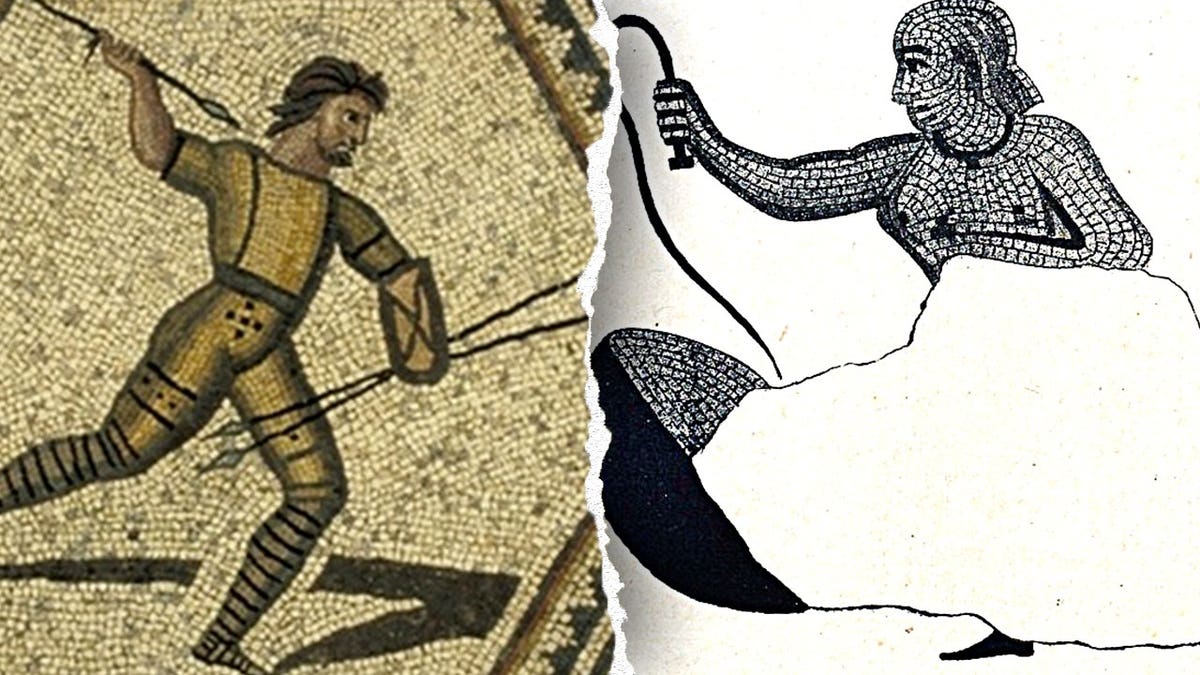
“Showing her topless was actually the typical resource in Roman mosaics to show that a figure was a woman, something hard to determine in [the] context of men due to the lack of fine detail of mosaics,” the expert noted.

“And the strongest piece of evidence showing she is a beast-fighter is the leopard on her left, running away from her whip.”
Manas added, “Thus, she is a female beast-fighter, a venatrix — the first known depiction of one of those women.”
The researcher emphasized that beast-fighters and gladiators were not synonymous, however.

The ancient artwork is believed to show a woman wielding a whip against a leopard, offering rare insight into female performers in Roman spectacles. (Alfonso Manas)
“To confuse them is as if we today confuse a boxer with a bullfighter — they are two completely different things,” he said.
“Their only feature in common in Rome was that they performed in the same building, the amphitheatre.”
LEGENDARY CAPTAIN WHO INSPIRED ‘THE THREE MUSKETEERS’ MAY HAVE BEEN FOUND UNDER CHURCH ALTAR
Manas said male beast-fighters were far more common, with over 1,000 known visual depictions of men compared to just one of a woman.
The historian added that women often attended shows as spectators.
“The main difference between men and women in the arena was that men were performers, managers and spectators.”
Men exclusively handled organizing the games and officiating the fights — but beyond those roles, women participated in nearly every other aspect of the spectacles.
“The main difference between men and women in the arena was that men were performers, managers and spectators, whereas women were only performers and spectators,” Manas noted.
TEST YOURSELF WITH OUR LATEST LIFESTYLE QUIZ
The discovery also proves that females performed topless, which was meant to intrigue men.
Doing so “would help those female performers to become more popular and, thus, earn more money in their careers,” said Manas.

The discovery highlights distinctions between gladiators and beast-fighters in ancient Roman culture. (Three Lions/Getty Images)
The researcher also noted that women were banned from taking part in gladiatorial matches in 200 A.D., on the command of Emperor Septimius Severus.
It was unclear if female beast-fighters were also impacted by the ban, but Manas said his discovery suggests they were not, as the mosaic dates to roughly 250 A.D. or later.
CLICK HERE TO SIGN UP FOR OUR LIFESTYLE NEWSLETTER
“It adds 50 years or more, perhaps a whole century, to the history of women as performers in the arena,” he said.
“This is very important…. Spectators wanted to continue seeing [women] performing in the arena.”
“Diana was the goddess of hunting. She was a huntress, a venatrix, and thus it was seen as acceptable… that women performed as hunters in the arena.”
Manas added that the fact that “a rich man ordered one of those women to appear in the mosaic… shows the great admiration spectators felt toward those women, something similar to the admiration we feel today for female stars of sports, music [and] cinema.”
Unlike female gladiators, who faced criticism and eventual bans, beast-fighters appear to have held a different status in Roman spectacles, Manas said.
CLICK HERE FOR MORE LIFESTYLE STORIES
“Diana was the goddess of hunting. She was a huntress, a venatrix, and thus it was seen as acceptable … that women performed as hunters in the arena,” he said.
“Whereas it was shameful for a woman, and man, to perform as a gladiator, essentially because gladiators killed fellow humans, which was always seen as reproachful.”

While Roman male beast-fighters were widely depicted, images of female counterparts remain extremely rare. (iStock)
The new research comes as discoveries from ancient Rome continue to surface.
In England, excavators recently found a large Roman industrial complex in northern England, complete with hundreds of well-preserved tools.
CLICK HERE TO GET THE FOX NEWS APP
In March, Swiss archaeologists found well-preserved ancient Rome treasures at the bottom of a Swiss lake.
Discover more from stock updates now
Subscribe to get the latest posts sent to your email.