


PepsiCo Stock Reversal Points Toward New All-Time Highs
PepsiCo’s (NASDAQ: PEP) stock price hit bottom in mid-2025 and began to reverse course after years of end-market normalization, company-specific headwinds eased, and the impacts of turnaround efforts began to show traction.
Traction, in the form of revenue growth and margin improvement, continued over the ensuing quarters until fiscal Q1 2026, when the turnaround story strengthened.
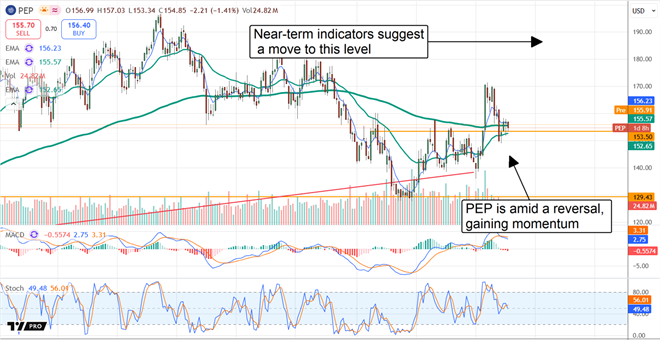
The Q1 results were better than expected, revealing strength in core and growth markets, leading stock price action to confirm support at the critical level, indicating this reversal is in full force and on track to advance as the year progresses. The critical level is near $153.50. This level aligns with prior resistance and the baseline of a Head & Shoulders Reversal pattern. The Head & Shoulders consists of a low followed by a lower low, and then a higher low, but is not confirmed until the baseline is broken.
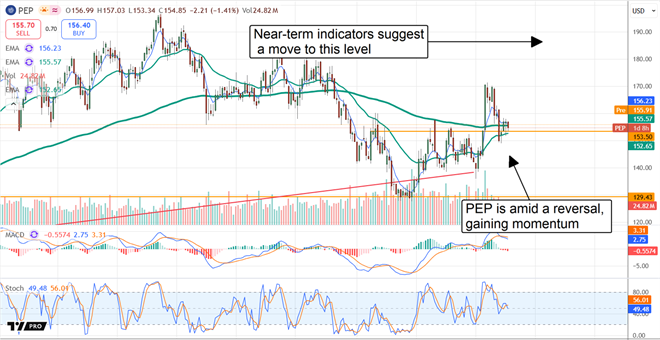

The baseline is a pivot point; when price action moves above it, it reveals a change in market dynamics from distribution to accumulation. Head & Shoulders patterns have significant meaning to technical traders, as they often lead to short-term rallies equal to the pattern’s magnitude, and longer-term uptrends limited only by results. In this case, PepsiCo is back on track to sustain growth over the next several years, meaning its uptrend can continue until the outlook changes.
PepsiCo on Track for New All-Time Highs This Year
PepsiCo’s reversal pattern is worth approximately $24, running from a low near $129.50 to $153.50. Projecting the dollar figure from the baseline yields a target of $177.5; projecting the percentage, approximately 18%, yields a target of $181.15, a target range that equates to 18-month highs for this market. A move to this level could be easily achieved, given the stock’s valuation as of mid-April 2026.
Trading near $155, PEP is valued at under 18X its forward earnings, about six handles below par. Based on that undervaluation, PepsiCo’s stock price could advance by more than $50 to over $200 in the near-to-mid-term, a fresh all-time high. In the longer term, this stock is trading below 12X its 2035 forecast, which is likely low, suggesting it can rise by more than 100% over the coming year.
Institutional activity aligns with the bottom, suggesting it is a hard floor. PepsiCo’s stock price may correct to lower levels if a catalyst arises, but institutional investors will likely step in to buy shares so long as no change in fundamentals is observed. As it stands, the group owns more than 70% of the shares and has been accumulating for eight consecutive quarters. More importantly, activity ramped in Q1 2026, hitting a multi-year high with the balance running above $3 bought for each $1 sold. This is a powerful tailwind for the market and one likely to continue in Q2 and 2026, if not strengthen.
Analysts are equally supportive of PepsiCo’s price action and may provide a catalyst for higher prices in Q2. The group of 20 tracked by MarketBeat rates the stock as a consensus Moderate Buy, with a 40% Buy-side bias. The consensus price target implied 10% upside at the time of the release, though some recent price target reductions capped gains at the high end.
A market catalyst could be the reversion to more bullish attitudes, including price target increases and upgrades. Until then, the consensus sentiment and price target have been relatively stable on a trailing 12-month basis despite ample revision activity, reflecting a high-level conviction in those levels.
PepsiCo Grows and Outperforms in Q1: Capital Returns Are Safe and Reliable
PepsiCo had a solid quarter with 8.5% revenue growth underpinned by 2.6% organic growth, 2.5% acquisitional growth, and a 3.4% currency-related tailwind. The top line and organic growth both accelerated sequentially and outpaced last year’s levels, driven by strength across all segments. Europe, the Middle East, and APAC were the strongest, growing by 7%, but notable gains were made in International Beverage Franchise, Latin America, and core U.S. markets.
Growth was driven by brand investments and pricing initiatives aimed at improving affordability; the critical takeaway is that pricing dynamics drove volume growth in key categories and aided systemwide margin improvement. Operating margin improved by 210 basis points, leaving adjusted EPS at $1.61, up a leveraged 9% compared to the 8.5% revenue gain, and more than a nickel better than expected.
Among investor takeaways is the strength of cash flow and its impact on capital returns. Net income approached $2.3 billion for the quarter, sufficient to cover the dividend and leave the company in a solid financial position. Dividends yield an annualized 3.65%, and repurchases were nearly $2.1 billion, reducing the count incrementally compared to the previous year. Balance sheet highlights show no red flags, as quarterly activity resulted in increases in cash, assets, and equity, with long-term debt at 2X equity.
Before you make your next trade, you’ll want to hear this.
MarketBeat keeps track of Wall Street’s top-rated and best performing research analysts and the stocks they recommend to their clients on a daily basis.
Our team has identified the five stocks that top analysts are quietly whispering to their clients to buy now before the broader market catches on… and none of the big name stocks were on the list.
They believe these five stocks are the five best companies for investors to buy now…
See The Five Stocks Here
The views and opinions expressed herein are the views and opinions of the author and do not necessarily reflect those of Nasdaq, Inc.
Discover more from stock updates now
Subscribe to get the latest posts sent to your email.