Two giant black holes are set to collide in the next 100 years, and Earth could feel the shockwaves |
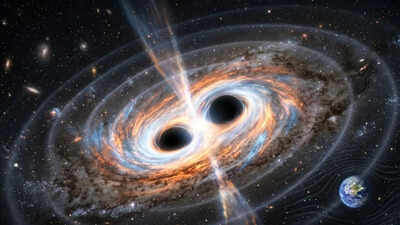
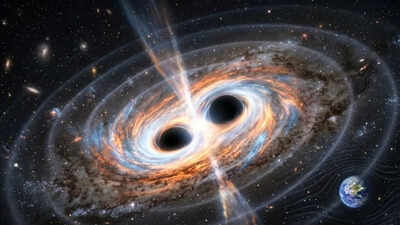
A supermassive black hole binary system (two black holes orbiting each other) has been directly identified in the final stages of orbital decay in all of astronomy. These two supermassive black holes (each boasting a combined mass ranging from 100 million to 1 billion solar masses, the mass of the Sun) are located at the centre of the galaxy Markarian 501, which is about 450 million light-years away from us. They are locked in a tightly bound binary orbit and could complete their merger within 100 years, as noted in the study on SKYCR. Although we are far away from this massive collision, the energy released by the final collision will send gravitational waves through the fabric of space-time and will be detectable on Earth. This exciting discovery opens an incredibly rare window into the later stages of galaxy formation and the birth of an entirely new supermassive object in the universe.
Two giant black holes are set to merge in the next 100 years

According to Research in Germany, an international team of scientists, led by Silke Britzen from the Max Planck Institute for Radio Astronomy, has discovered a second particle jet in the core of Markarian 501, challenging the previous belief that only one jet was present. Upon studying high-resolution radio data collected over 23 years, researchers identified that the second jet orbits the first jet. The periodic helical motion and precession of the jet provide direct evidence that two supermassive black holes are mutually bound by extreme gravitational interaction.
Why 100 years is an astronomical ‘blink of an eye’
The distance between the two black holes is only 250–540 times that between the Earth and the Sun, which astronomers view as a very tight orbit for such massive objects. Based on the 121-day orbital period of the black holes, researchers have determined that energy is being rapidly lost from the system, and that depending on the masses of the two black holes, they could merge and become one in 100 years. From an astronomical perspective, this is a short timeframe; therefore, the next 100 years will give humanity a unique opportunity to observe the ‘final parsec’ problem – how binary systems overcome the ‘Final Parsec’ barrier to achieve coalescence and merge.
How Earth will feel the energy of galactic giants
The eventual merger of these two black holes will create a burst of energy. This energy will be released as gravitational waves. While no direct danger to Earth exists from this energy, the gravitational waves produced will result in a periodic strain on the metric of spacetime such that future scientific instruments will detect ripples travelling at the speed of light.Gravitational waves are expected to be detected by Pulsar Timing Arrays (PTAs) before the black holes actually collide. In fact, as the two black holes approach collision, the frequency of the gravitational waves will increase, enabling astronomers to record and listen in on one of the most important events in gravitational radiation history, perhaps the greatest single source of gravitational radiation ever recorded by humans.
Discover more from stock updates now
Subscribe to get the latest posts sent to your email.