


Spain touts resilience amid Iran war, Trump trade tensions
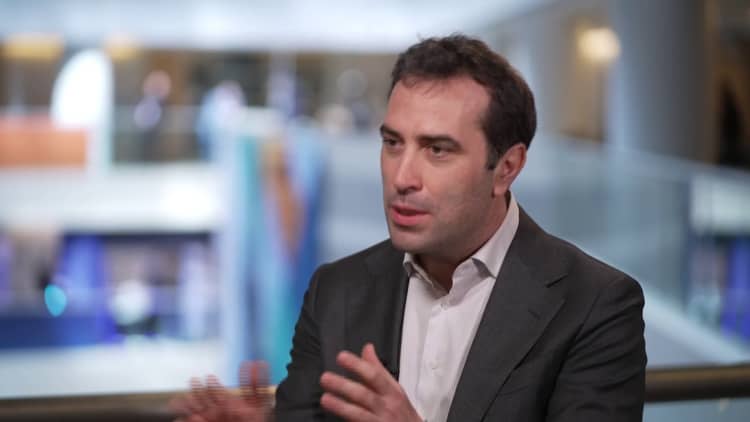
Bloomberg | Bloomberg | Getty Images
His comments come at a time when Spain’s government has emerged as one of the European Union’s leading critics of the U.S.-Israel war against Iran, with Prime Minister Pedro Sánchez having described the ongoing Middle East crisis as a “disaster.”

U.S. President Donald Trump pledged to cut off trade with Madrid after Spain prevented two jointly operated bases in its territory from being used in strikes against Iran.
Speaking to CNBC’s Karen Tso on Thursday, Cuerpo said that Spain had been better prepared for this crisis, pointing out that the country has been the fastest-growing advanced economy in Europe over the last couple of years.

Spain also created 40% of all new jobs in the euro zone last year, Cuerpo said, while noting that on budgetary terms, the country’s debt has nearly returned to pre-Covid levels.
“In energy terms, we’re also better prepared because we’ve pursued our agenda on renewables,” Cuerpo said on the sidelines of the IMF and World Bank Group Spring Meetings in Washington this week.
Spain’s reliance on gas for electricity prices has dropped to just 16% this year, Cuerpo said, down from 75% in 2019. “So, it kind of increases our energy sovereignty and reduces the exposure to the shock,” he added.
Cuerpo acknowledged, however, that citizens and businesses were still suffering the consequences of the Iran war through higher fuel and fertilizer prices.
Analysts have pointed to Spain as a prime example of how countries have been able to limit their exposure to fossil fuel price volatility in recent weeks.
Spain, alongside Portugal and some Nordic countries, is among the countries to have registered the lowest gas prices across the 27-nation bloc since the Middle East conflict began.
Spanish Prime Minister Pedro Sánchez (R) and Ukrainian President Volodymyr Zelensky (L) meet at Moncloa Palace on March 18, 2026 in Madrid, Spain.
Pablo Cuadra | Getty Images News | Getty Images
Spain’s renewables push has not been without its critics. Indeed, the country’s government was sharply criticized last year following a catastrophic blackout. The outage, which some U.S. lawmakers blamed on Spain’s green agenda, was one of Europe’s worst in living memory.
Spain’s government subsequently denied renewable energy was to blame for the blackout, and a report by Entso-e, which had been investigating the root cause of the April 2025 incident, later found that there was no single cause and instead said there was a combination of “many interacting factors” which led to the outage.
Spain’s anti-war stance
Speaking alongside German Chancellor Friedrich Merz last month, Trump pledged to sever trade ties with Spain, saying the White House did not want anything to do with the country.
The U.S. president has also repeatedly criticized Madrid for its refusal to meet the NATO defense spending target of 5% of gross domestic product.
Trump’s threat to punish Spain on trade is said to be challenging, however, given that the 27 EU nations negotiate trade agreements collectively.
“Spain did not want to participate in this unilateral conflict that is outside of international law. And that’s actually what we did,” Cuerpo said when asked about Spain’s anti-war position and Trump’s trade threats.
“We’re not alone in this position against the current situation and the participation in the war in Iran, many other European countries and partners have also expressed a very similar position,” he continued.
“And when it comes to trade relations with the U.S., Spanish companies operate in the exact same environment as French, German or Italian ones, because we have a unique trade relation. I mean within the EU with respect to the U.S., and we’re trying to go ahead with a deal that we signed last August, and that’s actually where we should put all our efforts to be able to fulfil that deal and make good on it.”
Discover more from stock updates now
Subscribe to get the latest posts sent to your email.