Energy transition to renewables in Seoul, South Korea: Minister
Shin Yong-ju | Afp | Getty Images
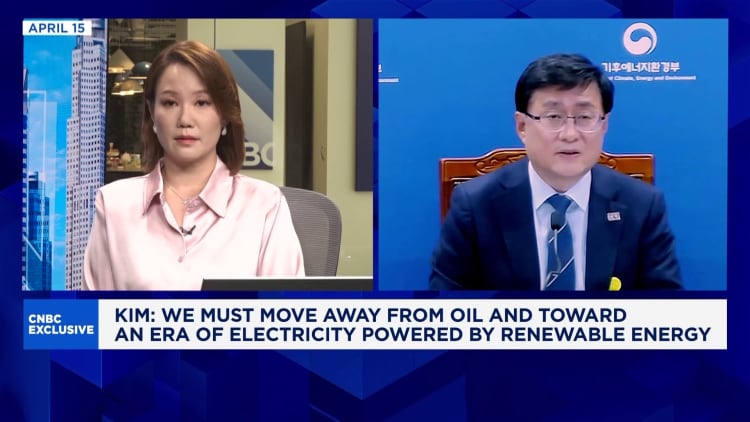
In an interview with CNBC’s Lisa Kim, South Korea’s Minister of Climate, Energy and Environment Kim Sung-hwan said there is a “growing national consensus that we must undergo a fundamental energy transition.”
Seoul has committed to achieving 100 gigawatts of renewable energy capacity by 2030. Currently, South Korea’s total renewable energy capacity stands at 37 gigawatts, according to the Renewable Energy Institute.


Kim said that the country will focus on wind and solar power to achieve its goal of increased capacity.
South Korea derived only about 9% of its power needs from renewables in 2025, mostly from solar, according to IEA data.
“Since wind power takes considerable time from preparation to actual generation, we will try our best while focusing on solar power as the most effective solution in the short term,” Kim said.
When asked if the country experiences enough sunlight to generate the required solar power, Kim expressed confidence. Seoul receives an average of 2,148 hours of sunshine annually, and Kim said provinces such as South Jeolla and Jeju Island receive 100 hours more than the capital. He contrasted that with Germany, saying South Korea was “in a much better position” than Europe.
Solar panels at a parking lot in the Jeju Techno Park in Jeju, South Korea, on Monday, Jan. 17, 2022.
Bloomberg | Bloomberg | Getty Images
Kim acknowledged that South Korea’s solar-related industries have shrunk considerably due to China dominating the market for solar components, but said his country possesses “substantial technological prowess in this field,” and Seoul will ensure that subsidies are directed toward fostering and protecting the domestic solar industry.
“By structuring solar power profits to benefit our own citizens, we can turn this challenge into a blessing in disguise,” he said.

A report from South Korean news outlet Chosun Ilbo said the market share of Chinese solar cells in South Korea surpassed 95% in 2024, up from 38% in 2019. South Korea’s domestic share, in contrast, fell from 50% in 2019 to just 4% in 2024.
According to data from the China Photovoltaic Industry Association, China produced 93.2 % of the world’s polysilicon, 96.6% of wafers, 92.3% of photovoltaic (PV) cells, and 86.4% of PV modules in 2024.
Near-term concerns
However, South Korea still needs to deal with the near-term energy fallout from the Iran war.
Kim said Seoul would delay by around six months the closure of two coal-fired power plants that had been expected to shutter in June, and restart one of its nuclear power plants in an effort to reduce the demand for natural gas. Increased gas prices feed into higher electricity production costs.
The country has committed 22 million barrels of oil to the International Energy Agency’s release effort, although the minister said there are currently no plans to release these reserves immediately as the situation has not had a “direct or significant impact on supply and demand.”
South Korea, Asia’s fourth-largest economy, imports 94% of its energy, according to a 2024 report from the Korea Energy Statistics Information Systems, and almost 72% of its crude oil comes from the Middle East.
Motorists line up to fill up at a petrol station in Seoul on March 9, 2026. The price of the main US benchmark for oil surged more than 30 percent on March 9, 2026 over concerns that the Middle East war could create prolonged supply disruptions. (Photo by Jung Yeon-je / AFP via Getty Images)
Jung Yeon-je | Afp | Getty Images
In late March, Seoul approved a supplementary budget worth 26.2 trillion won ($17.6 billion) to ease the burden of rising energy prices on households and industries, as well as imposing a price cap on fuel products.
To reduce energy demand, the capital has also reportedly implemented a rotating parking system for public car parks, and public sector workers’ vehicles will be banned from parking every other day based on license plate numbers.
Kim told CNBC the impact hasn’t quite reached the point where electricity rates need to be raised, saying an electricity price hike materializes about three to six months after oil and gas prices rise.
“That said, the situation is difficult to predict. We will closely monitor the situation in June and July and carefully devise various mechanisms to prevent electricity price hikes,” he added.
Discover more from stock updates now
Subscribe to get the latest posts sent to your email.