


Is Now a Good Time to Buy Microsoft Stock?

Key Points
- Microsoft’s revenue rose 17%, and its adjusted earnings per share jumped 24% in fiscal Q2.
- Alphabet’s Google Cloud revenue grew 48% in its most recent quarter, significantly outpacing Microsoft cloud computing revenue growth.
-
With AI introducing new risks to traditional software businesses, Microsoft’s stock may not deserve the premium valuation it previously commanded.
- 10 stocks we like better than Microsoft ›
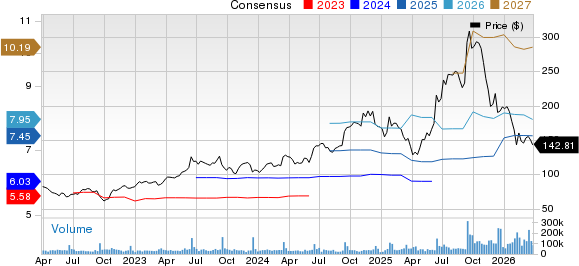
It hasn’t been a fun time to be a Microsoft (NASDAQ: MSFT) shareholder. Shares of the software and cloud computing giant have been hammered, falling nearly 7% last week amid a broader market sell-off. Year to date, the tech stock is down more than 26% as of this writing.
For investors looking at the company’s recent financial results, this sharp decline might look like a screaming buying opportunity. After all, Microsoft just reported another exceptional quarter of top- and bottom-line growth, driven by its impressive cloud operations.
Will AI create the world’s first trillionaire? Our team just released a report on the one little-known company, called an “Indispensable Monopoly” providing the critical technology Nvidia and Intel both need. Continue »
But risks are mounting on the horizon. While Microsoft’s business is currently performing well, a closer look at the competitive landscape reveals that rival Alphabet (NASDAQ: GOOG)(NASDAQ: GOOGL) is gaining serious ground in the cloud. Further, the rapid advancement of artificial intelligence (AI) is introducing new long-term risks to the software-as-a-service model that Microsoft relies on so heavily.
So, is this a good time to buy the stock? Is it actually a good time to avoid it?

Image source: Getty Images.
Strong results
If you were to judge Microsoft solely on its fiscal second-quarter performance, the stock’s sell-off would seem entirely unwarranted.

During the period, which ended on Dec. 31, Microsoft’s revenue rose 17% year over year to $81.3 billion. And profitability was even more impressive. The company’s non-GAAP (adjusted) earnings per share jumped 24% to $4.14.
The primary growth engine, as usual, was the company’s cloud operations. Microsoft Cloud revenue increased 26% year over year to $51.5 billion. Within that total, “Azure and other cloud services” revenue, which represents the company’s cloud computing business, climbed an impressive 39%.
Adding to the bull case, Microsoft’s commercial remaining performance obligations (RPO) — a measure of contracted but not yet recognized revenue — surged 110% year over year to $625 billion.
On the surface, the business looks unstoppable.
Intensifying cloud competition
However, the narrative changes when you zoom out and look at the broader cloud computing market.
Microsoft is investing heavily to capture AI workloads, with capital expenditures soaring 66% year over year to $37.5 billion in fiscal Q2. But despite this massive spending, competition is heating up.
Consider the recent results from Alphabet. In the company’s most recent quarter, Alphabet’s Google Cloud revenue accelerated to a staggering 48% year-over-year growth rate, reaching $17.7 billion. This significantly outpaced Azure’s 39% growth. Even more, Google Cloud’s growth rate was up from 34% in the prior quarter and Microsoft’s “Azure and other cloud services” revenue actually decelerated. This cloud-computing revenue growth rate was 40% in the prior quarter.
The fact that Google Cloud is growing so much faster than Microsoft’s cloud operations during such a critical period of AI infrastructure investment shows that competition is intensifying in this new and important frontier. Microsoft’s cloud business may be bigger than Alphabet’s, but it appears to be losing some relative momentum to a deep-pocketed rival.
AI’s risk to software subscriptions
Beyond the cloud infrastructure battle, another structural risk looms over Microsoft: the potential for AI to disrupt traditional software.
Microsoft’s productivity and business processes segment, which houses its Office products, is incredibly important to the company’s overall financial health. In fiscal Q2, this segment generated $34.1 billion in revenue. And Microsoft boasts over 450 million commercial seats for Microsoft 365, making it highly reliant on software subscriptions.
But as AI becomes more capable, the nature of software is changing.
The rise of agentic AI systems — software that can autonomously plan and execute complex workflows — could eventually reduce the number of human workers needed for certain tasks. If enterprises eventually need fewer human employees to execute basic knowledge work, they will inherently need fewer Microsoft 365 commercial seats. While AI tools like Microsoft’s Copilot offer near-term monetization opportunities, the long-term risk is that AI introduces deflationary pressure on the per-seat software subscription model.
And even more concerning is that AI enables even more heated competition overall, leading to less pricing power in software and ultimately reducing margins and — ultimately — software profits.
Time to buy?
With Microsoft stock trading at about $357 per share as of this writing, its price-to-earnings ratio sits around 22. Compared to the company’s historical valuation multiples, this might look like a good entry point.
But I believe the stock arguably deserves to trade around its current valuation, or perhaps even lower. The company is facing a brutal combination of soaring capital expenditures, intensifying competition from Alphabet in the cloud — and the unknown long-term risks that AI poses to its core software subscription business. Even more, these unknown risks introduced by AI will likely linger for years.
Overall, I think investors should consider staying on the sidelines and waiting for a deeper discount before buying shares. Given how rapidly Alphabet’s Google Cloud business is gaining market share and the unknowns introduced by AI, it makes more sense to wait for a price that represents a significant discount rather than pay one that looks closer to fair value. A wider margin of safety could help price in the stock’s increased risks.
Should you buy stock in Microsoft right now?
Before you buy stock in Microsoft, consider this:
The Motley Fool Stock Advisor analyst team just identified what they believe are the 10 best stocks for investors to buy now… and Microsoft wasn’t one of them. The 10 stocks that made the cut could produce monster returns in the coming years.
Consider when Netflix made this list on December 17, 2004… if you invested $1,000 at the time of our recommendation, you’d have $503,861!* Or when Nvidia made this list on April 15, 2005… if you invested $1,000 at the time of our recommendation, you’d have $1,026,987!*
Now, it’s worth noting Stock Advisor’s total average return is 884% — a market-crushing outperformance compared to 179% for the S&P 500. Don’t miss the latest top 10 list, available with Stock Advisor, and join an investing community built by individual investors for individual investors.
*Stock Advisor returns as of March 29, 2026.
Daniel Sparks and his clients have no position in any of the stocks mentioned. The Motley Fool has positions in and recommends Alphabet and Microsoft. The Motley Fool has a disclosure policy.
The views and opinions expressed herein are the views and opinions of the author and do not necessarily reflect those of Nasdaq, Inc.
Discover more from stock updates now
Subscribe to get the latest posts sent to your email.