



What is the Minor Planet Centre?

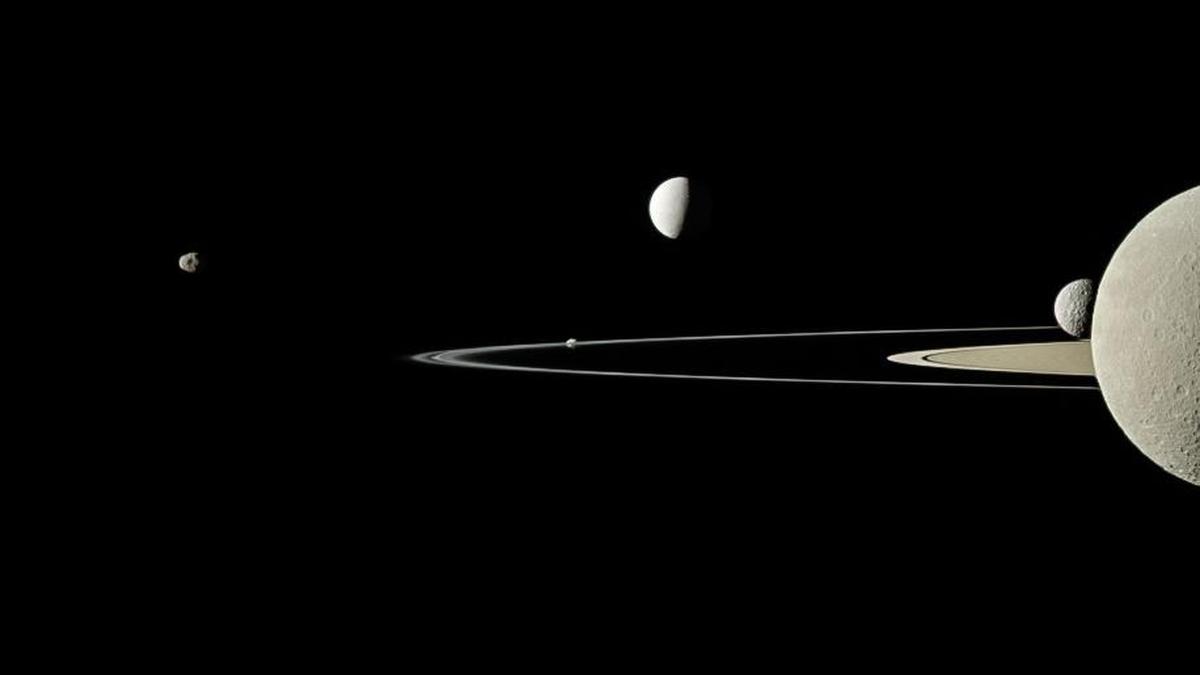
On July 29, 2011, the Cassini mission captured five of Saturn’s moons in a single frame with its narrow-angle camera.
| Photo Credit: NASA/JPL-Caltech

The MPC is the world’s primary repository for all observations of small bodies in the solar system. Located in Cambridge, Massachusetts, it operates at the Smithsonian Astrophysical Observatory under the International Astronomical Union, and plays a vital role in tracking asteroids, comets, and the moons of the outer planets.
When astronomers discover a new object, they send their data to the MPC, where experts verify the observations and calculate the object’s orbit. If the discovery is new, the MPC assigns it an official designation. This process ensures every known minor planet has a unique identity and a predictable path.
One of the MPC’s most critical jobs involves monitoring near-earth objects (NEOs). NEOs are space rocks that could potentially threaten the earth. With support from NASA’s Planetary Defense Coordination Office, MPC maintains a large database that allows scientists to predict if and when a rock might come close to the earth.
The MPC also facilitates communication within the global scientific community by publishing electronic circulars that alert researchers to new discoveries or interesting celestial events. These updates allow observatories worldwide to coordinate their efforts and gather more data quickly.
Published – March 22, 2026 07:30 pm IST
Discover more from stock updates now
Subscribe to get the latest posts sent to your email.