



Animals that show intentional communication is not just human

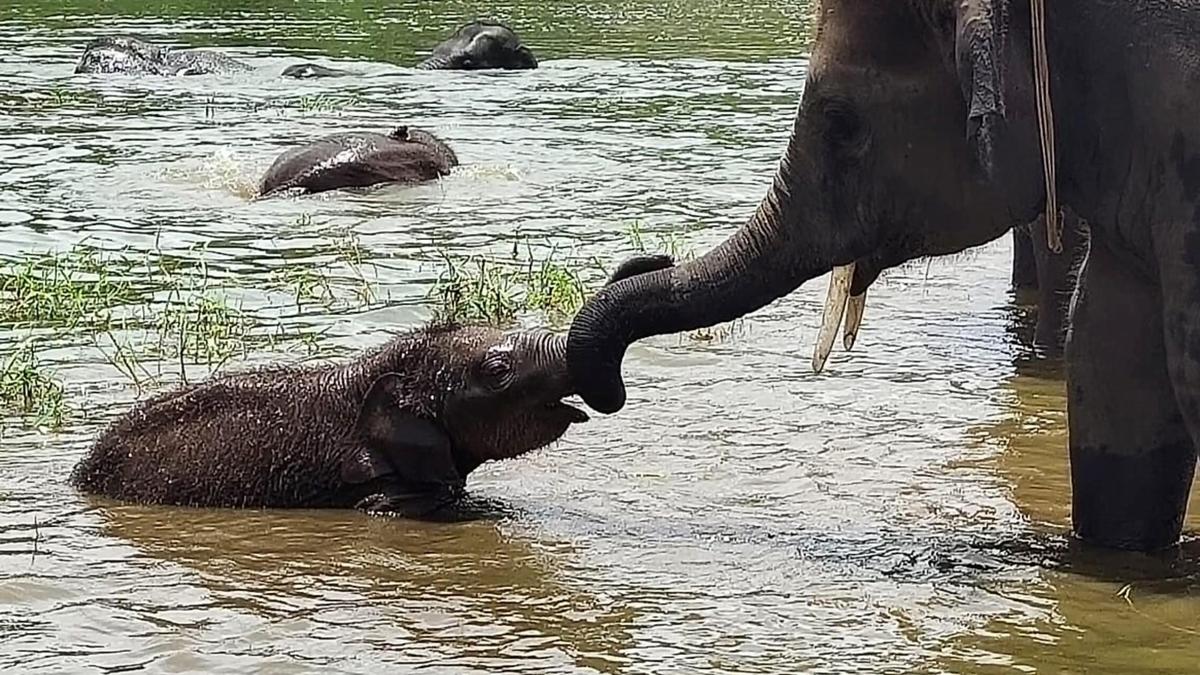
The elephant named Suvarna engages with her calf ‘Sudha’ at Bannerghatta National Park, 2020.
| Photo Credit: File photo
Intentionality requires an audience towards whom the signal is directed. How do we use a gesture to ask someone to do something for us? Take an example of a group at a dining table, where your goal is for a water bottle to be passed to you. First you make sure someone has your attention. Then you make a gesture, and repeat it if you are not understood, until the water is passed on.

Is intentionality a uniquely human trait? Experiments suggest that apes communicate in a goal-directed manner using appropriate gestures. At a higher level, they even seem to have an idea of what other apes in their vicinity know. Orangutans in captivity try communicating with their human handlers, using a particular gesture until their food arrives. Give them the wrong food and they will change over to another gesture — they seem to know that you know!
This brings us to elephants. Elephants are large animals that live in groups with a complex social structure. They are known to have cognitive skills: they are even known to mourn the death of a group member, standing guard over the body and covering it with tree branches.
Individuals, females particularly, are known to greet acquaintances even when they meet after years. The exchange involves flapping their ears and swinging their trunks from side to side, both gestures that require visual attention on part of the recipient. Elephants also have a repertoire of other gestures. Only a few of these, such as touching the recipient with their tail, do not require eye contact.
Elephants may also convey their intentions to their human handlers. In experiments conducted in a conservation area near the Victoria Falls in Zimbabwe, two trays, one empty and the other containing six apples, were placed before an elephant. If a researcher stood along with the trays, facing the animal and making full eye contact, it would begin moving its trunk in the direction of the tray with the apples. Soon, it would get its reward. However, if it was not given all the apples, it would continue to swing its trunk, as if indicating ‘I want more’. When the researcher stood facing away from the elephant, there were no gestures (Royal Society Open Science, 12-242203, 2025).
In India, we have a long history of mahouts, the elephant handlers at temples and in conservation zones, who have one-to-one relationships with elephants that can last a lifetime. Mahouts communicate with elephants and read their emotions using a combination of touch, gestures, and vocal jargon. The zoologist Nibha Nambudiri has meticulously documented elephant-mahout interactions in her book, Practical Elephant Management. At IIT-Guwahati, Seema Lokhandwala and her colleagues, using classifier algorithms, have shown that elephant trumpet calls to mahouts are distinct from those aimed at other elephants. (Speech & Computer, 426-437, 2022, Springer).
The article was written in collaboration with Sushil Chandani, who works in molecular modelling.
dbala@lvpei.orgsushilchandani@gmail.com
Published – March 21, 2026 08:00 am IST
Discover more from stock updates now
Subscribe to get the latest posts sent to your email.