Quantum test shows cause, effect need not follow a set order

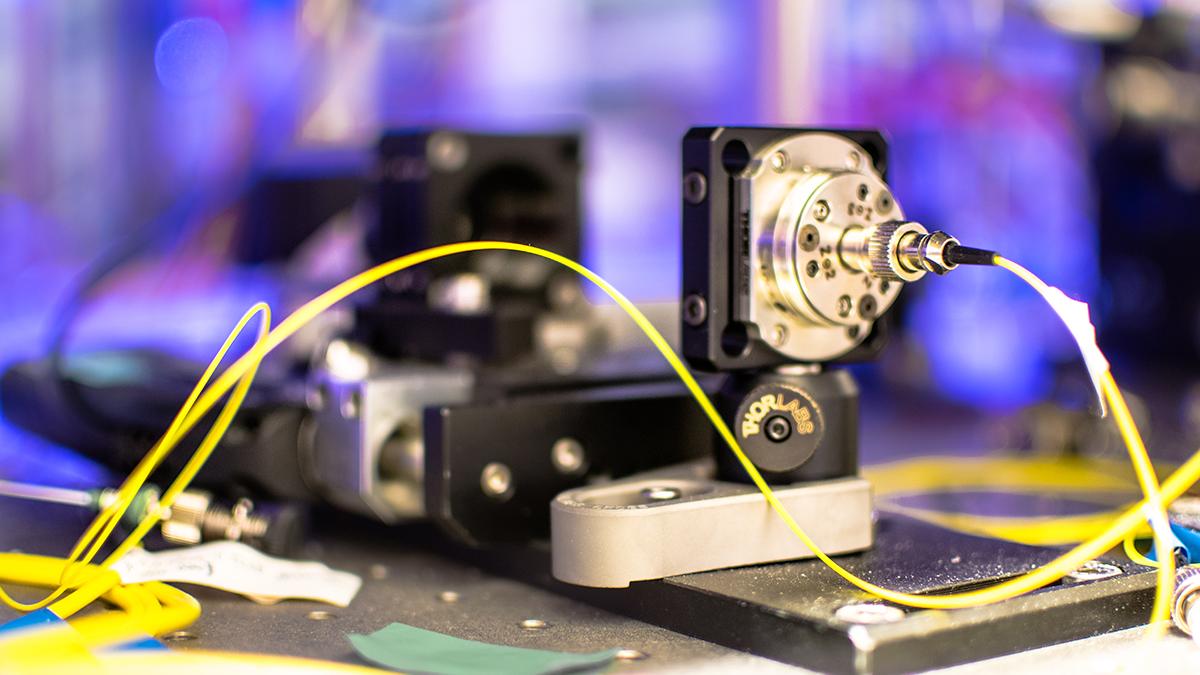
Quantum systems like atoms or electrons can exist in superpositions: a particle can be in two states at once until it is measured. Causality itself can be the same way.
| Photo Credit: Valeria Saggio/University of Vienna
Their results were published in PRX Quantum on March 17.

Quantum systems like atoms or electrons can exist in superpositions: a particle can be in two states at once until it is measured. When causality itself works the same way — e.g. if A happens before B and B happens before A at the same time — it’s called indefinite causal order (ICO).
Scientists have shown ICO can be used to increase the performance of quantum key distribution — a technology scientists worldwide, including recently at IIT-Delhi, are exploring to make communications unhackable. But before anyone can build technology around it, physicists need proof that ICO is a real phenomenon.
In standard causality, it’s impossible for an experiment to score higher than 1.75 on a mathematical test called VBC. If it’s higher, the experiment has ICO. The researchers created pairs of light particles (photons) and sent them through a quantum switch. The switch applied two operations to the photons but in a blurred order: neither operation was definitively first. When the team measured the photons that exited, the test’s VBC score was 1.83.
The photons were correlated with each other in a way that couldn’t be explained by anything happening to them in a fixed sequence. For instance if the photons had gone through operation A then B or B then A, their properties at the end would be correlated up to a certain degree. But the experimenters measured photons whose properties were correlated in a way that couldn’t exist unless there was no fixed order in which the operations happened. The alternative: the photons were in a superposition of both orderings at once.
The researchers were candid that their experiment had loopholes that prevented the result from being dispositive. For instance, because the experiment happened on a single table, it is not yet possible to rule out that some unknown signal travelled between the components to mimic the result.
Closing such loopholes will require separating the participants by much larger distances and improving detection efficiency.
Published – March 20, 2026 07:15 am IST
Discover more from stock updates now
Subscribe to get the latest posts sent to your email.