


U.S. launches fresh Section 301 probes into 60 economies over forced-labor trade practices
Kent Nishimura | Bloomberg | Getty Images
The new investigations, conducted under Section 301(b) of the Trade Act of 1974, include China, the European Union, India and Mexico, according to a statement from the United States Trade Representative.
“Despite the international consensus against forced labor, governments have failed to impose and effectively enforce measures banning goods produced with forced labor from entering their markets,” U.S. Trade Representative Jamieson Greer said.

“These investigations will determine whether foreign governments have taken sufficient steps to prohibit the importation of goods produced with forced labor and how the failure to eradicate these abhorrent practices impacts U.S. workers and businesses,” he said.
Section 301 permits the U.S. to impose tariffs on countries found to have engaged in unfair trade practices without congressional authorization — legal authority that U.S. President Donald Trump had used during his first term to levy duties on Chinese goods.
The forced-labor probes follow Section 301 investigations launched on Wednesday, which targeted excess industrial capacity across 16 economies, including China, Australia, Indonesia, Japan, Malaysia, Singapore, South Korea, Switzerland, Thailand.

The latest probes expanded the list of countries under Section 301 scrutiny to include more countries such as the U.K., Brazil and Russia.
The new investigations appear to serve as an alternative route to replace at least some of the “reciprocal tariffs” that the U.S. Supreme Court quashed last month.
“With the strike-down of the reciprocal tariffs, the administration made it clear that their plan-B would be rolled out soonest,” said Wendy Cutler, vice president at Asia Society Policy Institute and a former U.S. trade representative.
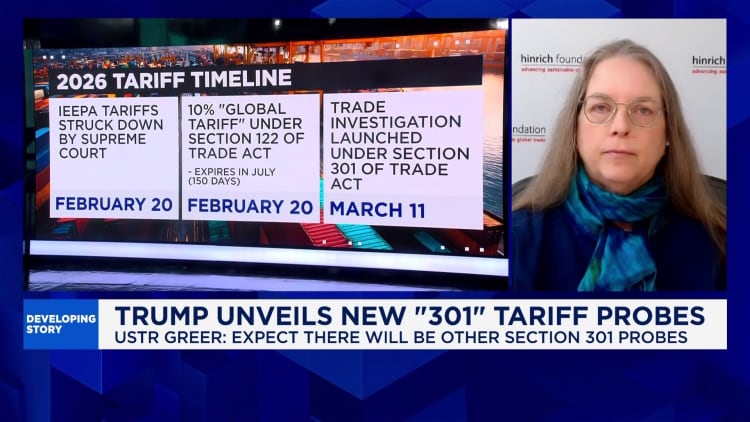
The Supreme Court invalidated Trump’s reciprocal tariffs last month, ruling that the president had exceeded his power. Trump then immediately imposed a 10% global blanket tariff based on Section 122 of the Trade Act 1974, and threatened to raise it further to 15%.
The sweeping scope of the investigations has drawn scrutiny over their feasibility and rationale among trade experts.
The U.S. Trade Representative will hold hearings on the investigations from April 28 to May 1 — an “unrealistically short” timeline given the breadth of countries under scrutiny, said Deborah Elms, head of trade policy at Hinrich Foundation.
Taking aim at European Union, which has enacted its own legislative framework prohibiting forced-labor practices, while sparing countries with significantly weaker enforcement records “does not make sense,” Elms said.
The sweeping breadth of the trade probes also risks alienating partners and squandering the goodwill needed to forge a collective response to address Chinese industrial overcapacity, according to experts.
“The administration is losing an important opportunity to work with partners to address the real excess capacity problem in the world, [which is] China,” Cutler said.
“By adding more than a dozen countries into an investigation on excess capacity our partners will be in no mood to work with us to address the serious challenges China’s excess capacity is presenting globally,” she added.
China in crosshairs?
The investigations come as Treasury Secretary Scott Bessent is expected to meet with his Chinese counterpart He Lifeng in Paris this weekend to continue trade and economic talks, and weeks ahead of a meeting between Trump and Chinese President Xi Jinping.
“China will not view this as good news and will use the upcoming meeting in Paris to express its displeasure,” said Stephen Olson, senior visiting fellow at ISEAS-Yusof Ishak Institute and a former U.S. trade negotiator.
But both sides appear committed to keeping the Trump-Xi meeting on track, “I wouldn’t expect this to upset the apple cart,” Olson said.
Responding to the U.S. section 301 probe on excess capacity, a spokesperson for China’s foreign ministry said at a press briefing Thursday that Beijing’s was opposed to all forms of unilateral tariff measures.
“Launching new trade investigations right before the summit sends the wrong signal,” said Wang Huiyao, founder of the Center for China and Globalization, a think-tank often seen as aligned with Beijing’s thinking.
“A unilateral approach is not going to work. Section 301 has been tried before, and what the two sides need now is to find a way to work together — including on what is happening in the Middle East,” he added.
The first Trump administration launched six Section 301 investigations, with probes into China and the European Union resulting in tariff hikes. The Biden administration also carried out Section 301 investigations, and two probes into Brazil and China remain ongoing.
Discover more from stock updates now
Subscribe to get the latest posts sent to your email.