



Astronomers uncover evidence of two planets colliding in a distant solar system |
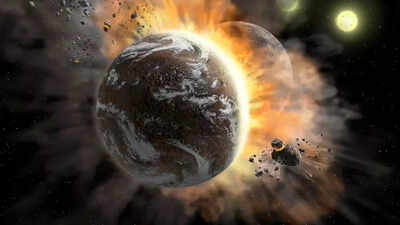
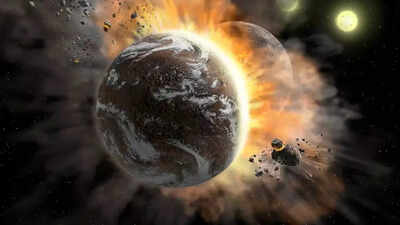
Astronomers have uncovered evidence of a spectacular collision of two planets within the confines of a faraway solar system, providing us with a rare chance to observe firsthand the extremes of celestial phenomena. According to ScienceDaily, the research was conducted by the University of Washington, who were intrigued by a star named Gaia20ehk that had been exhibiting irregular flicker rates. This flicker was identified as the result of a massive glowing cloud comprised of dust particles and heated rocks.According to Eurekalert, the study says that their research has revealed that the event was a high-velocity collision of two planet-like bodies releasing enormous amounts of energy due to the extremely high impact force. The collision was so strong it created what researchers believe is a synestia, a giant, spinning, doughnut-shaped cloud of rock vapour.
How astronomers found evidence of the collision

Astronomers initially noticed flickering starlight from the event, but it wasn’t until they looked at the event from another perspective that they were able to see the true nature of the event. After Andy Tzanidakis and the University of Washington analysed their data, they discovered a remarkable contrast in infrared light emissions compared to visible light emissions; while light from the star was diminishing in intensity, infrared emissions were increasing significantly.That discovery provided the first physical evidence for a planet-to-planet impact. Although the large clusters of material were blocking lots of visible light, the cluster of material was so heated by the impact that they were radiating intense amounts of heat. Their findings, published in The Astrophysical Journal Letters, suggest that the heating resulted from two different planets literally merging into one another.According to the data, the impact created by the two planets was not an instant explosion; rather, it was a series of impacts over multiple years, which included:
- Grazing Impact (2016–2020) – As the two planets were drawn closer together, they began to graze one another along the surface. As a result, they had a few grazing impacts, which were responsible for the first dips in the star’s brightness, but did not create an enormous amount of heating.
- Complete Impact (2021) – Eventually, the two planets collided at their ‘head/afront,’ producing a tremendous amount of heat, vaporising the rocks into a bright, visible cloud.
- Debris Orbit: This cloud of dust is in an elongated orbit around the original star, at 1 AU (the same as the distance between the Earth and the Sun), and scientists believe that the material could eventually cool and solidify into a new planet or moon system, similar to the one we have.
The birth of a Synestia
A planet versus a planet collision would typically be destructive and end their existence, but to a star, the collision is just a minor interruption. Since Gaia20ehk is millions of times larger than the rocky planets that collided, the star itself remains completely intact and will not be affected in any way. However, the debris created from the collision will start to go through an amazing evolution process.The first thing that will happen is that there will be a Synestia created. A Synestia is a huge, doughnut-shaped vapour and molten rock cloud that forms when an impact is so violent that the planet was solid and is instantaneously converted to gas under pressure from the impact. The doughnut-shaped Synestia will be much larger than the combined original planets and will serve as a temporary link between destruction and new life.
Discover more from stock updates now
Subscribe to get the latest posts sent to your email.