



Tamil Nadu needs more basic science funding to create green technology
First, the State’s strategy on environment and climate action has been to integrate climate action across sectors rather than increase a core allocation for the environment and climate change department. Within this framework, it has launched a series of dedicated environmental missions since 2021. In the 2021-22 fiscal, the State allocated ₹500 crore to establish the Tamil Nadu Climate Change Mission — one of the first of its kind among States — and another ₹150 crore for the Wetlands Mission to restore 100 ecologically sensitive water bodies.
The following year the State established the Tamil Nadu Green Climate Fund with a ₹1,000-crore corpus to finance renewable energy, electric mobility, pollution-control technologies, forest conservation, and circular-economy projects, among other climate-related technologies. It committed an initial ₹100 crore as sponsor capital with the fund tasked with mobilising more from development finance institutions and international climate investors.

By 2023-24, it had expanded its conservation efforts by dedicating ₹10 crore to Project Nilgiri Tahr and scaling up the Green Tamil Nadu Mission to increase forest cover. The 2024-25 budget expanded the Sustainably Harnessing Ocean Resources, or SHORE, scheme to strengthen the blue economy and provided subsidies for electric vehicles to promote sustainable transportation.
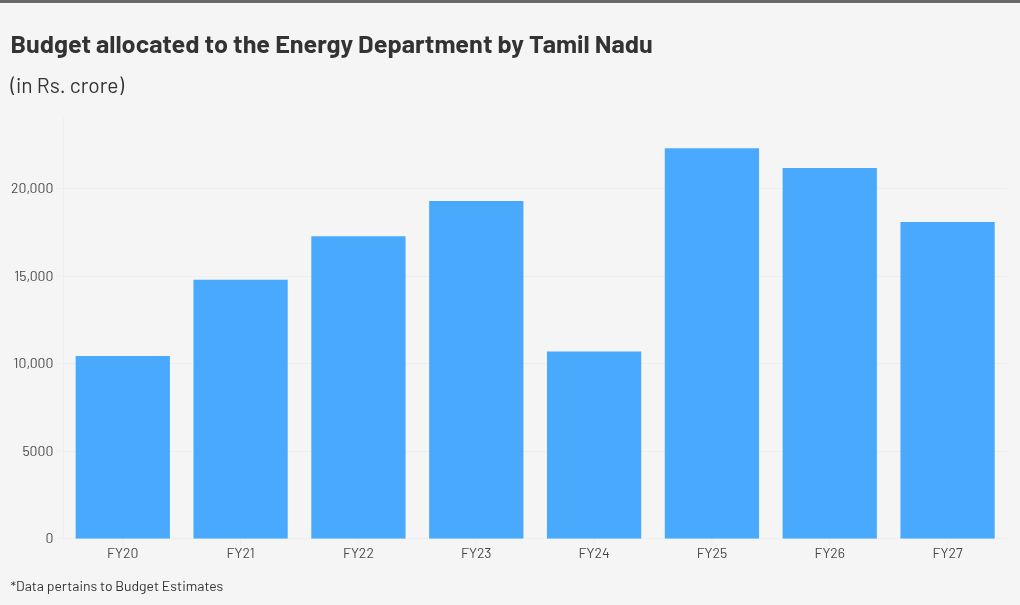
Spending surged in 2025-26 as the government allocated ₹21,178 crore to the energy department, which includes investments in renewable generation, pumped-storage hydro projects, battery energy storage systems, and other power infrastructure, and ₹100 crore to build new basic science research centres in Chennai and Coimbatore.
The government also said in 2025 that Tamil Nadu had spent around ₹15,270 crore over the previous four years on disaster relief, mitigation, preparedness, and capacity-building programmes.
S&T spending
Second, although revenue spending on science and technology (S&T) has risen in recent years, it still represents only a small share of the State’s broader fiscal priorities. Before proceeding further, note that according to the National S&T Management Information System (NSTMIS), Tamil Nadu had spent more than ₹600 crore a year on overall R&D until 2020-21. The difference arises because the NSTMIS assesses the R&D expenditure across departments rather than going by the expenses under the S&T head. For Tamil Nadu, this expenditure is spread across agriculture (crop research, pest control, soil science, etc.), veterinary services (livestock and aquaculture research), public health (clinical research at State medical college), and other applied sectors.
Even this figure has two important dimensions. For Tamil Nadu, this expense is spread across agriculture (crop research, pest control, soil science, etc.), veterinary services (livestock and aquaculture research), public health (clinical research at State medical colleges), and other applied sectors. Dimension 1: applied research doesn’t produce the underlying IP. Dimension 2: in the same period when Tamil Nadu spent just over ₹600 crore a year on overall R&D, Gujarat spent ₹922 crore and Uttar Pradesh, more than ₹1,000 crore.
A global comparison is possible as well. When South Korea’s GDP per capita was what Tamil Nadu’s is today, it was already allocating 1.2% of its GDP to R&D. However, Tamil Nadu’s total R&D expenditure is under 0.5% of its GSDP, meaning that the State is currently spending less than half of what is required (by the South Korean yardstick) to foster a world-class innovation ecosystem.
The State’s dedicated budgetary allocation for pure S&T in particular has been much lower of course. In the decade leading up to 2021-22, it had an annual revenue expenditure averaging around ₹10 crore. But as the State pivoted to being a technology-driven economy and got going on its ‘net zero’ commitment, the figures began to climb. By the 2025-26 fiscal, for instance, the allocation reached ₹67.5 crore and in 2026-27, an estimated ₹81 crore.
But while the increase between pre-2021 and 2021-27 is eightfold in nominal terms, it is dwarfed by the allocations for the climate-related missions. The State set aside more than ₹21,000 crore for the energy sector in 2025-26 alone. In fact, until it announced ₹100 crore in the 2025-26 budget for the new ‘Basic Sciences and Mathematics Research Centres’ in Chennai and Coimbatore, State funding for fundamental research was modest — most of it in the form of small grant programmes (₹10,000 to ₹1,00,000) such as those administered by the State Council for Science and Technology. The major research institutions in the State, such as IIT-Madras and the Institute of Mathematical Sciences, are mostly funded by the Union government.
As a result, the State currently lacks the mature R&D required to develop homegrown technologies. This means Tamil Nadu’s current expenditure risks rendering it a consumer of green technologies, including buying solar panels and EV batteries, rather than being a creator of the underlying research breakthroughs. For instance, despite Tamil Nadu being a national leader in solar installations, more than 80% of photovoltaic modules in these projects are imported from China or sourced from manufacturing hubs in Gujarat, such as those operated by the Adani Group or Waaree Energies.
Published – March 12, 2026 07:05 am IST
Discover more from stock updates now
Subscribe to get the latest posts sent to your email.