


Traders Buying Dips Using XND Bull Put Spreads
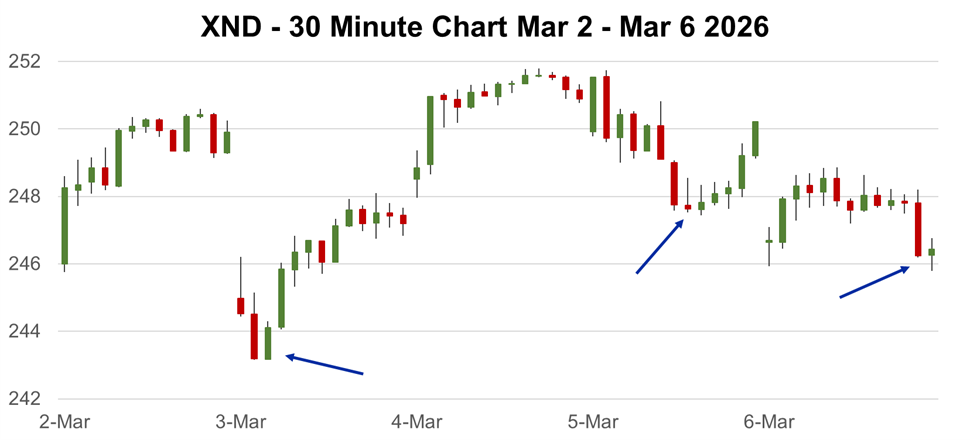
An old weather saying states March, “Is in like a lion and out like a lamb”. After the first week of March 2026, we may say the same about the stock market. The Nasdaq-100 and by association the Nasdaq-100 Micro Index (XND) were lower by over 2.5% early in the week, finishing down 1.27% for the full week. Weak markets usually have us looking for traders brave enough to put on a long position in the face of downside volatility. Bullish spreads, like those described below, are a common method of trying to buy the dips, and a variety of examples from a week that offered a few dips follow. The chart below shows XND’s price action on the 30-minute basis for the week of March 2 to March 6. The arrows highlight times where well timed bullish put spreads were executed using XND index options.

Data Sources: Barchart.com
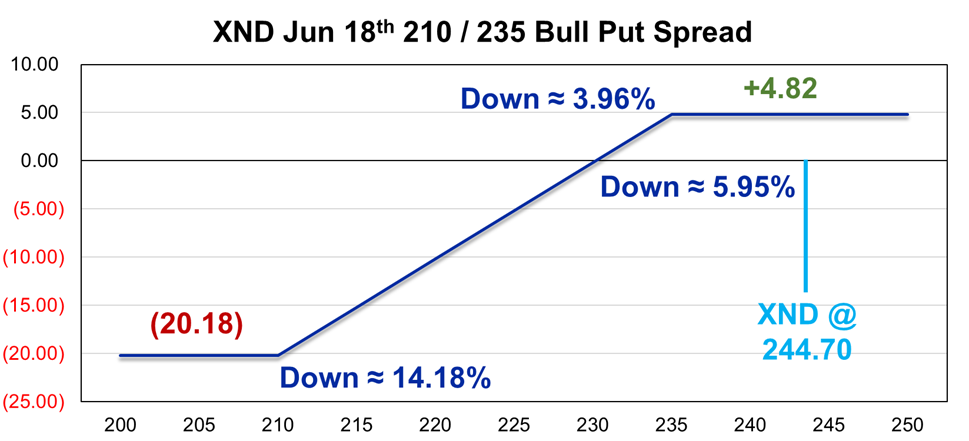
On Tuesday March 3, XND touched the lows for the week early in the trading session as the market gapped lower. There were a couple of well-timed bull put spreads with a longer-term outlook that hit the tape. First, with XND at 244.70 a trader sold XND Jun 235 Puts for 8.66 and then purchased the Jun 210 Put for 3.84, taking in a credit of 4.82. The payoff for this trade if held through expiration appears below.

Data Sources: Bloomberg and Author Calculations
This trade has a buffer of 3.96% between where XND was quoted when the trade was executed and the short 235 strike price. If XND settles above 235.00 at expiration, this trade will realize the maximum profit of 4.82. About 2% lower, at 230.18, the outcome for this trade turns into a loss and if XND is just over 14% lower at June expiration this trade loses a maximum of 20.18 per spread.
A few minutes later, with XND at 243.26, a trader sold the XND May 220 Puts at 4.34 and purchased the XND May 210 Puts for 3.02 taking in a net credit of 1.32. This trade has a bit more of a buffer between where XND was quoted at execution and the short strike price of 220.

Data Sources: Bloomberg and Author Calculations
This trade has a bit more of a buffer than the first one at down 9.56% before breaching the short put strike. The break-even level is down 10.10% and the worst-case scenario has XND at 210.00 or lower at expiration resulting in a loss of 8.68.
On Thursday, March 5, the lows of the day occurred mid-afternoon, and one trader executed a bullish spread to take advantage of this price action. They specifically sold the XND Mar 9th 238 Put for 0.39 and purchased the XND Mar 9th 233 Put for 0.17, taking in a credit of 0.22. This trade was executed with XND just over 248.00. The payoff on the close on March 9 appears below.

Data Sources: Bloomberg and Author Calculations
This trade uses options expiring in just a couple of days, versus weeks for the other trades we came across from the week of March 2 – March 6. The short 238 strike in this bull put spread is over 4% lower than where XND was quoted when the trade was executed. The worst-case scenario would have XND below 233 on March 9 expiration resulting in a loss of 4.78 per trade. The dollar risk versus reward for this trade is skewed to losses, but a lot had to go wrong in a short period of time for the trade to realize the maximum loss of 4.78.
Finally, on Friday XND was lower in the afternoon, bringing out a couple of other bullish trades. The most aggressive trade we are highlighting here occurred when XND was at 247.65, where a trader sold the Mar 27th 250 Put for 6.85 and purchased the XND Mar 27th 235 Put for 2.66 taking in a 4.19 credit.

Data Sources: Bloomberg and Author Calculations
For this trade to achieve the maximum profit of 4.19, XND needs to rise by 0.95% to 250.00 or over on March 27 expiration. Break even for this trade is lower by 0.74%. The risk for this trade would be XND losing over 5% to 235.00 or lower by the last Friday of month. This bullish spread has a dollar risk versus reward that is more attractive than the other bullish spreads in this piece, but to realize the maximum profit, the index needs to move higher.
All four of these trades from last week were well timed with respect to where the underlying market was trading at time of execution. Each was executed when the market was experiencing downside pressure, a condition that makes putting on a long position difficult as the trader is stepping in front of a trend. However, using vertical spreads defines the best- and worst-case scenarios, a certainty that makes countertrend trading easier using options in this manner.
Discover more from stock updates now
Subscribe to get the latest posts sent to your email.